

TechnologyFebruary 25, 2026
Beyond the Cable Run: Industrial PoE Solutions Built for the Remote Edge
Power over Ethernet (PoE) reliably delivers power to remote sites -- with a single Ethernet cable delivering both power and data over long distances acts as the enabling technology.
The industrial edge has moved to the frontline of Industry 4.0, and Power over Ethernet (PoE) is the driver making it possible. Nowhere is that momentum more operationally urgent than at remote industrial sites — oil fields, substations, mining operations, and distributed infrastructure — where a single Ethernet cable delivering both power and data over long distances acts as the enabling technology.
The challenge is understood: electrical infrastructure at the edge is sparse, cable runs are long, and downtime costs are high. PoE injectors and extenders solve this by delivering both power and data over a single Ethernet cable, eliminating parallel electrical infrastructure, and permitting the connected site architectures that modern industrial operations demand.
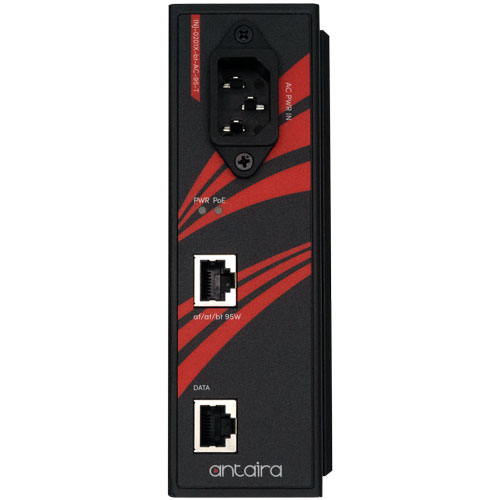
Antaira INJ-0200G-60-24-T is a Gigabit 802.3 bt Type 3 PoE injector that is backwards compatible with previous 802.3af/at standards.
The Connected Remote Site
Remote site connectivity isn’t just about keeping the lights on. It’s the operational intelligence layer that transforms isolated assets into managed, monitored, and optimized infrastructure. That translates directly to four critical capabilities:
Real-time visibility. IoT sensors at the edge stream process performance data, machine health metrics, energy consumption figures, and environmental conditions back to centralized control systems, eliminating unnecessary maintenance cycles and enabling condition-based interventions before failures occur.
Intelligent alerting. Ethernet-connected smart alert systems detect anomalies and route diagnostic data to remote operators the moment a performance threshold is crossed. Problems get resolved without a truck roll.
Crew connectivity. For personnel working extended rotations at remote installations, a reliable Ethernet backbone is mission-critical communications infrastructure.Unmanned surveillance. The majority of remote operations run with minimal or zero onsite personnel. IP PTZ cameras, proximity sensors, and intelligent lighting provide continuous security coverage and they all need power.
Distance, Resistance, and Voltage Drop
Standard twisted-pair Ethernet cable has a hard ceiling: 100 meters (328 feet). Push a signal beyond that limit and wire resistance, heat generation, and electromagnetic interference (EMI) begin degrading the data signal, leading to attenuation, packet loss, and eventual failure.
PoE transmission compounds the problem. As cable distance increases, voltage drop increases proportionally. The gap between the power sourcing equipment’s output and what actually arrives at the end device can become large enough to threaten device functionality entirely. In a remote industrial environment — where ambient temperatures swing, cable runs stretch hundreds of meters, and there’s no electrician down the hall — this isn’t an edge case. It’s the operating condition.
Two technologies address this directly: PoE injectors and PoE extenders.
PoE Injectors: Adding Electrical Power
A PoE injector is a standalone device that superimposes DC power onto an existing Ethernet data signal through modulation, combining a separate power input and data cable into a single PoE output without requiring a PoE-capable switch. For sites with legacy non-PoE network infrastructure, this eliminates a costly upgrade.
The 100-meter limit still applies per segment, but injectors can be chained to extend runs — with each injector compensating for cumulative voltage drop along the cable.
Antaira’s INJ-0200G-60-24-T PoE Injector is a purpose-built example: This 802.3bt Type 3 compliant device supplies up to 60W to PoE switches, IP cameras, wireless access points, and other end-devices, along with each port supporting 10/100/1000Tx data. The injector is IP30 rated, DIN-rail mountable, and supports an extended temperature of -40°C to 75°C, making it ideal for outdoor or harsh industrial sites.
PoE Extenders: Boosting Existing Signals
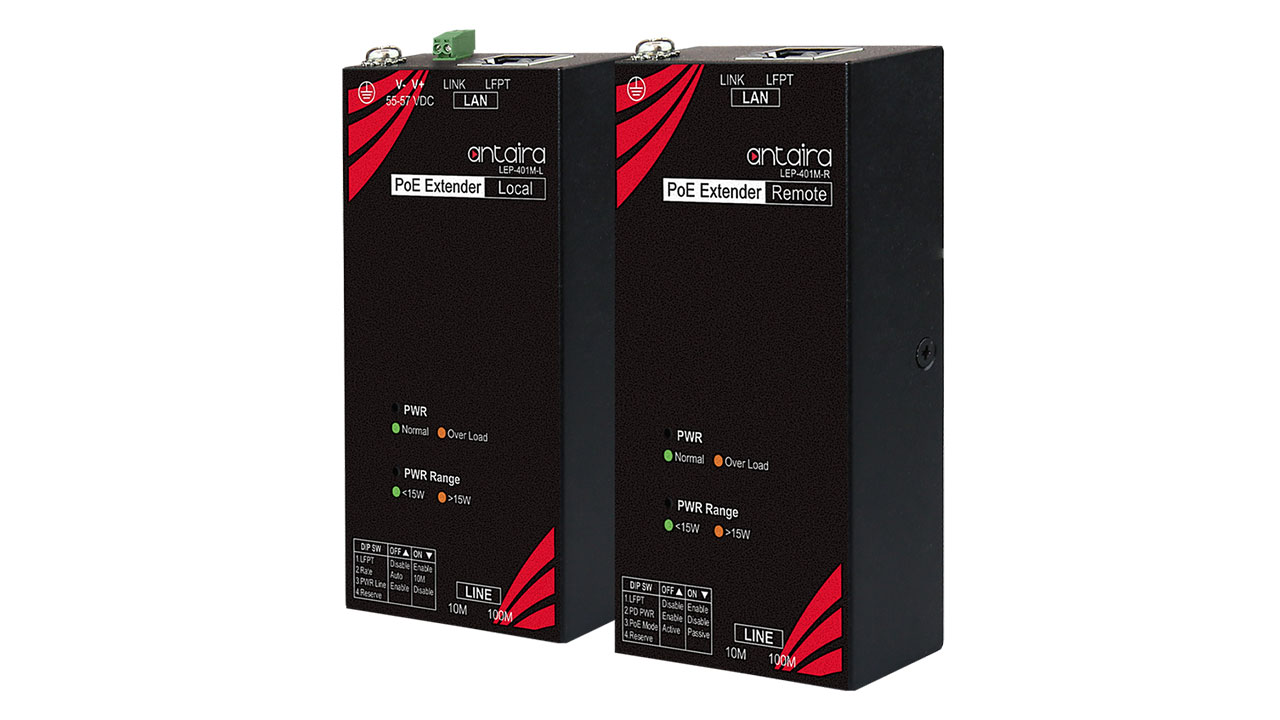
Where injectors add power to existing cable runs, PoE extenders take a different approach. Extenders regenerate both the power and data signal, eliminating the 100-meter ceiling entirely. No AC connection is required: the extender draws operating power from the PoE signal itself and forwards the remainder to the end device or to a downstream extender in a daisy chain.
Antaira’s LEP-401M-KIT eliminates the daisy-chain limitation entirely. This plug-and-play kit — pairing a long-reach transceiver with a long-reach receiver — enables simultaneous data and power transmission up to 800 meters in a single deployment. Compliant with 802.3af/at and delivering up to 30W, it supports IP cameras, WAPs, VoIP phones, and other edge devices without intermediary hardware.
The Next Distance Frontier
PoE technology is also evolving at the physical layer. Single Pair Ethernet (SPE) delivers standard Ethernet communication and power over just two wires, with a 1,000-meter range — ten times that of traditional Ethernet — along with smaller cables, higher connector density, and multi-drop capability that connects multiple sensors from a single port.
For remote industrial sites where field-to-cloud connectivity over extreme distances is the objective, SPE’s Power over Data Line (PoDL) standard is emerging as a complementary architecture, particularly in process automation and hazardous area applications where traditional PoE infrastructure reaches its limits.
The SPE market is projected to grow rapidly, driven by IIoT adoption, building automation, and long-distance sensor networks. The remote industrial site sits squarely in that addressable market.
The Right PoE Tool for a Remote Site
Understanding where PoE injectors, extenders, and emerging SPE architectures fit within a remote site network design is the foundation of a reliable, scalable, and cost-efficient deployment. To design the right PoE architecture for a remote application, contact the Antaira technical team at (714) 671-9000 or [email protected].