

TechnologyMay 24, 2026
Networks Run on Single Pair Ethernet and Ethernet-APL

In the age of AI-driven manufacturing, data quality matters as much as data availability. Single Pair Ethernet and Ethernet APL provide the physical layer foundation that factory networks need to keep pace with the computational and analytical capabilities being deployed above them.
Smart manufacturing has reached a tipping point. As digital transformation initiatives expand across factories and process plants, the limitations of traditional industrial networks have become increasingly visible, especially at the field level. While enterprise and control networks have largely standardized on Ethernet and IP technologies, the last mile of automation—sensors, actuators, and field instruments—has remained fragmented by legacy fieldbuses, gateways, and protocol conversions.
Two technologies are now changing that reality: IEEE 802.3 Single Pair Ethernet (SPE) and Ethernet APL (Advanced Physical Layer).
IEEE 802.3 SPE enables high performance Ethernet connectivity in space constrained and sensor dense environments, making it ideal for discrete manufacturing, infrastructure, and intelligent edge applications. In parallel, Ethernet-APL extends Ethernet into hazardous and long distance process applications, supporting intrinsically safe operation and cable lengths up to 1,000 meters using a two wire Ethernet connection. Combined, SPE and Ethernet APL form a complementary, standards based approach to extending industrial Ethernet.
This convergence is about extending – not replacing – Ethernet. SPE and Ethernet-APL are rapidly becoming foundational for smart manufacturing use cases such as asset health monitoring, predictive maintenance, and scalable Industrial Internet of Things (IIoT) deployments.
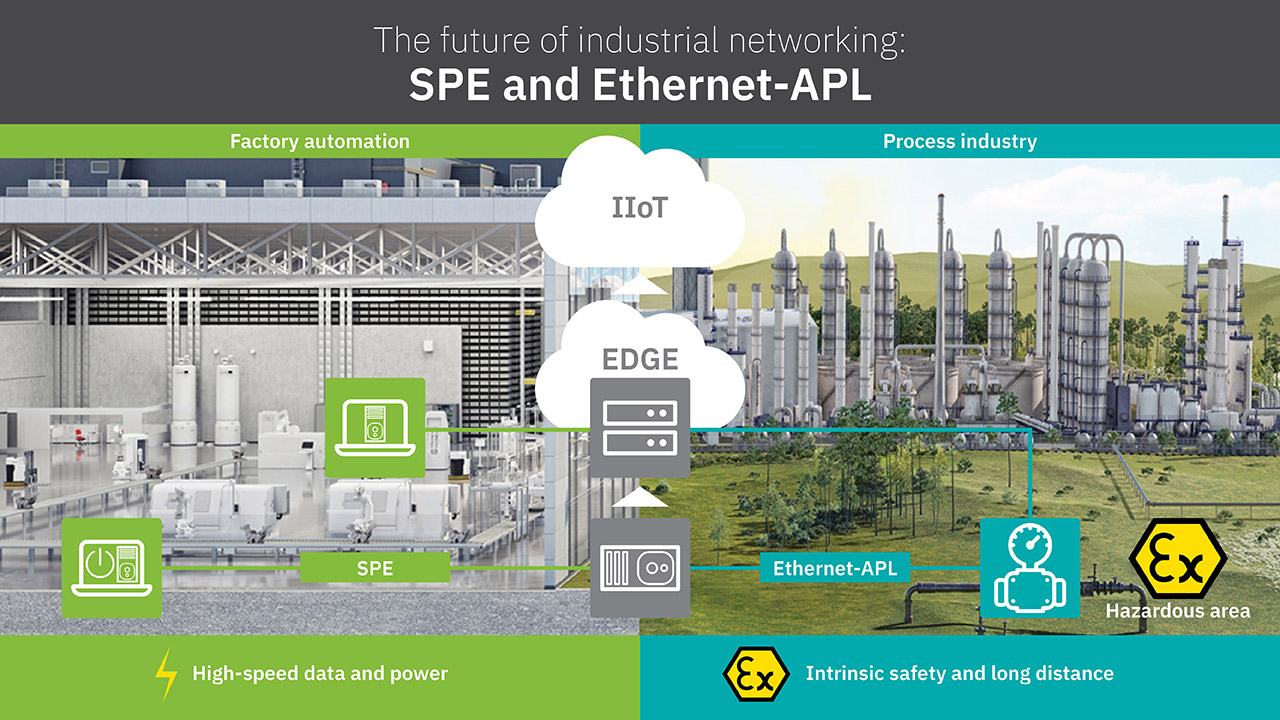
IEEE 802.3 Single Pair Ethernet (SPE) and Ethernet-APL present the natural evolution of Ethernet, engineered for industrial environments.
Why Industrial Networks Must Evolve
For decades, industrial automation architectures were built for reliability and determinism rather than data accessibility. This led to layered communication models: fieldbuses at the sensor level, Industrial Ethernet at the control level, and IT networks for analytics and enterprise systems.
While functional, this approach presented several challenges, including:
- Limited bandwidth and rigid data models that restrict diagnostics and monitoring
- Complex gateways and protocol conversions that add latency and ongoing maintenance burden
- Separate cabling infrastructures for power and communication
- Difficulty scaling networks to support large numbers of sensors and IIoT devices
- High costs associated with fiber deployment or cabinet dense architectures
SPE and Ethernet APL address these challenges together by collapsing network layers, reducing infrastructure complexity, and delivering native Ethernet connectivity directly to field devices, regardless of environment or distance.
What Makes SPE and Ethernet APL Different
SPE is not a single protocol but a family of Ethernet physical layers within IEEE 802.3, optimized for different distances, data rates, and application requirements. Ethernet APL builds on this foundation—specifically 10BASE T1L—and adds the requirements necessary for process automation, including intrinsic safety and long distance operation.
What unifies SPE and Ethernet APL technologies is their ability to transmit Ethernet over one twisted pair of copper wires, rather than the two or four pairs traditional Ethernet requires.
Key technological characteristics include:
- Long cable reaches—up to 1,000 meters for SPE (10BASE T1L) and Ethernet APL
- Easy retrofit of existing infrastructure by keeping the existing cabling in place
- Power over Data Line (PoDL) for SPE and engineered power profiles for Ethernet APL
- Native Ethernet/IP communication, compatible with existing IT and OT system
Together, SPE and Ethernet APL are uniquely capable of extending Ethernet deeper into industrial environments than ever before.
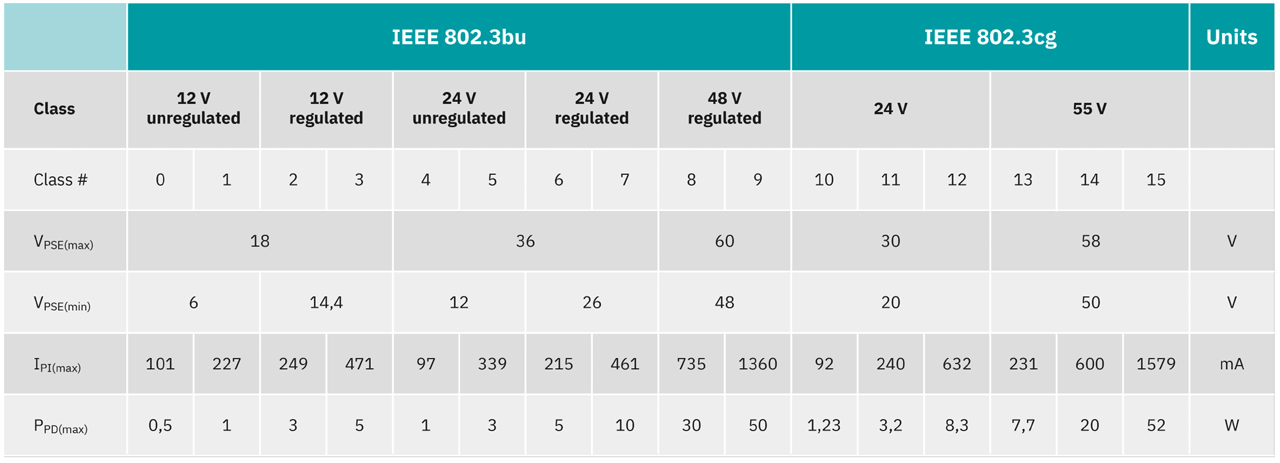
This chart explains the technical specifications for different PoDL classes.
Core Benefits for Original Equipment Manufacturers (OEMs)
Native Ethernet Connectivity at the Device Level
SPE allows OEMs to integrate true Ethernet and IP communication directly into field devices, rather than terminating connectivity at a controller or gateway. Sensors, actuators, drives, and intelligent modules can become first class Ethernet nodes—simplifying system architectures and enabling direct access to data for controllers, edge platforms, and cloud systems. The higher throughput and lower overhead allow faster sampling rates and the convergence of several sensors into a single package.
Unified Power and Data Delivery
With Power over Data Line (PoDL), SPE enables OEMs to deliver power and data over the same single twisted pair cable. Eliminating separate power connectors reduces wiring complexity, minimizes assembly steps, and lowers the risk of installation errors in the field (Figure 2).
Longer Reach Without Added Network Complexity
SPE supports Ethernet communication over distances of up to 1,000 meters, depending on the standard, without requiring repeaters or intermediate switches. For OEMs designing larger machines or systems, this simplifies product architectures and reduces the number of external components required to support Ethernet connectivity.
Smaller, Lighter, and More Flexible Device Designs
Compact SPE interfaces, including IP20, M8, and M12 variants, allow OEMs to significantly reduce connector size and cable bulk compared to traditional Ethernet. This enables smaller enclosures, denser PCB layouts, and lighter devices. These advantages are especially valuable in space constrained designs.
Lower System and BOM Costs Compared to Fiber
By leveraging copper based single pair cabling rather than fiber, OEMs can reduce the cost and complexity associated with optical transceivers, specialized connectors, and assembly processes. Over large production volumes, these savings scale quickly, supporting more competitive pricing while maintaining Ethernet performance and interoperability.
Enablement of Smart, Data Driven Products
Because SPE is standards based Ethernet, OEM devices can support advanced capabilities such as network based firmware updates, detailed diagnostics, continuous condition data, and secure communication. OEMs can move beyond hardware only differentiation and support value added services, such as predictive maintenance, remote monitoring, and lifecycle optimization.
Core Benefits for End Users and System Integrators
Power and Data Over Long Distances
SPE and Ethernet APL deliver both power and data over a single twisted pair cable across distances far exceeding traditional Ethernet’s 100 meter limit. This allows installation of sensors, actuators, and monitoring devices along long conveyor systems, pipelines, process units, utility corridors, or distributed production areas without additional power wiring, gateways, or intermediate cabinets. The result is faster deployment, reduced infrastructure cost, and greater flexibility in device placement.
Easier Field Installation Than Fiber
Compared to fiber Ethernet, SPE and Ethernet APL cabling are significantly easier to install and terminate in the field. No fiber splicing, polishing, or optical testing is required, so standard industrial electricians can complete installations without specialized tools or training. Copper-based cable is also more robust than fiber, which has a glass or plastic core that can break. This reduces integrator’s labor costs, minimizes scheduling risks, and shortens commissioning timelines—particularly in remote or harsh industrial environments.
Reduced Maintenance Complexity and Downtime
Simplified cabling architecture means fewer connectors, fewer active components, and fewer potential points of failure. SPE and Ethernet APL connected devices are directly addressable over Ethernet, enabling remote diagnostics and faster fault isolation. For example, Ethernet diagnostics can identify failing field instrumentation in a hazardous area or a motor sensor on a production line before it causes unplanned downtime.
Lower Cabling Costs Across Large Facilities
Single pair cabling significantly reduces material usage, cable tray congestion, and installation effort. In large industrial networks with hundreds or thousands of field devices, these reductions translate into substantial cost savings over the entire system lifecycle. In retrofit scenarios, SPE and APL can often leverage existing cables.
Scalable Architecture for IIoT Growth
Because SPE and Ethernet APL are based on open Ethernet standards, new sensors and devices can be added incrementally as operational needs evolve. Facilities can expand condition monitoring, energy management, or quality tracking initiatives without redesigning or replacing their existing communication infrastructure.
Ethernet APL: Intrinsic Safety and Digitalization for Oil & Gas and Process Industries
Ethernet APL extends these same Ethernet principles into the most demanding industrial environments, particularly where intrinsic safety and long distance connectivity are non-negotiable.
Ethernet APL is based on IEEE 802.3cg 10BASE T1L Single Pair Ethernet, but it adds a standardized physical layer profile specifically designed for process automation. This profile incorporates intrinsic safety (Ex i) requirements, engineered power concepts, and topology rules that allow safe Ethernet deployment in hazardous areas, down to Zone 0 or Class I, Division 1.
Historically, process plants have relied on 4–20 mA and fieldbus technologies to meet explosion protection requirements. While reliable, these systems severely limit bandwidth and data accessibility. Ethernet APL removes this trade off by delivering 10 Mbps, full duplex Ethernet and power over a two wire cable, over distances of up to 1,000 meters, while maintaining intrinsic safety.
Instruments in hazardous areas can now provide continuous access to process variables, secondary parameters, and rich device diagnostics without gateways or protocol conversions. Maintenance and reliability teams gain visibility that was previously impractical, enabling asset health monitoring and predictive maintenance in areas where manual inspection was once the norm.
Ethernet-APL can integrate seamlessly with analytics platforms, MES systems, and cloud based asset management tools. Because of this, it can support initiatives such as NAMUR Open Architecture (NOA) and Open Process Automation (O PAS).
Ethernet APL is a process industry extension of SPE, delivering Ethernet where safety, distance, and harsh conditions have historically been barriers.
Why Future Factories Will Leverage SPE and Ethernet APL
The factories of the future will not be defined solely by automation but by data fidelity, speed, and continuity from sensor to software. As artificial intelligence, machine learning, and digital twin technologies move from pilots into production, industrial networking requirements are changing fundamentally.
As factories evolve, there is a clear trend toward converged IT/OT networks. Maintaining parallel networks for control, monitoring, asset management, and analytics adds cost, complexity, and cybersecurity risk. SPE and Ethernet APL support a single, standards based Ethernet infrastructure capable of carrying control traffic, diagnostics, and analytics data simultaneously—creating a consistent data fabric from field device to digital twin.
In practical terms, convergence enables:
- Faster sampling and richer datasets for AI models
- Real time synchronization between physical assets and virtual twins
- Closed loop optimization where analytics insights can influence operations immediately
- Scalable architecture that supports incremental digitalization rather than disruptive upgrades
In the age of AI driven manufacturing, data quality matters as much as data availability. SPE and Ethernet APL provide the physical layer foundation that factory networks need to keep pace with the computational and analytical capabilities being deployed above them.