

TechnologyMarch 4, 2026
Open CC-Link Industrial Ethernet Guarantees Stable Production Processes
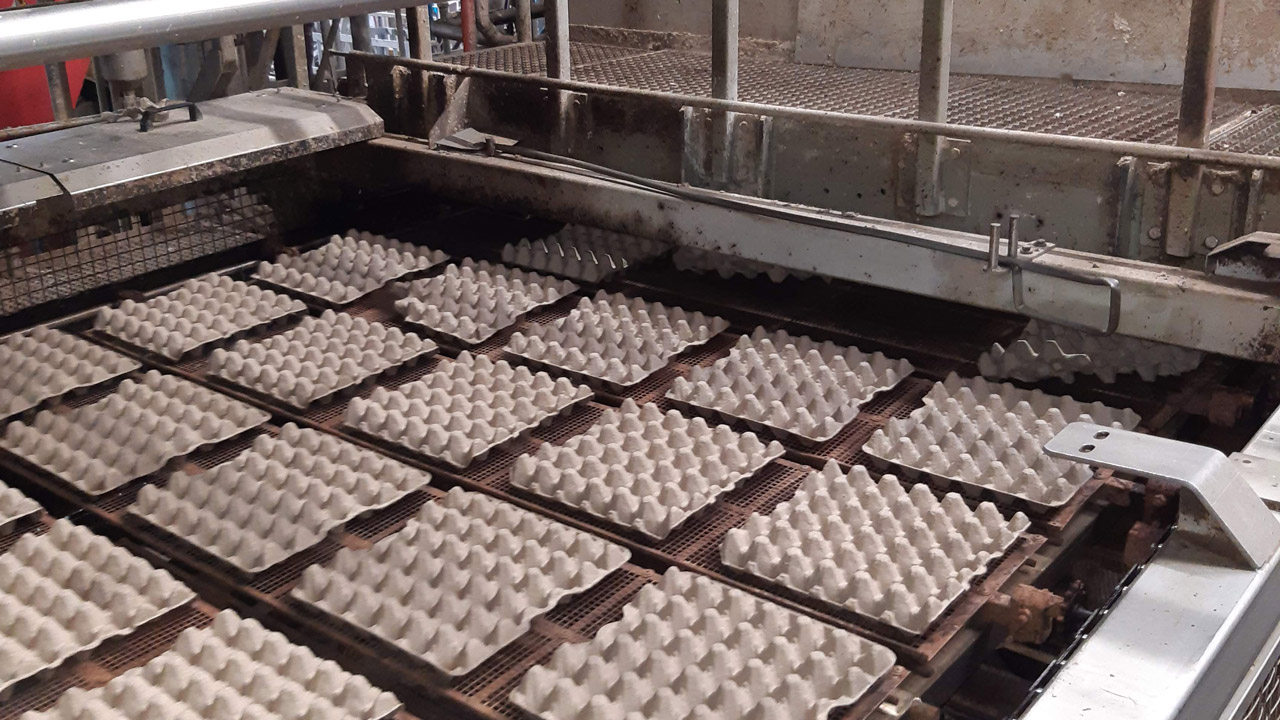
Huhtamaki plant has begun upgrading its automation systems to Open CC-Link Industrial Ethernet from older serial network standards to CC-Link IE Field.
Huhtamaki’s plant in Franeker, Netherlands, produces more than 11 million egg cartons from recycled paper every week. To maintain this production around the clock, the plant relies on highly automated production lines that must be reliable, easy to maintain, and adaptable to future requirements.
To achieve this goal, the plant has begun upgrading its automation systems from older serial network standards to CC-Link IE Field. This is an open industrial Ethernet technology for automation that offers greater performance and improved diagnostics due to its gigabit bandwidth. The upgrade has already been implemented on the plant’s production lines and has yielded significant results. Maintenance is streamlined thanks to unique diagnostic data obtained via the network, reducing complexity, simplifying troubleshooting, and thus shortening downtime. As a result, CC-Link IE Field will now serve as the standard for future upgrades at the site.
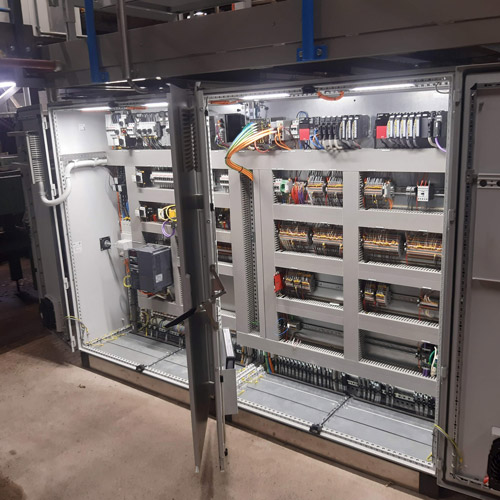
The switch to CC-Link IE Field brought advantages such as improved fault diagnosis, a more flexible wiring structure and simpler hardware configurations.
Long-term investments in automation
The Franeker plant boasts an efficient engineering team responsible for both maintaining existing equipment and developing new in-house solutions. After decades of collaboration with Mitsubishi Electric, the plant has gradually migrated its systems to MELSEC iQ-R series PLCs and CC-Link IE Field.
“We try to avoid constant changes,” said Albert Bruining, electrical engineer at Huhtamaki. “We want systems that will still work in ten years. When we update our technology, it has to offer clear, long-term benefits. That’s the case with CC-Link IE Field.”
The new network was implemented as part of a comprehensive modernization of the control system, which also included updating the PLCs, frequency converters, and HMIs of an older machine. Switching to CC-Link IE Field offers advantages such as improved fault diagnostics, a more flexible cabling structure, and simpler hardware configurations. This has significantly simplified both commissioning and long-term maintenance for the engineering team.
Improved diagnostics reduce downtime.
One of the main reasons for moving away from the previous network configuration was the limited availability of diagnostic data. “With our old systems, you can see whether a device is online or not, but that’s about it. This means that if a fault occurs, it’s more difficult to pinpoint the cause,” said Bruining. “You might need additional measuring devices or software tools to analyze the problem.”
With CC-Link IE Field, diagnostic information is immediately available and can be more easily integrated directly into the PLC and HMI. This means clear error messages for the maintenance team, faster troubleshooting, and therefore shorter downtimes.
“In the event of a communication error, the HMI can pinpoint exactly which network component or cable is affected. This makes troubleshooting much faster and more efficient.”
These additional insights are incredibly valuable for a production facility that operates around the clock, where downtime has a significant impact on throughput and delivery commitments.
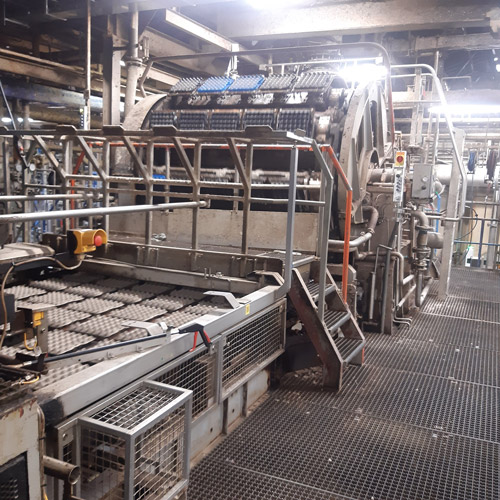
To maintain production around the clock, the plant relies on highly automated production lines that must be stable, easy to maintain and adaptable to future needs.
A flexible and simplified network
In addition to improved diagnostics, the switch to CC-Link IE Field also offered practical advantages in installation and maintenance.
Unlike serial networks based on daisy-chain connections, CC-Link IE Field’s Ethernet-based architecture allows for a star topology using standard switches. This means that a fault in one cable won’t bring down the entire network. This is another important factor in ensuring availability, maintaining operations on a scale similar to those at the Franeker plant.
The use of standard cables also proved advantageous. “Our old technology required special cables that weren’t always easy to obtain,” Bruining explained. “With CC-Link IE Field, we can use high-quality standard Ethernet cables, which significantly simplifies procurement and logistics for us.”
Furthermore, the newer frequency converters from Mitsubishi Electric are equipped with CC-Link IE Field interfaces, eliminating the need for the expansion cards previously required for the existing solution. “This means we have fewer components to install and maintain,” Bruining added. “That makes things easier.”
A standard for the future
The success of CC-Link IE Field has led the engineering team to adopt this network technology as the site standard in Franeker for future automation projects. As older machines are decommissioned, the new network will be further expanded throughout the entire plant.
The Franeker plant continues to develop and build a large portion of its machinery in-house, using automation hardware from Mitsubishi Electric. Mitsubishi Electric relies on CC-Link IE technology for its automation solutions and is a member of the CLPA board. Therefore, the use of CC-Link technology is well established and will be further expanded.
“The introduction of CC-Link technologies is a reliable way for manufacturers to prepare for the future,” said John Browett, General Manager of the CC-Link Partner Association (CLPA) – Europe.
“We are committed to providing open networking solutions that meet the needs of industry today and in the future. In addition to CC-Link IE, we also offer CC-Link IE TSN, which makes it easier for users to integrate high-speed, enterprise-level controls and data into a deterministic network that is ready for the demands of modern smart factories. As Huhtamaki plans future upgrades, CC-Link IE TSN will enable the company to meet the requirements of digitized manufacturing by providing the foundation for a converged gigabit architecture with time-critical networks. This gives the Franeker plant the potential to maintain its global leadership position in the future.”