

TechnologyMarch 20, 2026
Hyperconnected Factories Using OPC UA, MQTT and AI
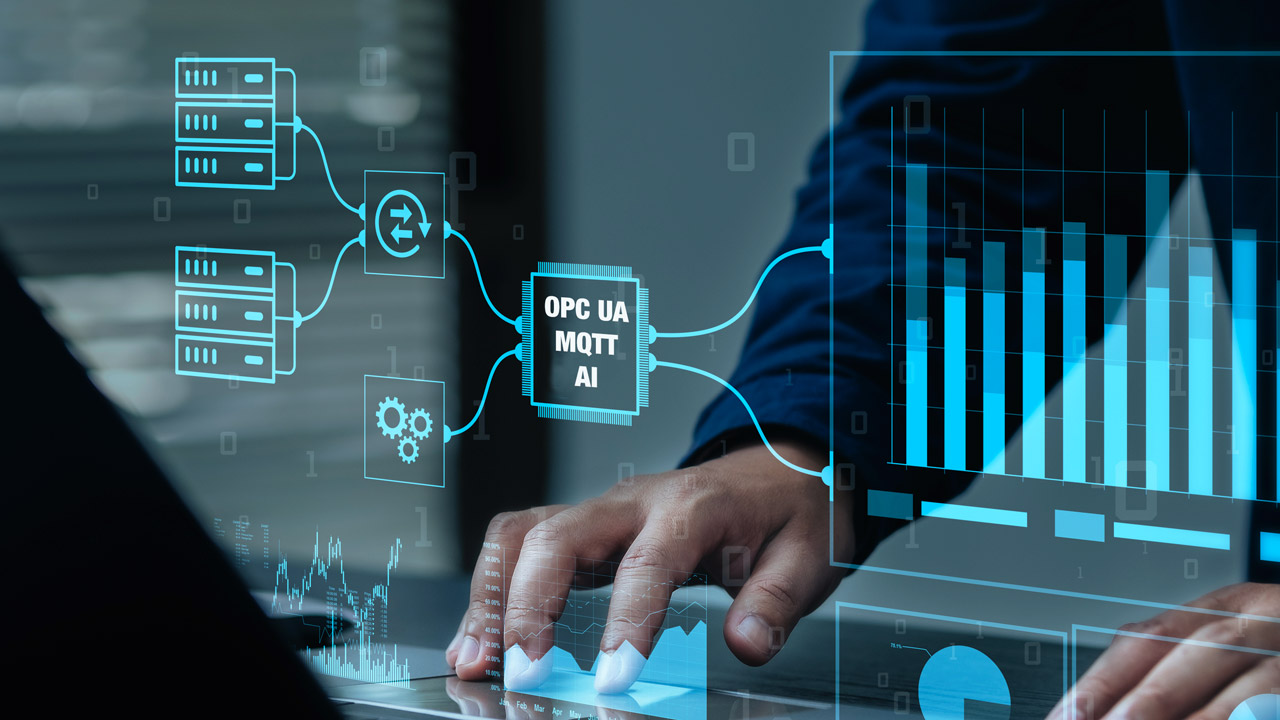
OPC UA for standardized, secure communications, MQTT as a lightweight, publish/subscribe protocol ideal for IoT and edge devices and AI to leverage data from OPC UA and MQTT-enabled devices to deliver predictive maintenance, real-time quality control and adaptive learning is a powerful combination.
OPC UA, MQTT, and AI technologies are transforming manufacturing networks into hyper-connected, intelligent systems that enable real-time data exchange and decision-making. These advancements promise scalable, efficient, and more sustainable industrial operations.
For this special report, Industrial Ethernet reached out to industry experts for their views on how these technologies are reshaping the future of hyperconnected factory networks.
Standardized secure communication: OPC UA provides a vendor-neutral, secure and scalable communication framework that supports interoperability from shop floor devices to cloud platforms, enabling future-proof smart manufacturing.
Efficient real-time data transmission: MQTT offers a lightweight, publish/subscribe protocol ideal for IoT and edge devices, ensuring reliable, low-bandwidth data exchange and simplifying cloud integration for advanced analytics.
AI-driven optimization and autonomy: AI leverages data from OPC UA and MQTT-enabled devices to deliver predictive maintenance, real-time quality control, autonomous system operation, and adaptive learning that continuously optimizes manufacturing processes.
Transformative industrial impact: Together, these technologies enable predictive maintenance, dynamic process optimization, and autonomous systems that increase efficiency, scalability, sustainability, and competitiveness, while addressing integration, cybersecurity, and scalability challenges in modern industrial environments.
“Today, roughly 95% of manufacturers say they have already invested in AI or machine learning or plan to within the next five years. In manufacturing environments, AI is already helping improve quality control, optimize processes and strengthen cybersecurity. And over time, it will help manufacturers shift from automated operations to more autonomous ones,” Joseph Biondo, Sr. Program Manager, Rockwell Automation.
Manufacturing Networks Rapidly Evolving
AI is helping to unlock more value from operational data.
“Enterprise manufacturing networks are evolving rapidly as manufacturers look to unlock more value from their operational data,” Joseph Biondo, Sr. Program Manager at Rockwell Automation told Industrial Ethernet recently. “Today, roughly 95% of manufacturers say they have already invested in AI or machine learning or plan to within the next five years. In manufacturing environments, AI is already helping improve quality control, optimize processes and strengthen cybersecurity. And over time, it will help manufacturers shift from automated operations to more autonomous ones.”
“On the connectivity side, OPC UA and MQTT are enabling more scalable data architectures across the plant and enterprise. OPC UA has long been used to move machine data to manufacturing execution systems (MES) for data collection, historians and the like,” Biondo said. “MQTT is newer to the operations technology (OT) environment, but it’s lightweight, more ‘enterprise-centric’ and familiar to software developers. As a result, we’re seeing more machinery/equipment OEMs and technology suppliers adapt MQTT to simplify and standardize data communications between equipment and enterprise systems.”
AI as Enabling Technology
Biondo said that AI is enabling manufacturers to analyze and act on massive volumes of production data in ways that simply weren’t possible before. This deeper level of insight creates new possibilities at every level of production.
One area that’s top of mind today is quality. About three in four OEMs say they view AI or machine learning as critical to designing quality into equipment, and half of manufacturers say they plan to use AI and machine learning for quality control. AI-enabled technologies already exist to help manufacturers improve if not revolutionize quality control. For example, inspection solutions that use AI and machine learning can identify subtle anomalies and notify production teams so they can detect issues earlier and respond faster.
From a connectivity standpoint, technologies like OPC UA and MQTT help standardize how machine data is structured and shared. This requires an agreed-upon set of datapoints that correspond to machine/equipment metrics, so information can be reliably collected and analyzed. For example, energy metrics such as electricity usage in each machine state need to be mapped to an output in the controller, and the data source(s) need to be defined down to the tags in the controller and any other devices (e.g. variable frequency drives) that are drawing electric current. This is a key part of data communications, regardless of the protocol, and often it is not clearly defined, especially if the communications are being retrofitted on existing equipment.
MQTT offers advantages in industrial networks because it’s lightweight and resilient, particularly with unreliable networks. That makes it well suited for non-hardwired networks.
Production Transformation
“Manufacturers are investing heavily in AI because it has the power to transform multiple areas of production. In fact, AI is now the second largest technology investment priority for many manufacturers, behind only cloud or software-as-a-service technologies. Quality is certainly a candidate as has been discussed, but AI can also help address needs like process optimization,” Biondo said.
“We’ve seen manufacturers achieve measurable results with these types of solutions. In one example, a frozen foods maker deployed model predictive control to improve throughput, yield and energy usage,” he said. “Now, they’re in a multi-year rollout of the solution at sites across five continents.”
He added that AI can also help strengthen cybersecurity. By analyzing data across multiple sources, AI can detect anomalies that may indicate a threat, filter out false alarms and automate parts of the response and remediation process.
Technology Moving Forward
Historically, Biondo said there were “house protocols” like Modbus, that were opened up to more technology suppliers. Technologies like OPC UA and MQTT were designed from the ground up to be open, which helps simplify integration across complex environments. MQTT especially comes more from the consumer software world, so its applicability is more known and supported on the IT/enterprise side.
“AI is already transforming production operations, and its impact will accelerate as it’s combined with other technologies like industrial robots to create self-learning and self-optimizing machines that make autonomous production possible,” Biondo said.
“In this new environment, automation systems can orchestrate production and self-optimize all on their own. Operations management systems can self-organize schedules and resources,” he said. “Intelligent motion technology and autonomous mobile robots can move materials and products efficiently all the way to packaging. And maintenance systems can self-diagnose equipment and recommend work orders.”
“This shift represents the next big evolution in manufacturing – from automated production to autonomous production,” he added. “It has the potential to improve efficiency, enhance safety and help manufacturers operate more sustainability. And AI makes it possible.”

“Building on this connected data foundation, AI and advanced analytics play a critical role in turning information into actionable insights. Applied across operations and asset management, AI enables early anomaly detection, predictive maintenance, and performance optimization,” — Paul Pereda, Engineering Manager-Systems Operations, Yokogawa.
Open, Secure and Scalable Solutions
A connected data foundation for trusted and contextualized industrial data.
According to Paul Pereda, Engineering Manager-Systems Operations for Yokogawa, OPC UA, MQTT, and AI are key enablers of open, secure, and scalable enterprise manufacturing networks from Yokogawa’s perspective.
“OPC UA serves as the foundation for trusted and contextualized industrial data, ensuring interoperability, data integrity, and cybersecurity across multi-vendor environments;” Pereda said. “MQTT complements this by enabling efficient, event driven data distribution from the plant floor to enterprise and cloud systems, supporting modern IT/OT convergence architectures.”
Pereda said that these technologies are already embedded in Yokogawa’s portfolio. Solutions such as the Collaborative Information Server (CI Server) leverage open standards to aggregate, contextualize, and manage data from distributed control systems, safety instrumented systems, field devices, and third party applications. By breaking down data silos, CI Server makes operational information readily available for enterprise applications, analytics platforms, and digital transformation initiatives—while preserving control system integrity.
Building on this connected data foundation, AI and advanced analytics play a critical role in turning information into actionable insights. Applied across operations and asset management, AI enables early anomaly detection, predictive maintenance, and performance optimization. Together, these capabilities support Yokogawa’s vision of resilient, data driven, and increasingly autonomous manufacturing operations, helping customers improve reliability, efficiency, and long term operational sustainability.
Technical benefits
“These technologies provide concrete technical advantages that are enabling a new class of IIoT applications beyond what traditional monitoring and dashboard centric systems can deliver today,” Pereda added.
“OPC UA enables IIoT success by providing semantic data models, standardized information structures, and built in security. Unlike typical applications that rely on raw tags or flat data streams, OPC UA preserves engineering context—such as asset relationships, units, states, and events—making data immediately usable for advanced analytics, AI models, and cross system integration, all without extensive custom engineering,” he said.
He explained that the key is that MQTT delivers event driven, scalable, and bandwidth efficient data distribution, which typical polling based applications cannot achieve efficiently. Its publish/subscribe architecture decouples data producers from consumers, enabling large scale, multi site IIoT deployments and real time data sharing across enterprise and cloud platforms with minimal overhead.
AI, when applied to contextualized and reliable OT data, provides benefits that go far beyond today’s rule based alarms and historical trending. AI supports early anomaly detection, predictive failure identification, and prescriptive recommendations, allowing systems to learn normal behavior and detect subtle degradation patterns that are impractical to capture with static thresholds.
Together, these technologies shift IIoT from isolated visibility tools to scalable, intelligent, and operationally integrated systems, enabling predictive, resilient, and increasingly autonomous manufacturing operations aligned with Yokogawa’s digital transformation vision.
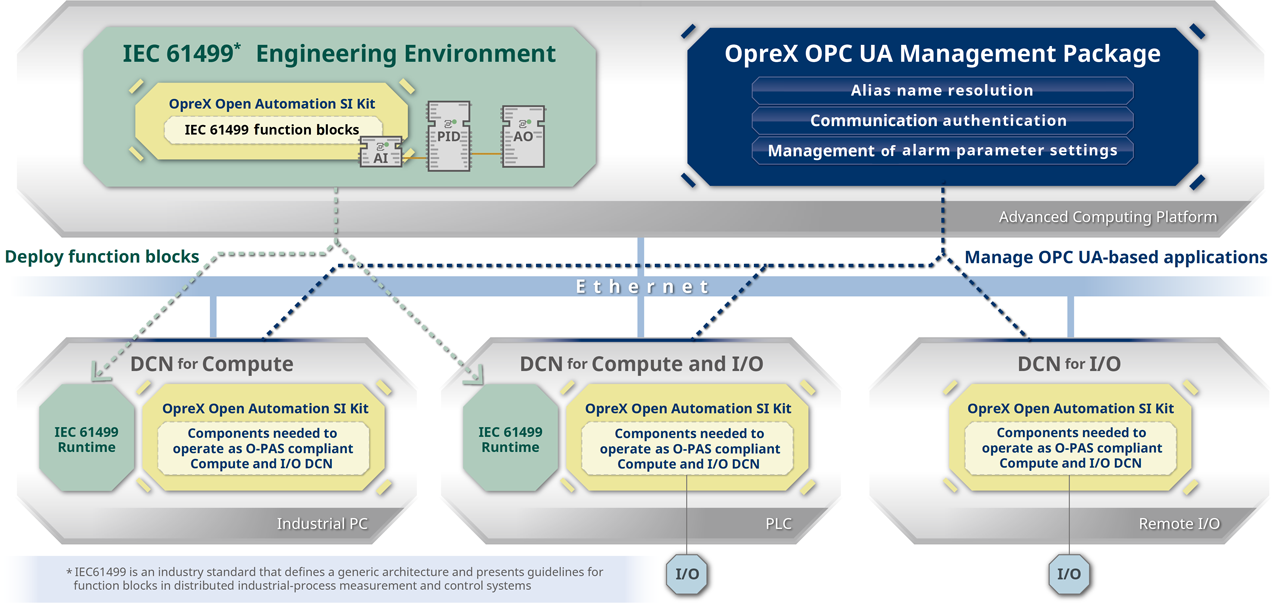
OPC UA is closely integrated with Yokogawa software platforms and systems, providing a standardized method for data exchange.
Solutions for industry
“The prospects for applying OPC UA, MQTT, and AI in industry are strong and accelerating, as manufacturers move from isolated digital pilots toward enterprise scale, operationally embedded IIoT solutions. The combined use of OPC UA and MQTT is increasingly becoming a standard architectural pattern, where OPC UA provides structured, secure, and contextualized OT data, and MQTT enables efficient distribution of that data across plants, enterprises, and cloud environments,” Pereda said.
As these architectures mature, IIoT solutions are expected to expand beyond monitoring and reporting into closed loop optimization, remote operations, and decision support. The availability of standardized data models and scalable messaging enables faster deployment of applications across multiple sites, reducing engineering effort and improving consistency in global operations.
AI will further amplify the impact by enabling systems to continuously learn from operational data, supporting predictive maintenance, process optimization, and operator decision assistance. Rather than relying on static rules or historical analysis, future solutions will increasingly support adaptive and prescriptive capabilities that improve reliability, energy efficiency, and safety.
“Overall, these developments are expected to shift IIoT from a supporting role to a core enabler of resilient, sustainable, and increasingly autonomous industrial operations, aligning with Yokogawa’s long term vision for IT/OT convergence and digital transformation,” Pereda said.
Looking to the Future
Pereda said that these technologies directly address several long standing challenges faced by automation and control engineers. One of the most significant challenges is system fragmentation and data silos across distributed control systems, programable logic controllers, supervisory control and data acquisition system, historians, and enterprise systems. OPC UA addresses this challenge by providing a standardized, secure, and semantically rich framework that preserves engineering context, reducing custom interfaces and manual data mapping efforts.
Another key challenge is scalability and efficient data distribution. Traditional polling based architectures and point to point integrations become complex and costly as systems expand. MQTT’s publish/subscribe model simplifies system expansion, supports event driven architectures, and enables reliable data sharing across sites and cloud environments, all with minimal engineering overhead required.
Engineers also face increasing pressure to support advanced analytics and AI, often on brownfield systems never designed for these use cases. By combining OPC UA’s contextualized data with scalable data pipelines, AI can be applied more effectively for anomaly detection, predictive maintenance, and operational optimization, reducing reliance on static rules and manual tuning.
Looking forward, the ongoing impact of these technologies will be a shift in the engineer’s role, from maintaining isolated control systems to designing resilient, data centric architectures that support continuous optimization, remote operations, and progressive autonomy. This transition will improve engineering efficiency—while enabling safer, more reliable, and more sustainable industrial operations.
Technology Impact
“The impact of OPC UA, MQTT, and AI will continue to grow as these technologies become the default foundation for industrial digital architectures rather than optional add ons. Looking ahead, their combined use will accelerate the shift from isolated automation systems toward enterprise connected, data centric operations, enabling faster deployment of IIoT solutions across multiple plants and regions,” Pereda said.
“In the near term, OPC UA and MQTT will further standardize how OT data is structured, secured, and distributed, significantly reducing integration complexity for automation and control engineers,” he added. “This will enable organizations to scale digital initiatives more predictably, while maintaining cybersecurity and system reliability.”
Pereda’s perspective is that, over the next three years, AI is expected to move from experimental pilots to operationally embedded capabilities. Rather than replacing control systems, AI will increasingly augment them, supporting predictive maintenance, process optimization, energy efficiency, and operator decisions. These AI applications will rely heavily on high quality, contextualized OT data to deliver trustworthy and explainable results suitable for industrial environments.
“The anticipated impact is a gradual transition toward more autonomous, resilient, and sustainable manufacturing operations—one where engineers spend less time managing data and alarms—and more time designing systems that continuously learn, adapt, and optimize performance, fully aligned with Yokogawa’s long term vision for IT/OT convergence and industrial autonomy,” Pereda concluded.

“This updated information model architecture enables more detailed data models, better extensibility and greater interoperability between systems. This forms the basis for networked production architectures in which machines from different manufacturers can work together efficiently,” — Arno Martin Fast, Senior Specialist PLCnext Technology, Phoenix Contact GmbH.
Central Building Blocks of Modern Manufacturing
Connecting machines, plants and IT systems in a secure, interoperable and scalable way.
In 2026, OPC UA, MQTT and AI will be the central building blocks of modern manufacturing networks because they connect machines, plants and IT systems in a secure, interoperable and scalable way. OPC UA provides semantically structured and standardized communication, which has been further strengthened by the latest version IEC 62541 5:2026,” Arno Martin Fast, Senior Specialist PLCnext Technology for Phoenix Contact GmbH told Industrial Ethernet recently.
“This updated information model architecture enables more detailed data models, better extensibility and greater interoperability between systems.
This forms the basis for networked production architectures in which machines from different manufacturers can work together efficiently,” Fast said.
He explained that MQTT complements these capabilities with lightweight publish/subscribe messaging, which is particularly suitable for large, distributed and cloud-based production environments. Due to its scalability and robustness, MQTT supports thousands of devices and enables real-time distribution of telemetry data across multi-site networks.
AI becomes a key driver in these networks by leveraging structured data from OPC UA and high-frequency event streams from MQTT for predictive analytics, process optimization and autonomous decision-making.
The result is a flexible, intelligent network that significantly increases efficiency, transparency and adaptability.
Technology Enables IIoT Applications
“The combination of OPC UA, MQTT and AI offers significant technical advantages over traditional automation technologies that make new IIoT applications viable. Thanks to its highly structured information model, including defined objects, variables and events, OPC UA enables semantic interoperability that is now much more comprehensive and precise than with classic fieldbuses or proprietary protocols. This facilitates cross-manufacturer integration and significantly reduces individual interface developments.
MQTT offers technical advantages in terms of scalability, network load and robustness. Its publish/subscribe principle ensures that systems only receive relevant data, while Quality of Service (QoS) levels ensure reliable message transmission and OPC UA-defined structures. This is particularly advantageous in environments with many sensors, mobile devices or cloud connections – scenarios that classic SCADA architectures can only achieve to a limited extent.
AI extends these technical foundations by processing data intelligently: Predictive maintenance, self-optimizing control algorithms and real-time anomaly detection are applications that were hardly achievable with previous technologies.
Positive Application Focus
“The prospects for the use of OPC UA, MQTT and AI in industry are extremely positive, as they form the basis for the next stage in the development of industrial digitalization. Industrial standards such as OPC UA are clearly recommended by associations such as ZVEI and VDMA as key technologies of Industry 4.0, particularly because of their interoperability and their ability to network machines and systems across manufacturers. This makes it easier for companies to invest in modular production environments and accelerates the transformation towards flexible manufacturing networks,” Fast said.
At the same time, MQTT-based architectures are gaining in importance as companies increasingly use cloud-based services, global production networks and decentralized sensor technology. MQTT is ideal for this and supports new use cases such as mobile robotics, remote monitoring or cross-location data aggregation.
Fast said that “AI is seen as the most important amplifier of these technologies. It enables data-based decisions, automated optimization and predictive maintenance.”
The expected effects include greater production flexibility, less downtime, better quality, less manual intervention and the trend towards largely autonomous production systems.
Challenges for automation and control engineers
“These technologies pose new technical and organizational challenges for automation and control technology experts. OPC UA brings with it complex semantic information models, certificate management and new security architectures that require in-depth understanding and additional qualifications. The introduction requires more modeling skills instead of pure programming skills, which means a significant change in skills.” Fast added.
“MQTT opens up new communication architectures that are more networked, cloud-oriented and event-based than traditional automation technology. Technicians need to familiarize themselves with broker architectures, topic structures, QoS mechanisms and edge computing concepts – areas that have typically been assigned to IT, while the OT focused on fieldbuses and serial communication.”
He added that AI brings the biggest challenge: it requires data understanding, model evaluation, monitoring, edge AI integration and a basic understanding of algorithms. As AI is increasingly used in control-related areas, the boundaries between OT and IT are becoming increasingly blurred.
In the long term, these technologies will change job roles: From classic control technology to data , integration and system architects in hybrid OT/IT environments.
The next three years
“In the next years, OPC UA, MQTT and AI will have a much greater impact on industrial manufacturing than they do today. OPC UA will form the semantic basis for fully interoperable machine parks through further standardized companion specifications.” Fast said. “But also the possibility to use the OPC UA standardized way to manage devices by performing software updates or using the OPC UA GDS to manage the device certificates are a big advantage.”
His view is that MQTT will continue to gain in importance due to its scalability and cloud suitability, especially in the globally networked machine environment. It enables faster data flows, finer monitoring structures and cross-regional optimization of production networks.
AI modules are already showing that they can predict failures weeks in advance and independently optimize processes. Over the next three years, AI will be more deeply integrated into edge and control environments, enabling autonomous decisions in real time. This includes self-adapting parameters, automatic quality control, intelligent resource utilization and continuous process improvement.
“This makes production more efficient and more resilient. Companies that integrate these technologies early on create a sustainable competitive advantage.” Fast said.

“OPC UA, MQTT, and AI are all technologies working together on industrial networks to bring more value to the data created during operations, greatly benefiting users. OPC UA elevates and secures data; instead of simply reporting a basic value with a timestamp and engineering units, OPC UA securely delivers contextualized information to provide value and understanding,” — Keith McNab, director of control and automation software, Emerson.
Seamless Path to Powerful AI Models
Software technologies working together on industrial networks.
Keith McNab, director of control and automation software for Emerson’s machine automation solutions business, and Daniel Smith, senior product manager for Emerson’s machine automation solutions business, teamed up to respond on how OPC UA, MQTT and AI shaping and enabling the evolution of enterprise manufacturing networks in 2026 and beyond.
“OPC UA, MQTT, and AI are all technologies working together on industrial networks to bring more value to the data created during operations, greatly benefiting users. OPC UA elevates and secures data; instead of simply reporting a basic value with a timestamp and engineering units, OPC UA securely delivers contextualized information to provide more value and greater understanding,” McNab said. “MQTT then defines how to move that contextualized information at scale via a lightweight framework. This capability provides a seamless path to drive valuable information to powerful AI models that can interpret the information to deliver insights that help teams make better decisions.”
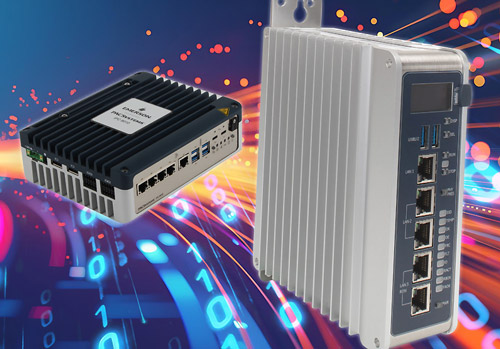
Emerson’s PACSystems™ industrial PCs and controllers bring high performance AI capabilities right to the edge, combining advanced computing, built in cybersecurity, and scalable industrial connectivity like OPC-UA and MQTT to ensure secure data flow, uninterrupted control, and scalable performance.
Enabling IIoT application successes
McNab and Smith said that IoT applications typically work in an environment where there exists equipment from many different vendors. When those different pieces of equipment can all intercommunicate, critical applications work more easily and effectively. OPC UA’s companion specifications allow different vendors to have varied equipment that all speak the same, consistent language. Modern protocols also simplify setup by creating an effective plug-and-play environment. Systems can automatically discover and auto-configure devices, allowing them to participate in the communication network automatically.
“First and foremost, this increased flexibility gives users a better view into the process as a whole because they can collect data from many sources and bring it together to make better decisions via a wide array of tools, including AI models. In addition, the consistency offered by a shared language makes tools like AI agents far easier to create,” Smith said.
He added that AI also empowers teams to add an intelligence layer to communication, allowing the network to be more adaptive and self-optimizing. The system can make parameterization changes based on real time data to make communications more effective or address issues that are detected by the AI.
Anticipated impact
“These solutions create a lot more functionality at the edge that will enable many edge-to-cloud technologies, including cloud AI. The edge will be a normalizing factor, bringing in many disparate protocols and transforming the data they transmit into a semantically rich OPC UA information model and then using MQTT to communicate at scale to the cloud,” McNab said. “The normalized OPC information model contains the intent of the data that can be shared with enterprise solutions such as AI tools. Cloud applications can be programmed more efficiently when teams know the type definitions they must be programmed against.”
He added that modernization is important, but legacy devices will remain in the mix for a long time. If teams can start gathering data better and can collect it in a contextualized format by slowly moving content from all devices onto the edge and standardizing it, they can do a lot more modeling rather than just pulling data into a chart.
Moreover, that cloud connectivity allows other critical data to come back from the cloud, such as weather forecasts, pricing information, feedstock availability, and more, to help teams better optimize their operations in real time.
Challenges for automation and control engineers
“Control engineers have many legacy solutions in the field. Most users have 10 to 12 different manufacturers of automation, speaking many different languages and following many different standards for how they each do the same thing,” Smith said. “The move toward OPC UA, MQTT, and even AI will help them slowly transition and simplify their data. They will get more data out of the devices they have today, which allows them to make their processes more efficient and simpler to set up.”
“We’ve had predictive analytics and maintenance applications running in the cloud for some time now, but to get them configured, teams would have to tap an application engineer who would spend hours trying to map the data from the field to the data that resides or is consumed in the cloud,” he added. ?All that mapping was manual and took a lot of effort. Now, since we’ve standardized and normalized that information at the edge, nearly all of that manual effort is eliminated. It’s almost entirely automatic.”
In addition, everything going from the edge to the cloud needs to be secure. Previously, teams would have to bolt on complex security solutions, but today, security is inherent in the protocols making it much simpler to protect communication.
Replacing failed equipment is much easier as well because many of these devices using modern protocols can be auto-discovered and auto-configured when they are plugged into the network. This gets the plant up and running much faster so any fallout from forced outages is minimized.
Anticipated Impact
“Adaptability is the core benefit of AI. The intention of AI is to be able to take a model and build on top of it without having to manually create code each time. It simplifies the overall model process,” McNab said.
He said that modern protocols like OPC UA and MQTT and their integration with AI is enabling the creation of critical optimization tools—many of which we can’t even imagine at this point. With contextualized data, an AI model can learn what is happening in the factory. The improved connections between data are making AI’s consumption of data much more efficient and raising the ceiling on what we can accomplish with optimization tools.
“AI also unlocks continuous optimization, not just for process but for networks as well. It can continually increase network efficiency and might at some point even tell the devices what types of information are needed in the payload for increased adaptability,” Smith said. “In coming years, AI might also automatically detect and predict network failures and make those networks more tolerant to failures in the future. AI can also reduce engineering time by automatically generating logic from P&IDs and specifications.”
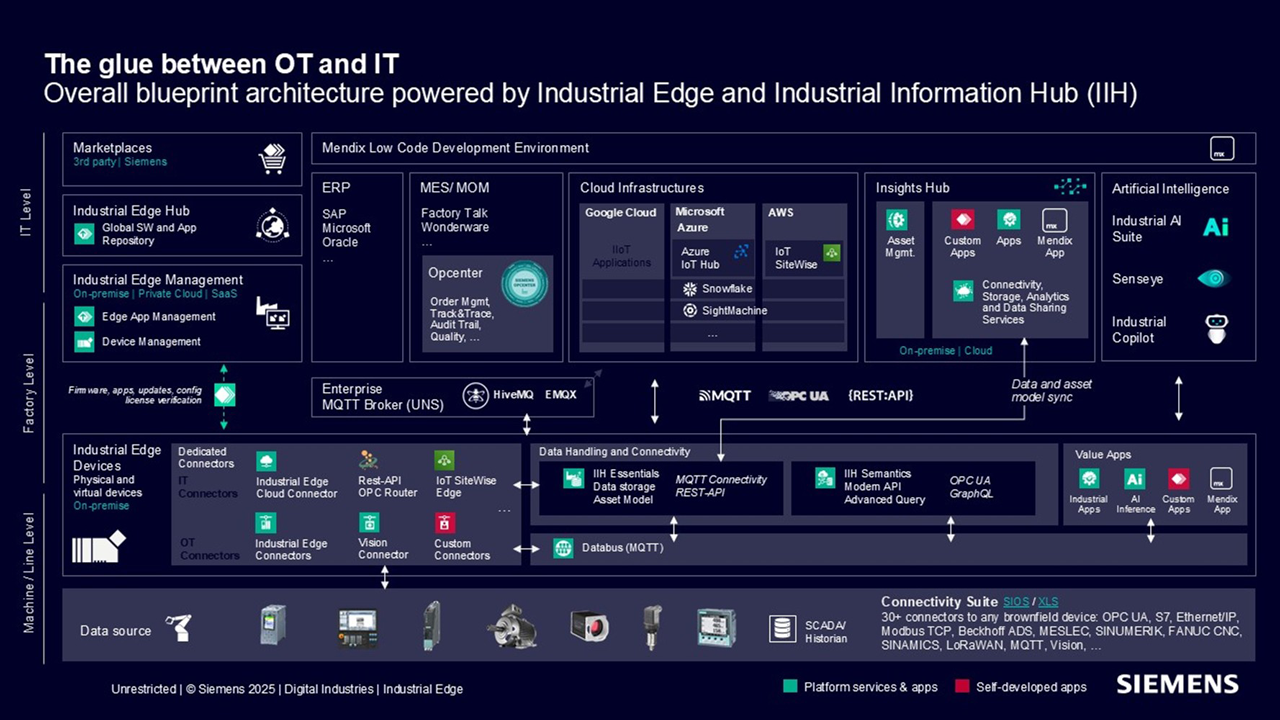
A modern connected-plant network architecture, consisting of many OPC UA-, MQTT, and other digitally-connected devices.
Real-time Data Exchange, Intelligent Decision-Making
Enterprise manufacturing networks fuel hyper-connected factories.
According to Raj Rajendra, portfolio sales specialist at Siemens Industry, Inc., “OPC UA, MQTT, and AI are revolutionizing enterprise manufacturing networks by enabling seamless communication, real-time data exchange, and intelligent decision-making.”
Here is Rajendra’s view of the technology landscape and how the combination of OPC-UA, MQTT and AI is expected to make an impact.
OPC UA ensures standardized, secure, and scalable communication across devices and systems, from the shop floor to the cloud. Its interoperability supports future-proof connectivity and compliance with global standards, making it a cornerstone for smart manufacturing.
MQTT, a lightweight protocol, excels in transmitting real-time data with minimal bandwidth, ideal for IoT and edge devices. It enables structured data exchange through unified namespaces and simplifies cloud integration for advanced analytics and monitoring.
AI processes data from OPC UA- and MQTT-enabled devices to deliver predictive analytics, optimize maintenance, and enable autonomous systems. It enhances decision-making by analyzing large datasets, driving smarter and faster operations.
“These technologies will create hyper-connected factories in the coming years with seamless integration of devices, systems, and cloud platforms,” Rajendra said. “AI will drive real-time process optimization, improving efficiency and reducing waste. Together, OPC UA, MQTT, and AI will enable scalable, energy-efficient, and sustainable manufacturing practices, ensuring factories are adaptive and future-ready.”
Technology Innovation
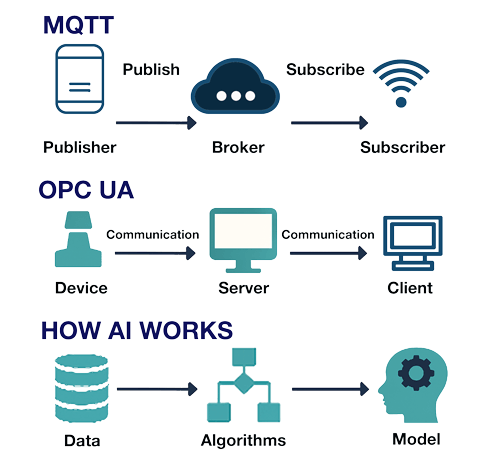
OPC UA, MQTT, and AI address key challenges for automation and control engineers, including system integration, real-time data processing, scalability, and cybersecurity.
Rajendra said that OPC UA, MQTT, and AI offer distinct technical advantages enabling new IIoT applications beyond traditional systems.
OPC UA provides semantic information models, delivering data context (e.g., instrument and equipment diagnostic data, in addition to process data) and eliminating manual mapping for AI. Its built-in security safeguards OT-IT system connections, while platform independence fosters vendor-neutral architectures. Complex data structures allow sophisticated remote interactions, enabling digital twin synchronization.
MQTT offers a lightweight, publish/subscribe model, decoupling data producers from consumers for massive scalability. Its efficiency suits resource-constrained devices and unreliable networks, extending IIoT reach. QoS ensures reliable data delivery, and topic-based filtering reduces network traffic.
AI excels at pattern recognition and anomaly detection in big data, powering predictive maintenance and real-time quality control, and its adaptive learning optimizes processes continuously. Predictive modeling enables proactive decision-making, while autonomous control facilitates self-optimizing systems. AI also enhances human-machine interaction through intelligent assistance.
Together, these technologies transform industrial operations from reactive and manual to interconnected, proactive, intelligent, and autonomous, defining the success of modern IIoT.
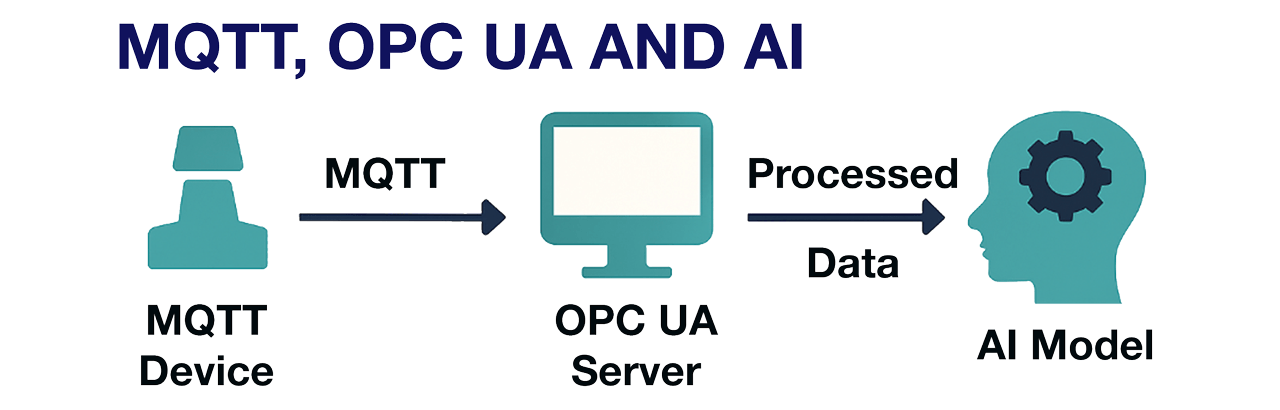
OPC UA, MQTT, and AI drive greater efficiency by streamlining operations and enabling predictive maintenance, as well as enhancing adaptability, which facilitates response to changing production needs and market demands.
Anticipated impact
Rajendra said that the prospects for OPC UA, MQTT, and AI in industry are transformative, enabling smarter, more adaptive, and sustainable operations.
Applications: These technologies will drive predictive maintenance by collecting real-time data via OPC UA and MQTT, and by using AI to predict equipment failures, reducing downtime and costs. Real-time optimization will be achieved through AI dynamically adjusting production processes, improving efficiency and minimizing waste. Autonomous systems powered by AI will enable self-optimizing machines, reducing human intervention and increasing productivity. Additionally, OPC UA and MQTT will facilitate seamless integration between edge devices and cloud platforms, enabling advanced analytics and decision-making.
Anticipated Impact: These solutions will significantly increase efficiency by streamlining operations and reducing resource consumption. They will enhance scalability, allowing systems to adapt to changing production demands, and support sustainability by optimizing energy usage and reducing carbon footprints. Furthermore, industries will benefit from faster innovation cycles, improved product quality, and enhanced competitiveness.
“By leveraging these technologies, industries can achieve higher levels of performance, flexibility, and sustainability,” Rajendra said.
Challenges Addressed: System integration across multi-vendor devices is simplified with OPC UA’s standardized communication. Real-time data processing is enhanced by MQTT’s lightweight protocol and AI’s ability to analyze large datasets efficiently. Scalability challenges are resolved as OPC UA and MQTT support architectures that grow from edge devices to enterprise systems. Cybersecurity is strengthened with OPC UA’s encrypted communication and AI’s advanced threat detection. Additionally, AI provides actionable insights through predictive analytics, helping engineers optimize processes and reduce downtime.
Ongoing Impact: These technologies will accelerate innovation with the adoption of autonomous systems and advanced analytics, while sustainability goals will be supported through optimized energy usage and reduced environmental impact. By addressing these challenges, OPC UA, MQTT, and AI empower engineers to build smarter, more secure, and future-ready industrial systems.
“OPC UA, MQTT, and AI are set to transform manufacturing by enabling smarter, more efficient, and adaptive operations,” Rajendra said. “Over the next three years, AI will play a pivotal role in driving automation, predictive capabilities, and real-time optimization.”
Impact of OPC UA and MQTT: These technologies will enhance connectivity by enabling seamless communication across devices, systems, and cloud platforms, creating fully integrated manufacturing ecosystems. They will support scalable architectures, enabling manufacturers to adapt to changing demands, while also improving cybersecurity through encrypted communication and secure data exchange.
Anticipated Impact of AI: AI will revolutionize manufacturing by furthering predictive maintenance capabilities, along with reducing downtime and maintenance costs. It will drive autonomous systems, allowing machines to self-optimize and reduce human intervention. AI will also support sustainability by optimizing energy usage and reducing carbon footprints. Additionally, AI will accelerate innovation, improving product development cycles and manufacturing agility.
“Together, these technologies will create more efficient, secure, and sustainable manufacturing environments, ensuring that factories remain competitive in an increasingly digitalized and connected world,” he concluded.