

TechnologySeptember 21, 2026
IT-OT Convergence and AI Shaping Network Operations
Industrial IT/OT convergence is continuing to accelerate as edge computing, open protocols, AI and stronger cybersecurity reshape how plants connect, contextualize, and govern data—turning once‑isolated systems into unified, insight‑driven operations.
Industrial environments are undergoing a profound architectural shift as IT/OT convergence moves from aspiration to necessity. Manufacturers are replacing isolated, site‑specific systems with hybrid edge‑to‑cloud designs that keep time‑critical control close to the process while enabling enterprise‑level analytics, governance, and cross‑site learning.
Open, multi‑protocol connectivity—OPC UA, MQTT, Modbus TCP, EtherNet/IP, REST APIs—is becoming the backbone that dissolves data silos and supports Unified Namespace models where contextualized events flow freely to automation, MES, analytics, and AI systems. At the same time, powerful industrial PCs, containerized edge software, and secure-by-design OT products are enabling advanced processing, AI inference, and protocol conversion directly at the edge, reducing latency and improving resilience. Cybersecurity frameworks, regulated expectations, and AI‑driven analytics are pushing organizations toward more governed, collaborative architectures. The result is a new era where industrial data becomes accessible, contextual, secure, and actionable—fueling reliability, optimization, and smarter decision‑making across the enterprise.
Open, Multi-Protocol Connectivity
Focus is moving from isolated, site-specific systems toward hybrid edge-to-cloud architectures.
Chris Herrera, Head of API and Interoperability at Seeq said that IT/OT convergence is moving from isolated, site-specific systems toward hybrid edge-to-cloud architectures. Time-critical processing and resilience stay close to equipment on the shop floor, while cloud and enterprise platforms handle governance, fleet-wide analytics, and cross-site learning.
“Open, multi-protocol connectivity is essential for effective IT/OT convergence. Manufacturers need to connect assets using OPC UA, MQTT, Modbus TCP, EtherNet/IP, REST APIs, and other standards instead of building a point-to-point integration for every application,” Herrera said. “Unified Namespace architectures are emerging as a shared, event-oriented information layer that makes contextualized operational events available to automation, analytics, MES, and enterprise applications.”
Herrera said that context is just as important as connectivity, and a tag or alarm is useful only with asset, process state, batch, product, recipe, and operating-mode context. Software-defined automation and industrial edge platforms bring control-adjacent workloads and analytics onto manageable infrastructure while keeping real-time and non-real-time functions isolated.
AI is also a driving force, as organizations pursue faster and more productive ways of using operational data, raising the importance of cybersecurity, governance, and context. Ontologies and context providers connect AI to assets, processes, and operating states, while human-in-the-loop design keeps people accountable for decisions.
Technology Solutions
“The most effective answers to IT/OT convergence are usually architectural patterns rather than a single product. That can include segmented networks, industrial gateways or edge agents, open protocol adapters, a governed operational data layer, semantic models, ontologies or a Unified Namespace, hybrid analytics, and secure application lifecycle management,” Herrera said.
Many of these technologies are mature, yet the IT/OT gap remains. Historically, convergence often meant copying OT data into IT, but consuming meaningful, contextualized outputs while preserving authoritative sources is a better approach. Systems like Seeq serve as an industrial analytics and decision layer across historians, databases, cloud sources, and other systems, empowering engineers to work with time-series data in context. It is not intended to replace PLCs, DCSs, safety systems, historians, or a customer’s broader data platform, but its role is to add context to signals, conditions, events, and calculations so they are more useful to people and workflows. A unified namespace (UNS) can expose normalized events, while ontologies help explain what those events mean.
AI extends this model through governed, natural-language questions. An agent can resolve asset and time context, call the right connector or analytics service, and retrieve evidence without copying every signal. But maintaining accuracy is a challenge: evaluations must cover query selection, calculations, provenance, permissions, uncertainty, and safe abstention. Deterministic calculations and repeatable tests make that reliability measurable, while people remain responsible for final decisions.
Specific Technical Benefits
Herrera noted that these technologies provide benefits at several levels. At the plant or edge, local processing can reduce latency for anomaly detection, quality monitoring, predictive maintenance, and operator assistance. Filtering, aggregation, compression, and event-based transmission reduce the need to move high-frequency raw data. And local buffering improves resilience when cloud connectivity is intermittent.
And at the data level, contextualization, timestamp alignment, asset modeling, and operating-state awareness make analytics more trustworthy and reduce false alarms. Seeq helps engineers define and scale conditions, events, calculations, and analytical patterns that connect operations to quality, reliability, energy, production, or business context. Enterprise applications can consume those outputs without understanding every source-system detail.
At the enterprise level, a governed data foundation—potentially including a UNS—makes reuse easier. Once a source is connected and its data has consistent meaning, multiple teams and sites can use the same analytical patterns instead of creating custom integrations. Identity controls, segmentation, encrypted transport, and managed updates make the environment easier to protect.
“So the end goal is not simply connecting more equipment, but creating a repeatable path from machine data to governed insight and action, while keeping deterministic control and safety functions local and within normal OT change-management practices,” he said.
How the Technology Works
Herrera said that an effective IT/OT architecture starts with the control and information systems already operating in the plant. Sensors provide measurements, PLCs execute control, and DCS/SCADA provides a graphical interface and alarming. Historians capture and retain timestamped time-series data, but they do not, by themselves, explain what each tag means or why a value changed.
Determining this requires context. A temperature tag, for example, should be tied to a specific asset, location, unit, operating mode, batch, and set of engineering limits. Other important sources of context include current P&IDs linked to tags, SOPs, asset hierarchies, maintenance history, and FMEA analyses. They should be current, versioned, searchable, and linked to signals; otherwise, both AI systems and human users can end up working with technically correct data in the wrong operational context.
Systems like Seeq query source data in place and contextualize signals, conditions, events, and calculations without copying data. An AI assistant can resolve the asset and time range, retrieve data and documents, apply calculations, and return evidence. If context is missing or stale, it should abstain, and human review must remain in the workflow before action.
A UNS or context-provider layer can publish normalized events, while secure connectivity and auditability support the combination of control data, historization, and engineering knowledge.
Progress Toward IT/OT Convergence
“IT/OT convergence has been a north star for many organizations for years. AI is now adding urgency, pushing companies to move faster and get more value from operational data. But organizations cannot simply roll out AI without addressing how it is implemented,” Herrera said.
‘AI needs context to be useful in an industrial environment. Operational data models, ontologies, and context providers must connect signals with the assets, processes, documents, and operating states they represent to make human-assisted AI practical and narrow the gap between OT and IT. It also gives teams something concrete to evaluate: Did it use the right sources and calculations? Did it apply the correct engineering context? Those are the types of questions that should be answered before trusting a result.”
“Progress depends on more than connectivity. Organizations need governed architectures that preserve OT boundaries, maintain authoritative sources, and expose meaningful information to AI and enterprise workflows. Agentic systems should be tested against defined scenarios and expected ranges, with traceable tool calls, permission checks, regression testing, red-team cases, and human review before action is taken. Flexible orchestration can be valuable, but a convincing answer is not the same as a proven one. cloud security,” he concluded.
Connecting Data Islands the Priority
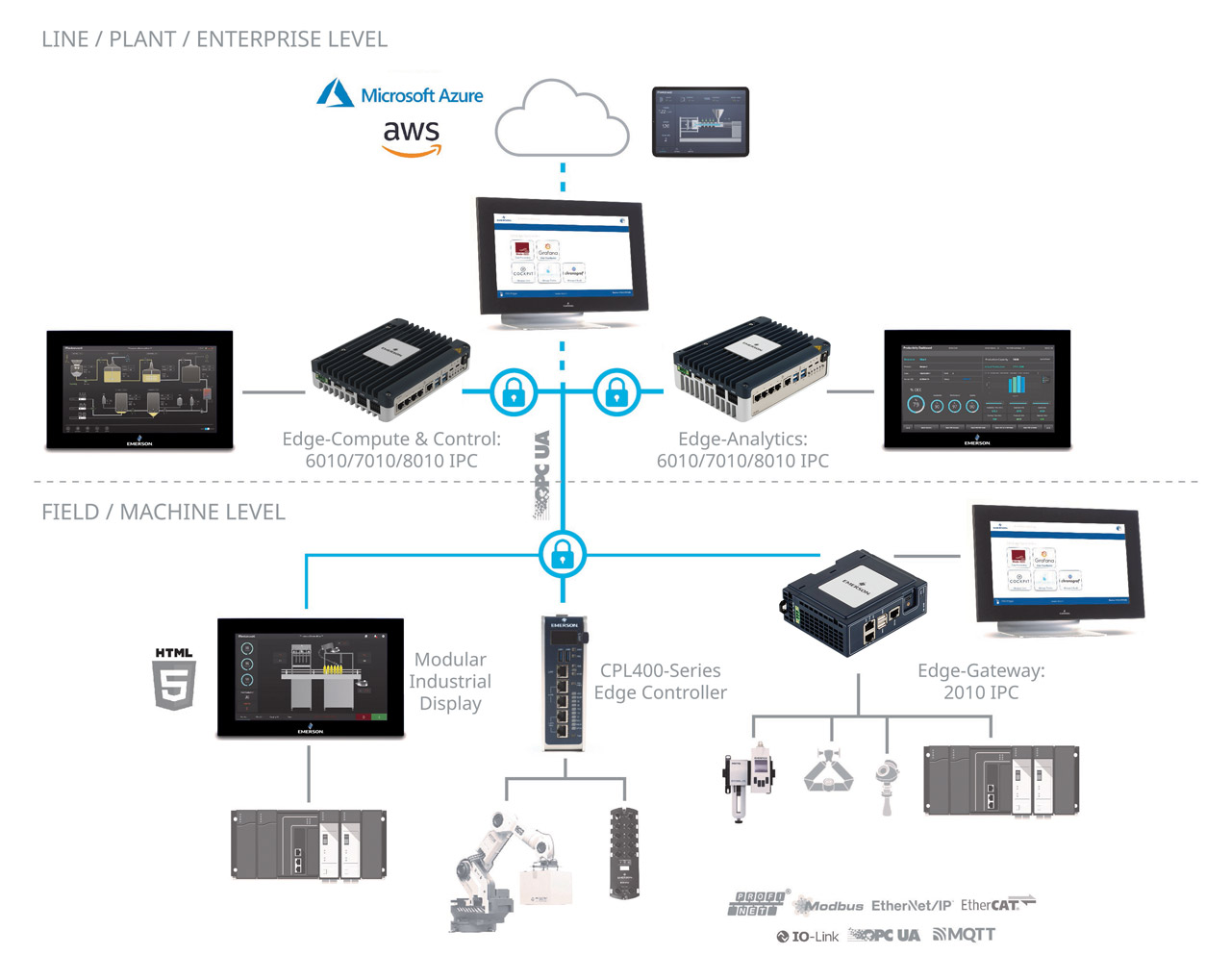
Emerson’s next-generation Industrial PCs, edge controllers, and PACEdge™ software create a unified data fabric that seamlessly connects OT assets with IT systems to support protocol conversion, edge analytics, and cloud integration.
Democratizing data to ensure it can get where and when it’s needed to help users and analytics systems turn data into actionable information.
According to Gene Juknevicius, solution architect at Emerson, connecting data islands has become an imperative across nearly every industry. In the OT world, teams have different control and monitoring systems, and each often have their own data, protocol stacks, and key objectives.
He said that systems typically don’t communicate well, if at all, with each other. This creates data islands, with critical information siloed. Teams are looking for ways to democratize data to ensure that it can get where and when it is needed to help human users and analytics systems turn that data into actionable information.
Another trend that is becoming common is that compute power at the edge is steadily increasing. “Historically, in the OT world, edge control technology was very limited in its capability. But today, powerful and robust edge compute devices—along with modern, fully featured operating system and application software—are available to help OT teams unlock more sustainable, flexible, efficient, and profitable operations,” Juknevicius said. “Much of this capability comes from analytics, but teams are learning that some of their goals cannot support the latency or cybersecurity risk of constantly sending data back and forth to and from the cloud or remote data centers.”
Impact on Industry
“If a team is putting all its data up in the cloud before they perform analytics, they can only send so much data, and it becomes easy to miss valuable insights that can only be captured right at the device,” Juknevicius said.
“This challenge only increases as operations become more remote and cloud connectivity becomes less reliable, such as in mining operations. As a result, we’re seeing far more compute power being delivered right at the edge, including full operating systems that can perform more complex and power-consumptive tasks. Today, teams are leveraging that processing power to run AI processing right at the edge. This power comes from technologies like modern industrial PCs (IPC) that provide ruggedized and increased processing power for deployment closer to the process to leverage AI at the edge to provide feedback and adjust processes in real time,” he added.
In addition, OT teams are also increasingly leveraging solutions like Emerson’s PACEdge™ software to transform those industrial PCs into more intelligent edge nodes in a very freeform manner in a containerized, intuitive format that makes them easy to configure, deploy and maintain. Both the best modern IPCs and the most advanced edge software platforms are also designed to communicate with a multitude of PLCs and IO devices, providing the seamless integration necessary to eliminate data silos.
New Levels of Enterprise/Automation Integration
Juknevicius said that the most advanced modern IPCs bring high-performance and AI-accelerated computing power right to the edge without sacrificing the stability necessary for industrial operations. With no moving parts, soldered memory, and reliable SSD storage, modern IPCs can deliver AI-capable performance at the edge without the risk of high vibration, extreme temperatures, or dust and dirt contamination causing failures.
In addition, the most advanced IPCs offer far longer lifecycles than off-the-shelf consumer hardware, empowering teams to implement validated solutions without fear they will have to re-validate if they need to replace an IPC within a typical industrial lifecycle.
“Edge software solutions empower teams to run applications, process data, and integrate systems in a containerized environment as close to the industrial application as possible. These solutions provide a sandbox environment for development of advanced applications like analytics and vision systems, and they create a centralized solution for protocol conversion,” Juknevicius said.
Instead of a wide variety of analog connections—modern IO devices now integrate serial, wireless or even Ethernet/IP interfaces—simplifying connectivity to the edge systems where different protocols can be terminated, and where data can be normalized and made available to the upper software layers in a uniform fashion.
“Consider a device like a temperature sensor which traditionally transmitter data using a 4-20 mA analog signal. Today, a temperature sensor might instead have a microcontroller powerful enough to run a true IP protocol stack and support an ethernet port, wi-fi, or even low-energy Bluetooth,” he said. “It can communicate via an IT protocol like MQTT or OPC UA. That allows automatic connectivity to the IPCs without a need for hardware-specific converter devices so that the data can flow naturally from the OT world into the IT stack.“
He added that there are also many more applications designed to perform AI processing in the OT world, right on edge devices, to bring the benefits of AI to the edge. These solutions, with vision systems being the most common example today, can often work in closed-loop control systems because they meet the latency requirements necessary to operate without disrupting the process.
In terms of the software stack, in the IT world, technologies like virtualization have been the standard for a long time. But in OT, compute power has typically been insufficient. Memory and processing cores were much more limited, so virtualization was much harder to implement than with IT-based systems.
Now, with the increase of the available compute power at the edge, and advances in software containerization, the concept of micro services has emerged. Instead of using virtual machines and virtualizing the full operating system, teams can instead use containers to provide isolated environments for applications, while sharing many of the same software resources in the operating system. Now, teams can easily add, remove, or replace applications without worrying about software conflicts and other technology challenges. This approach is more cybersecure, and far more intuitive to implement.
Given the challenges of IT-OT Convergence from a technology perspective, Juknevicius said that the trend is connectivity.
“Today, seemingly everything in the OT environment is being connected to everything else to make the best use of the data as it is the key to operational excellence. To gain the best business insights, teams need access to data—the more robust, granular, and real-time the better—so they can drive the desired business outcomes resulting from timely decisions,” he said.
“Moreover, if the ultimate vision is autonomous control, teams will need to be able to deploy the technologies that have traditionally been stuck in the IT realm, and they will need to do so as close to the OT devices as possible. The outcomes will be better reliability, better optimization, and more uptime—ultimately improving business outcomes,” he concluded.
Edge Controllers Communicate Multiple OT Protocols
Technology is collapsing the gap between the plant and the enterprise.
According to Dan White, Director of Technical Marketing at Opto 22, convergence used to mean bolting a PC gateway between the plant and the enterprise. The trend now is collapsing that gap. Edge controllers speak OT protocols like Modbus, Ethernet/IP, ProfiNET, OPC UA and IT protocols like MQTT and REST—all from the same device. The translation layer that used to be its own box is now a feature of the controller.
A second trend is publish-subscribe data movement. MQTT with Sparkplug decouples who produces data from who consumes it. A controller publishes once, and SCADA, a database, and a cloud analytics service all subscribe. You stop building point-to-point integrations for every new consumer.
And third, IT technology is showing up natively in OT gear: Linux, containers, Git, standard APIs. That lets OT teams use IT tools, and lets IT people work with equipment they recognize. The result is that the old Purdue model—rigid layers stacked between the sensor and the enterprise—is flattening. Data can move from an I/O point to a cloud database in one hop, securely, without the middle layers that used to define plant architecture.
Potential Solutions for IT-OT Convergence
“A few technologies do most of the work. Edge programmable controllers combine real-time control with an IT-friendly computer, so one device handles the machine and the data. MQTT with Sparkplug provides the messaging backbone: lightweight, secure, and built for report-by-exception, which fits industrial data far better than constant polling,” White said. “OPC UA still has its place, as a way to consolidate various proprietary protocols into a single information model. And container platforms plus tools like Node-RED let teams add logic, protocol conversion, and integrations without ripping out the controller.”
White said that why it matters is that these are open, widely supported technologies, not one vendor’s proprietary stack. That lowers the risk of lock-in and lets IT and OT meet on common ground. The impact on industry is practical. When a controller can publish clean, described data straight to a database or cloud service, you stop spending projects on plumbing and start spending them on outcomes: predictive maintenance, energy tracking, quality analytics. Convergence stops being an integration headache and becomes the plumbing that finally lets a plant use its own data.
When asked about the specific technical benefits these solutions provide, White said the clearest benefit is cybersecurity. Almost every recent OT attack exploits the same weakness: a controller exposed to the internet with open inbound ports. In July 2026, coordinated attacks hit more than 30 Minnesota water systems through internet-facing PLCs—attackers changed passwords, locked out operators, and forced a switch to manual control.
“A publish-subscribe architecture removes that exposure,” White said. The controller makes one outbound, encrypted connection to a broker and authenticates with a certificate. There are no inbound ports to scan and no controller sitting on the public internet. Secure connectivity becomes a property of the design, not a firewall rule you hope holds. The integration benefits follow from the same model. Decoupling lets you add a consumer, like a dashboard, a databased, or an ML model, without touching the controller. Sparkplug’s self-describing data carries structure and context, so tags arrive already explained instead of mapped by hand.
“Let’s walk through the data, start to finish,” White added. “An edge controller scans its I/O the way it always has, reading sensors and driving outputs. When a value changes, the controller sends that change to an MQTT broker over an encrypted connection. That’s called report-by-exception. The network carries data only when something actually happens, instead of asking every point “what’s your value?” over and over on a timer.”
Sparkplug adds the structure. When a device connects, it introduces itself with a birth message that lists every tag it has and each one’s current value, so any subscriber knows the device’s full state right away. If the device drops off, a death message lets everyone know. Nobody has to wonder whether their data is stale.
The subscribers, like a SCADA screen, a SQL database, or a cloud service, all connect to that same broker and get only the tags they ask for. None of them talk to the controller directly, which keeps it protected.
“And if you need to do some work on the data first, onboard tools, like Node-RED or Ignition Edge can run right on the controller. You filter, reshape, and even add context to data at the edge before it ever leaves the plant,” White said. “The payoff is real-time data from across the whole plant that any authorized system can use, and you don’t have to rebuild the network every time you add one.”
Challenges of IT-OT Convergence
“Convergence matters more every year, and I think the technology side is largely solved. Edge controllers, MQTT, Sparkplug, and OPC UA are proven and in production across the industry,” White said. “Sparkplug is now a managed open standard, brokers are mature, and the tooling is good. If you start a project today, you are not fighting the technology. The progress that is left is cultural. The hard part was never the protocols. It was getting IT and OT to share ownership, agree on who secures what, and trust a shared data layer. That is people and process, and it moves slower than firmware.”
“My honest opinion: we have crossed the point where convergence is a question of whether. It is now a question of how well. The plants pulling ahead are the ones treating their data as a shared asset instead of two teams guarding two networks. The technology has done its job. The remaining work is organizational, and that is where companies should put their attention now,” he concluded.
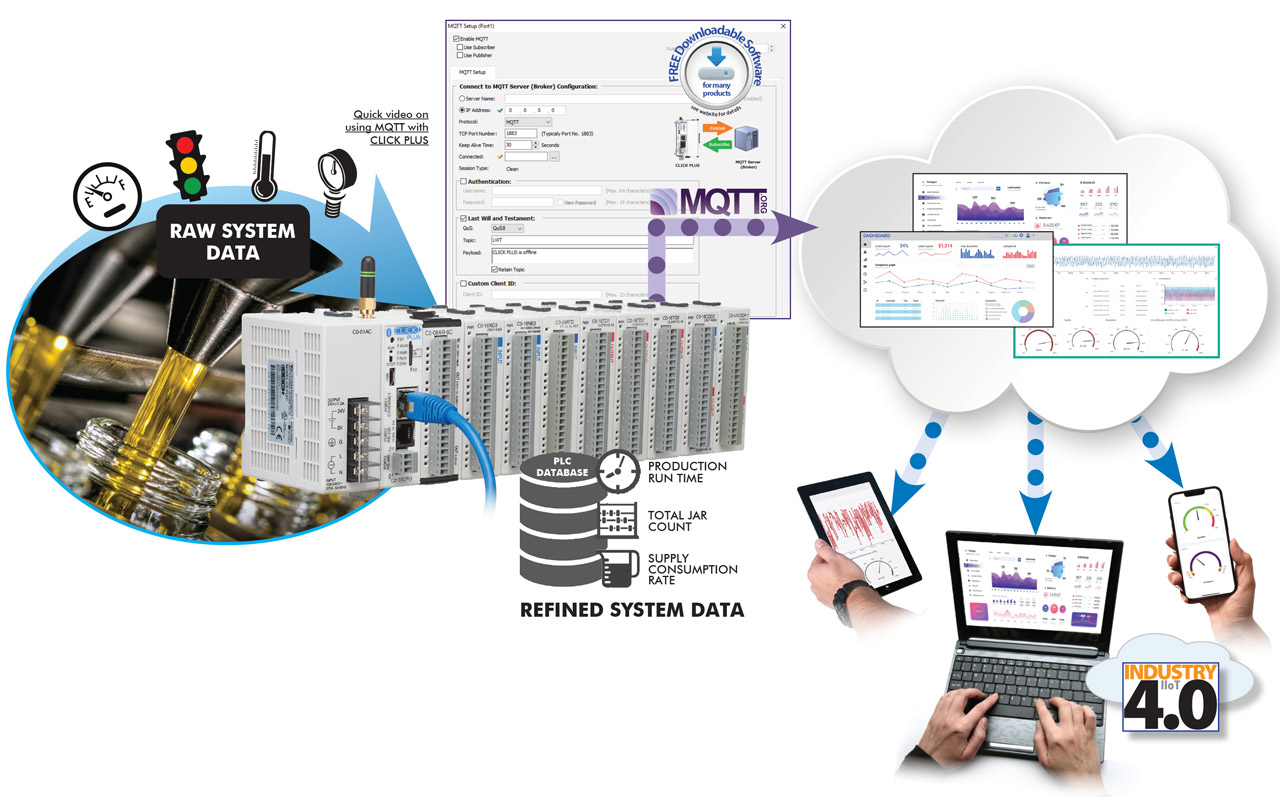
For new automation systems or updates of existing installations, IT-OT convergence is essential for realizing the full value from massive amounts of field-sourced data available, especially for AI and analytical purposes. Modern PLCs, like the AutomationDirect CLICK and BRX, provide a capable way to connect OT-centric manufacturing zone data up to the IT-centric enterprise zone while addressing safety, reliability, regulatory, and other requirements.
Resources, Regulation and AI
Organizations can no longer afford to treat IT and OT cybersecurity as completely separate efforts.
Tim Wheeler, cybersecurity manager for industrial products at AutomationDirect told Industrial Ethernet that three key technology trends shaping IT-OT convergence are resources, regulation, and artificial intelligence.
“One of the biggest drivers of IT-OT convergence is resources. Organizations can no longer afford to treat IT and OT cybersecurity as completely separate efforts, especially as industrial environments become more connected. OT teams traditionally have strong knowledge of the physical process, industrial equipment, and operational risks, while IT teams often have greater experience with networking, identity management, cloud services, cybersecurity monitoring, and enterprise security tools. Bringing these resources together allows organizations to take advantage of the strengths of both groups rather than attempting to duplicate expertise,” Wheeler said.
“At the same time, the shortage of experienced OT cybersecurity professionals is forcing organizations to find more efficient ways to use the people and technology they already have. Successful convergence does not necessarily mean combining IT and OT into a single organization. Instead, it means establishing clear responsibilities, communication paths, and shared security processes while recognizing that OT environments have different priorities than IT—particularly safety, availability, reliability, and operational continuity,” he added.
Regulation
Wheeler said that regulation is accelerating IT-OT convergence because cybersecurity is increasingly becoming a product, operational, and business requirement rather than simply an IT concern. Requirements and frameworks such as the EU Cyber Resilience Act (CRA), IEC 62443, NIS2, and sector-specific critical-infrastructure requirements are pushing organizations toward more structured cybersecurity practices across the entire lifecycle of industrial products and systems.
Meeting these expectations requires cooperation across departments that historically operated independently. Engineering, IT, OT, cybersecurity, legal, product management, and supply-chain teams increasingly need to share information and coordinate activities such as vulnerability management, asset inventories, SBOMs, incident response, access control, patching, and risk assessment. Regulation is therefore helping drive convergence not simply at the network level, but at the organizational and process level.
Artificial Intelligence
AI is another major driver of IT-OT convergence. Industrial organizations are beginning to use AI for cybersecurity monitoring, predictive maintenance, anomaly detection, engineering assistance, vulnerability research, and analysis of large amounts of operational data. To provide value, many of these technologies need access to information that historically remained within isolated OT environments.
This creates both opportunities and new risks. Connecting industrial data and systems to AI platforms can improve visibility and efficiency, but it also introduces questions about data security, system access, cloud connectivity, trust, and the ability of AI-driven decisions to affect physical processes.
Organizations will need IT, OT, engineering, and cybersecurity teams working together to establish appropriate boundaries for AI. The challenge will be gaining the benefits of AI without introducing connectivity or automation that negatively affects the safety, reliability, or security of industrial operations.
IT-OT Convergence Solutions
“Emerging technologies are providing new ways to address the challenges associated with IT-OT convergence, with artificial intelligence being one of the most significant. AI can help organizations process the growing amount of information generated across both IT and OT environments, improving areas such as anomaly detection, predictive maintenance, asset monitoring, vulnerability identification, and incident response,” Wheeler said. “As industrial environments become more connected, AI can help teams identify patterns and potential risks that would be difficult to recognize manually. However, the value of AI will depend on how responsibly it is integrated into OT environments, with appropriate controls to ensure that new capabilities do not negatively affect safety, availability, or reliability.”
He noted that equally important is the continued growth of cybersecurity frameworks and the security capabilities built into OT products themselves.
Frameworks and standards such as IEC 62443 are creating a more consistent approach to securing industrial environments, while manufacturers are increasingly incorporating technologies such as secure communications, authentication, role-based access control, secure boot, signed firmware, logging, and improved vulnerability management directly into industrial products. As OT devices gain the resources necessary to support these capabilities, organizations can begin applying stronger security controls without relying entirely on external IT security solutions. Together, AI, mature cybersecurity frameworks, and more capable OT products can help industry achieve convergence in a controlled manner—taking advantage of the connectivity and visibility of IT while maintaining the safety, reliability, and availability required by OT.
Enterprise/automation Integration
These solutions provide several important technical benefits by improving visibility, communication, security, and decision-making across IT and OT environments. AI can help analyze large amounts of operational and cybersecurity data to identify abnormal behavior, equipment issues, and potential threats more quickly. At the same time, maturing cybersecurity frameworks provide a common structure for managing access, network segmentation, secure communications, vulnerability management, and incident response. Modern OT products are also gaining the processing power and security capabilities needed to support technologies such as encryption, secure boot, signed firmware, role-based access control, logging, and more secure industrial protocols. Together, these improvements allow organizations to increase connectivity without having to sacrifice the safety, availability, and reliability required in industrial environments.
“From an enterprise and automation integration perspective, these capabilities allow information to move more securely between the plant floor and enterprise systems. Production data can be made available to business applications, analytics platforms, cloud services, and AI tools while stronger security controls help maintain separation between critical control functions and higher-level enterprise networks,” Wheeler said.
“This can improve predictive maintenance, production planning, asset management, cybersecurity monitoring, and overall operational visibility. Ultimately, the goal of IT-OT convergence should not simply be to connect more systems—it should be to create secure, controlled pathways for sharing the right information with the right systems while protecting the industrial process itself.”
New possibilities for Addressing Challenges
Wheeler noted that modern IT-OT integration works by creating controlled and secure pathways for data to move between industrial systems and enterprise platforms without exposing critical control functions to unnecessary risk. Technologies such as industrial firewalls, secure gateways, network segmentation, encrypted protocols, role-based access control, and centralized logging provide the foundation for this connectivity, while newer OT products increasingly have the processing resources to support these security capabilities directly.
AI can then analyze information collected from both environments to identify abnormal behavior, cybersecurity threats, equipment degradation, and operational trends that may otherwise go unnoticed. Cybersecurity frameworks such as IEC 62443 provide the structure for determining where these technologies should be applied and how systems should be separated into appropriate security zones and communication paths. Together, these technologies create new opportunities to securely connect plant-floor information with enterprise analytics, cloud platforms, predictive maintenance systems, and business applications while maintaining the safety, availability, reliability, and integrity of the industrial process.
“IT-OT convergence will continue to grow in importance as industrial systems become more connected, capable, and dependent on enterprise technologies, but successful convergence requires a thoughtful and balanced approach rather than simply applying traditional IT solutions to OT environments,” Wheeler said. “Organizations should adopt a risk-based process that considers the specific needs of their systems, including safety, availability, reliability, cybersecurity, operational requirements, and business objectives. Continued improvements in OT security capabilities, cybersecurity frameworks, AI, and collaboration between IT and OT teams are making secure integration increasingly achievable.”
“The goal should not be convergence for the sake of connectivity, but rather to identify where integration provides meaningful operational or business value and then implement it with security controls appropriate to the actual risks. Ultimately, there is no single solution that works for every industrial environment; organizations must develop an approach that balances risk and opportunity while protecting the systems and processes that matter most to their operations,” he concluded.
“Today, AI comes along with its own insatiable appetite. Not just for the information that we have deemed important, but for every possible data point it can consume. If we are going to ask AI to tell us what is important. If we want AI to identify correlations that we had never before recognized, then it needs to be fed EVERYTHING,” Bruce Cloutier, CEO/Founder of INTEG Process Group.
IT/OT Collaboration
Growing overlap has driven adoption of standardized communications, stronger cybersecurity, and enterprise connectivity.
Bruce Cloutier, CEO/Founder of INTEG Process Group, said that key technology trends are shaping the discussion about IT-OT Convergence.
“Consider the perspective in which IT and OT are not converging into a single discipline, but that the interaction between them is becoming increasingly collaborative. Modern automation systems are expected to provide secure, structured access to operational data while continuing to meet the deterministic and long-life requirements of industrial control,” Cloutier said. “The growing overlap has driven adoption of standardized communications, stronger cybersecurity, and enterprise connectivity, allowing IT and OT systems to cooperate without sacrificing the unique strengths of either.”
Cloutier said that the expanding overlap requires each discipline to contribute its strengths without imposing its architecture on the other. OT systems must expose useful operational information through secure, well-defined interfaces while preserving deterministic control, reliability, and long service life. IT systems must consume that information, manage identities and access, correlate data across the enterprise, and support analysis without becoming part of the real-time control path. The most successful integration therefore establishes a deliberate boundary: operational decisions remain close to the equipment, while information needed for supervision, maintenance, planning, and optimization moves securely into enterprise systems.
“The enabling technology trend is therefore the development of purpose-built edge controllers that embody the growing collaboration between IT and OT. Rather than favoring one discipline over the other, these technologies are designed from the outset to respect the unique strengths and requirements of both,” Cloutier said. “They enable each discipline to continue doing what it does best while providing the secure, reliable, and predictable exchange of information needed for modern industrial systems. The result should be solutions valued equally by enterprise architects and automation engineers alike, providing the all-important confidence and longevity demanded by both.”
IT-OT Convergence Solutions
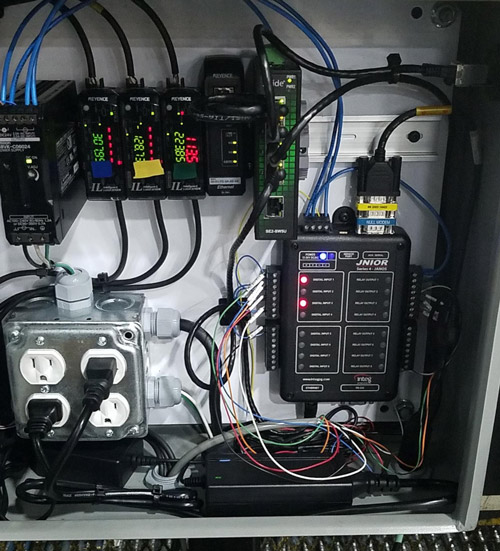
The INTEG Process Group JNIOR automation controller, first envisioned over 20 years ago, was architected to deliver balanced functionality, determinism, and longevity, providing designers with a trustworthy platform incorporating the unique strengths of both IT and OT, so end users can easily handle the increasing demands of IIoT, AI, and other applications.
Cloutier said that the technologies enabling IT-OT convergence are commonly known. More interesting are the technologies increasingly challenging its future.
For more than two decades, the industry has spoken of IT-OT convergence as though it were an inevitable destination. Ethernet, standardized protocols, and secure communications have unquestionably brought the two worlds closer together. Yet at the very moment convergence appears within reach, one of its greatest enablers has become one of its greatest challenges.
Strong encryption, authenticated identities, and trusted communications have enabled OT devices to participate safely in enterprise networks. But each new generation of cybersecurity demands potentially unavailable computational resources, more frequent updates, and increasingly complex trust infrastructures. Those expectations fit naturally within enterprise computing, yet they challenge industrial platforms designed for deterministic operation with service lives measured in decades rather than years. Ironically, the complexity required to secure these systems can itself become a source of operational risk.
“AI only amplifies this trend, increasing expectations for secure, persistent connectivity to enterprise intelligence. The question is no longer simply how to converge IT and OT, but how to ensure that advances in cybersecurity remain practical across the long service lives of industrial systems,” Cloutier said. “New technology makes its greatest impact not when it demands replacement of proven platforms, but when it extends their ability to participate safely and confidently in an increasingly connected world.”
Technology Benefits
Cloutier said that many of the technologies commonly presented as IT-OT convergence solutions are better described as enabling tools. Ethernet, secure communications, web technologies, standardized protocols, APIs, and enterprise messaging all provide important capabilities, but none by themselves solve the fundamental challenge of integrating two disciplines with very different design priorities.
“The solution is not a collection of enabling technologies, but a purpose-built edge controller that incorporates those technologies within an architecture intentionally designed to satisfy both IT and OT requirements simultaneously. By treating these technologies as capabilities rather than the architecture itself, the platform can incorporate today’s tools—and those yet to come—without compromising the deterministic behavior and longevity that industrial automation demands,” Cloutier said.
From the IT perspective, the platform provides capabilities that traditional industrial controllers were never expected to offer: secure web interfaces, authenticated communications, encrypted protocols, enterprise APIs, structured data exchange, identity management, and seamless integration with business systems and cloud services.
From the OT perspective, none of those capabilities matter if they compromise deterministic operation, long service life, reliability, or the confidence that the controller will behave predictably years after installation. Enterprise software often assumes continual updates, evolving dependencies, and changing infrastructures. Industrial automation cannot.
The operating system, communications architecture, security model, and application environment must be designed together to maintain predictable operation while exposing modern enterprise functionality. The result is an automation platform that avoids unnecessary software complexity, minimizes version dependency, reduces update anxiety, and remains stable throughout the operational life of the equipment. Perhaps the greatest technical benefit is that integration is no longer something added to the controller. It becomes an inherent property of its design..
Addressing Engineering Challenges
The challenges of IT-OT integration are not static. New protocols emerge. Security requirements evolve. Enterprise software changes. Cloud services come and go. The engineer’s task is therefore not to solve one integration problem, but a continuing series of integration problems. It is a career,” Cloutier said. “Since engineering resources are always finite, success depends less on eliminating future challenges and more on giving engineers the right tools to address them efficiently.”
He added that many of the technologies discussed in IT-OT convergence—secure communications, standardized protocols, enterprise messaging, APIs—are valuable tools for specific tasks. Equally important is providing an integration platform that allows those tools to be employed naturally, consistently, and without repeatedly solving the same architectural problems.
The key technical detail is establishing a strategy based upon a packaged engineering-certified platform that is fully supported by a manufacturer. A reliable edge controller with demonstrated longevity. One in which you can have confidence. And that would be familiar to other engineers should service be required in the future in your absence.
The greatest technical advantage of a purpose-built IT-OT platform is not that it eliminates future integration challenges. It is that it removes the need to repeatedly solve those same issues day after day. By providing a stable, integrated foundation, it frees engineers to focus their limited time and expertise on the next new challenge rather than continually rebuilding the platform beneath it. It is what makes careers successful.
“In looking back over the past two decades, there has always been a growing need for IT-OT edge devices. That it is not a new requirement. Technologies have been available to service that need throughout that period,” Cloutier concluded.
“Beyond local process control, remote monitoring and control has been a steadily growing theme. Edge controllers have been deployed successfully. In Digital Cinema, beginning in 2005, for example, applications manipulate I/O and coexist simultaneously with ongoing protocol conversion and web-based GUI. This has all been handled by engineering-certified, deterministic and trusted devices all supported by manufacturers.”
The fact of the matter is that the technologies that most will cite as being solutions for this have been available for quite some time. Perhaps not by the same names or in exactly the same packages. Lightweight Publish/Subscribe protocols have been in use for years and predate MQTT and others.
There is no doubt that engineers have, and have had, the tools, technologies, and skills to create successful integrated IT-OT solutions for some time.
What has changed is the appetite for information. In years past, anything that was needed remotely had to have a specific purpose. A switch needed to be located miles away or the main office needed up to date status as to county water tank levels. With the proliferation of cloud-based analytics, the quantity of information needed remotely has increased. We are no longer talking about a single displayed value, but multiple values charted over time. And, in enough detail to help us visualize the correlations.
“Today, AI comes along with its own insatiable appetite. Not just for the information that we have deemed important, but for every possible data point it can consume. If we are going to ask AI to tell us what is important. If we want AI to identify correlations that we had never before recognized, then it needs to be fed EVERYTHING,” Cloutier said. “The demand for IT-OT integration has exponentially skyrocketed. And, suddenly we have an IT-OT convergence problem in need of a solution? There are already solutions. But, getting control over the situation and in an economically sensible fashion… now that may be real the problem.”

“The challenges of IT-OT integration are not static. New protocols emerge. Security requirements evolve. Enterprise software changes. Cloud services come and go. The engineer’s task is therefore not to solve one integration problem, but a continuing series of integration problems,” Chris McLaughlin, former Chief Information Security Officer at Johns Manville.
Zero Trust Concepts Valuable
Concepts translate well between the IT and OT worlds, and tools often can be applied between the two.
Chris McLaughlin, a frequent speaker on OT cybersecurity topics and former Chief Information Security Officer at Johns Manville said that technology has shifted dramatically over the course of his 30 years in the industry and perhaps we have yet to see the biggest shift that will occur with AI. The adoption of ethernet, the Internet, mobile expansion, big data and digital transformation efforts have each played a part in the slow convergence that has occurred between IT and OT over the years.
“Today, many organizations find that they have converged further than they may have thought and are forced to recognize that they may not have done it securely enough. As organizations continue to find themselves victims of ransomware, sadly, many discover that their businesses are integrated tighter that they thought between IT and OT,” McLaughlin said. “Many business executives discover the hard way that when IT functions fail, their OT functions are unable to be performed. For instance, how does a company that manufactures a product continue to produce goods if they are not able to send schedule changes or put products away? How confident is the CEO of an oil and gas pipeline to continue operations if all of their physical security cameras, etc. have been taken offline. Many Chief Information Security Officers (CISOs) are starting to understand that they must partner with their OT counterparts to collaboratively identify risks and mitigate them.”
Zero Trust Concepts
McLaughlin said that, generally, Zero Trust concepts in which access to a given system or service only by what someone is required to have access to is being implemented heavily in IT. With IT focused solutions maturing, some of the technology will be applied to OT worlds. ISA / IEC 62443 has long defined the concepts of Zones and Conduits to separate out segments based upon level of access (Zones) and limit communications between those segments to only what is required (Conduits). The fundamental concepts translate well between the IT and OT worlds, and the tools often can be applied between the two.
He said that security monitoring solutions have also developed significantly over the last 5 years along with OT targeted monitoring. Security teams have been collecting massive amounts of log data over the last few decades and each year the amount of data (and undoubtable the costs of that data) has risen. With Machine Learning, Behavioral Heuristics, and AI advances in technology; this data is becoming extremely valuable in early detection and response to cyber activity. This is the good news; the bad news is that attackers are also using AI to launch attacks against us.
Perhaps this these ultimately support what is most important for IT / OT convergency, effective OT operations. Organizations that are able to secure their operations with standards such as ISA / IEC 62443 are able to focus on Data integration and the benefits of digital convergence and the use of AI to better understand their business.
Technology Benefits
“Zero Trust technologies help organizations limit the exposure from a breach while provide greater security for the things that they want to protect to a great level. Breaches still largely come about through phishing emails or other forms of social engineering,” McLaughlin said. “In most organizations, the breach of a single user and their computer can expand into a full blown ransomware attack. Zero trust solutions help to isolate the blast area from a compromise of a single user and in some cases provide warnings to security teams when that user account or computer has started to do things that are not ‘normal’. “
OT monitoring solutions then detect unusual activity on OT networks and likewise, are able to detect and stop attacks at early stages and could prevent a catastrophic event from happening to the Industrial Control Systems.
Ultimately these technologies are in place to allow organizations to focus on operational advances with AI and other business level digital convergence efforts. Providing real time data for modeling, using AI to scan for visual defects, detecting machine problems though indicators and preventing a major outage; these are the true benefits. Organizations that are able to achieve these benefits will have a competitive advantage against their competitors. Those that decide to implement these OT / IT integrations without security? They do so at their own peril.
McLaughlin added that zero Trust technologies are complex and can vary significant from one supplier to the others. Essentially, they start with the concept of “Identity” and determine from there what services that identity can access. Fundamentally, concepts of identity management have been around a long time. As a user of a system you may have access to some things while others users may have access to others. Zero Trust is deeper than that in that it specifically blocks you from access those services. For instance, your access may have been able based upon security roles in that system but were you able to get to other applications on that system that you should not have. Zero Trust takes things a step further by blocking that access entirely.
OT Monitoring solutions, generally, work in one of two ways. They are either passive or active. Active systems actually scan the OT network or may have agents installed on OT systems for the purposes of monitoring or system management. Passive systems can often be configured so they cannot actually interface with the industrial network at all. Essentially, they are configured as a mirror of the traffic from the ethernet switch and simply provide data to the monitoring service and the service evaluates the network traffic. Passive monitoring is the more conservative options for many companies as it reduces the monitor as a potential attack point. Active monitoring systems may provide more information to analyze and perhaps greater visibility into threats, but that comes at potentially higher risk.
Given the challenges of IT-OT Convergence from a technology perspective, his opinion is that there has been continuing progress made on this issue.
“Progress will continue to be needed and although many of the technology advances will be driving that progress, the biggest issues will involve people and process. The biggest risk that I see for OT organizations is that they will be tempted to integrate IT systems too quickly and will not appropriately implement the people, process, and technology considerations. AI will likely provide tremendous opportunities in the future for OT based businesses, however, if done without securing those properly, they could be introducing extinction level risks to a business,” McLaughlin said.
He also noted that ISA/IEC 62443 standards provide guidelines for implementing things such as Zones and Conduits in OT environments which is a core foundation for Zero Trust. These standards go beyond that and help organizations understand the risks related to convergence specifically between IT and OT systems and best practices for both understanding the risk and implementing these integrations while managing that risk.