

TechnologyOctober 19, 2026
Connected and Intelligent Devices
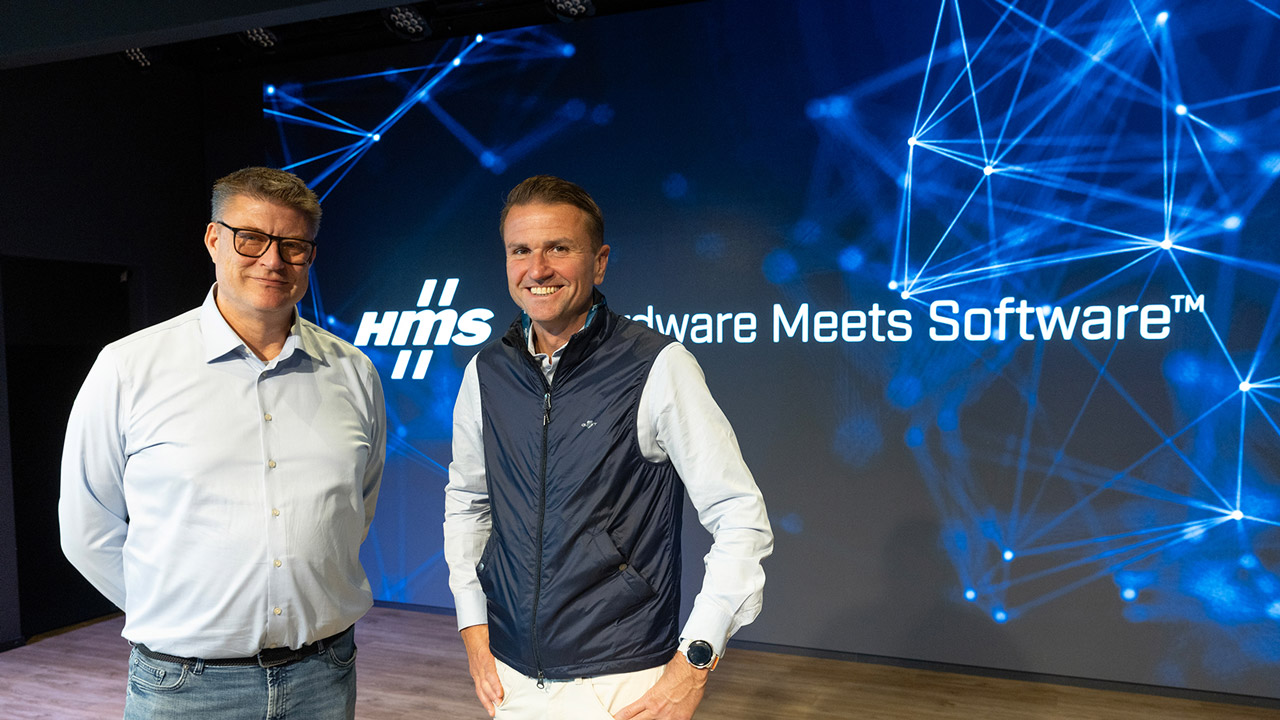
An Industrial Ethernet interview with key executives at HMS Networks shows how Anybus ONE Device Intelligence brings embedded intelligence into industrial field-level devices.
IMAGE ABOVE On the left: Jörgen Palmhager, VP Technology Industrial Network Technologies/HMS Networks.
On the right: Bartek S. Candell, SVP Industrial Network Technologies/HMS Networks
An Interview between Industrial Ethernet magazine and Bartek S. Candell, SVP Industrial Network Technologies/HMS Networks and Jörgen Palmhager, VP Technology Industrial Network Technologies/HMS Networks, illustrates how connected and intelligent devices are bringing embedded intelligence into industrial field-level devices.
1. From connectivity to intelligence
Question: Industrial communication has traditionally focused on connecting devices reliably and securely. Why is intelligence now becoming part of connectivity itself – and why is this shift particularly relevant for industrial device makers today?
Answer: Bartek S. Candell
For decades, Anybus has done one job very well: connecting industrial devices to any network, reliably and securely. Millions of devices in the field rely on that, and it remains the foundation of Anybus ONE, our new embedded communication platform. What we add is a new level of intelligence: enabling devices to learn from their own operation, recognize changing conditions and turn insights into improved performance and reliability.
The reason is practical. Most industrial devices already measure current, speed, pressure, temperature or cycle time. Turning it into insight has required cloud platforms, data scientists and large historical datasets – which most device makers and their customers either do not have or do not want to share. And control logic is designed for typical conditions, while every installation behaves differently.
Machine learning that runs and learns inside the device addresses all of these barriers at once. For device makers, connectivity becomes the platform for products that adapt, warn early and improve over time – without hardware redesign.
2. What sits under the hood
Question: You call the concept Anybus ONE Device Intelligence. What exactly runs inside Anybus ONE, and how is it designed to avoid interfering with the device’s primary communication task?
Answer: Jörgen Palmhager
Anybus ONE is built on a dual-core architecture with two equally important parts. The Communication Core runs industrial communication exactly as customers expect from Anybus: protocol stacks, real-time data exchange, security functions and diagnostics. That path does not change, and its timing is not affected by what happens on the Application Core.
In parallel, the Application Core runs embedded machine-learning software based on technology from Ekkono, a Swedish edge-AI company in which HMS invested in 2026. It is designed for very constrained hardware and both trains and infers on the device. It is not a cloud service and not generative AI; it uses compact models for time-series signals such as current, pressure, temperature and vibration.
Because Anybus ONE already handles the process data that passes between the host application and the network, it can feed selected signals to the model and return the results – a health indicator, a deviation, a predicted value – to the host or to the PLC over the existing network connection. Raw data stays in the device. This is the starting point: over time, the Application Core will also capture data directly from the device or external sources, without using the communication interface.
3. From Studio to learning device
Question: What would implementation look like for a device manufacturer – from opening Anybus Studio to having Anybus ONE Device Intelligence running inside the device?
Answer: Jörgen Palmhager
Anybus Studio is already the tool in which device makers configure Anybus ONE – host interface, network protocol and device identity – instead of integrating protocol software into their device software project. Work that used to take months of protocol development can be completed in hours, signed, installed on the module and changed later without touching the hardware. Anybus ONE Device Intelligence is added to the same workflow.
The developer selects a predefined AI function – for example condition monitoring for a motor drive, a pump or a valve – maps the relevant signals that are already part of the Anybus ONE configuration, defines the operating boundaries and deploys model and configuration together. Each function builds on a model of the device and its typical operation – predefined by HMS, or adapted or designed by the device maker. Models are files that can be updated or replaced over the product’s life.
‘No data, no problem’ needs a precise reading. The device needs its live signals. What it does not need is a large, labelled historical dataset collected before the project can start. The model learns from real operation in the field.
4. How a device learns what ‘normal’ means
Question: If Anybus ONE Device Intelligence is not trained in advance with a large labelled dataset, how does it learn typical behavior – and how does that become an early indication that something is beginning to change?
Answer: Jörgen Palmhager
The principle is incremental learning. Instead of training a model offline and deploying it as a fixed artifact, the learning loop sits inside the device. During commissioning and the first period of operation, the model learns how the selected signals relate to each other for that specific unit – how motor current follows speed and load, or how pressure follows flow – and keeps refining it as conditions change.
The learned relationship becomes a virtual reference. Take a fan or pump drive: the model predicts the power consumption it expects at the current speed and load. If measured power begins to rise above the prediction, something has changed – a clogging filter, bearing wear, a fouled impeller – well before a fixed alarm threshold is reached. The same principle already runs in building-automation controllers, which learn when an air-handling unit actually needs to defrost. It can also create virtual sensors for values that are not measured directly.
Answer: Bartek S. Candell
For the OEM’s customers this means earlier warnings, fewer false alarms because each unit is judged against its own normal, and results that engineers can follow because the models are small and built on physical signals. The first output is an early indication, not a complete diagnosis; the OEM’s domain knowledge remains essential.
5. From detection to prediction and optimization
Question: How can device makers start with a simple Anybus ONE Device Intelligence function and then expand it toward prediction, optimization or even learning across a fleet of connected devices?
Answer: Bartek S. Candell
It follows the device lifecycle, and each step can be validated before the next. Commissioning becomes adaptive initialization: the device learns its installation instead of being tuned manually. Operation moves from detection to prediction – estimating time to service or remaining useful life of wear parts – and later to optimization, where the device adjusts parameters to reduce energy use or improve performance. Engineers define the intent and the boundaries; the model adapts within them. Service becomes condition-based rather than scheduled or reactive. Across a fleet, federated learning can share experience between units without centralizing raw data.
Commercially, device makers gain in three ways. They can differentiate products with functions that previously required extra sensors, hardware or cloud subscriptions. Their customers get higher uptime and lower maintenance cost while process data stays on site. And they can build services on insight their own devices generate. Because the capability sits in the communication module they already integrate, it scales across product lines without redesign.
6. From demonstration to industrialized capability
Question: At SPS, HMS is presenting the Anybus ONE Device Intelligence concept as a tangible technology demonstration. What does the demonstration prove today, what still needs to be industrialized, and where do you want this capability to take industrial connectivity?
Answer: Jörgen Palmhager
At SPS, visitors can follow the full chain on a reference design: configure Anybus ONE in Anybus Studio, deploy a predefined AI function, let the device learn normal behavior while the industrial network keeps running, and then see a deviation detected locally and reported to the controller. Communication and learning run in parallel in the same Anybus ONE module. It is a technology demonstration. Next, we will validate clear target applications together with selected device makers and complete model lifecycle management. Our plan is to make the full capability for smart devices available during the first half of 2027.
Answer: Bartek S. Candell
Anybus has always stood for connecting any device to any network. With Anybus ONE, the module that connects the device also helps make it smarter. Communication remains the foundation, running on the Communication Core. The Application Core, working in parallel, is where devices start to learn. Any network, any device – and now, any intelligence.