

TechnologyMay 25, 2026
Ethernet-APL Standard Drives Next Level Factory Innovation

Ethernet‑APL (Advanced Physical Layer) has emerged as a pivotal standardization standard, providing a common physical layer that brings Industrial Ethernet all the way to the field and technology innovations that will help unlock new opportunities for industrial digitalization in the automation industry.
Ethernet‑APL is becoming a unifying standard that delivers new levels of connectivity, scalability and digital intelligence that is positioning modern factories for the next generation of industrial innovation.
Built on the IEEE 802.3cg 10BASE‑T1L standard, Ethernet‑APL supports 10 Mbit/s communication over distances up to 1,000 meters and delivers both power and data over two wires. Its intrinsic safety features allow deployment in hazardous areas, making it suitable for oil, gas, chemical, and pharmaceutical environments where explosion protection is essential.
But the real strength of Ethernet‑APL lies in its broad ecosystem. Supported by PI, ODVA, FieldComm Group, and the OPC Foundation, and adopted by major vendors, it offers broad industry interoperability.
In this spedial report, Industrial Ethernet magazine reached out to industry experts to get their perspectives on the current state of the technology and what promises to be a bring future.
Ethernet-APL and OPC UA Powerful Combination
Standardized and secure connectivity offering vendor-independent semantic interoperability across all levels of a factory or process plant.
According to Peter Lutz, Director Field Level Communications for the OPC Foundation, Ethernet-APL and Single Pair Ethernet (SPE) establish a unified Ethernet infrastructure that enables seamless digital communication from enterprise systems down to field-level sensors and actuators. By extending Ethernet into industrial and process environments, these technologies eliminate traditional barriers between IT and OT networks and enable direct, end-to-end Ethernet communication across the entire automation architecture.
“While SPE and Ethernet-APL provide the physical Ethernet connectivity infrastructure, OPC UA and OPC UA FX, together with other Ethernet-based protocols, define the interoperable communication and data exchange framework,” Lutz said.
SPE and Ethernet-APL support long cable distances as well as power and data transmission over a single wire pair, making them highly suitable for scalable Industry 4.0 and smart manufacturing environments. And Ethernet-APL further extends SPE technology specifically for process automation environments, including hazardous areas and intrinsically safe applications.
As a result, manufacturers benefit from simplified architectures, easier device integration, reduced gateway requirements, and direct connectivity between the shop floor, enterprise systems, edge platforms, and cloud-based analytics applications. Unified Ethernet infrastructures also improve access to real-time operational and diagnostic data, supporting predictive maintenance, digital twins, and AI-driven optimization initiatives.
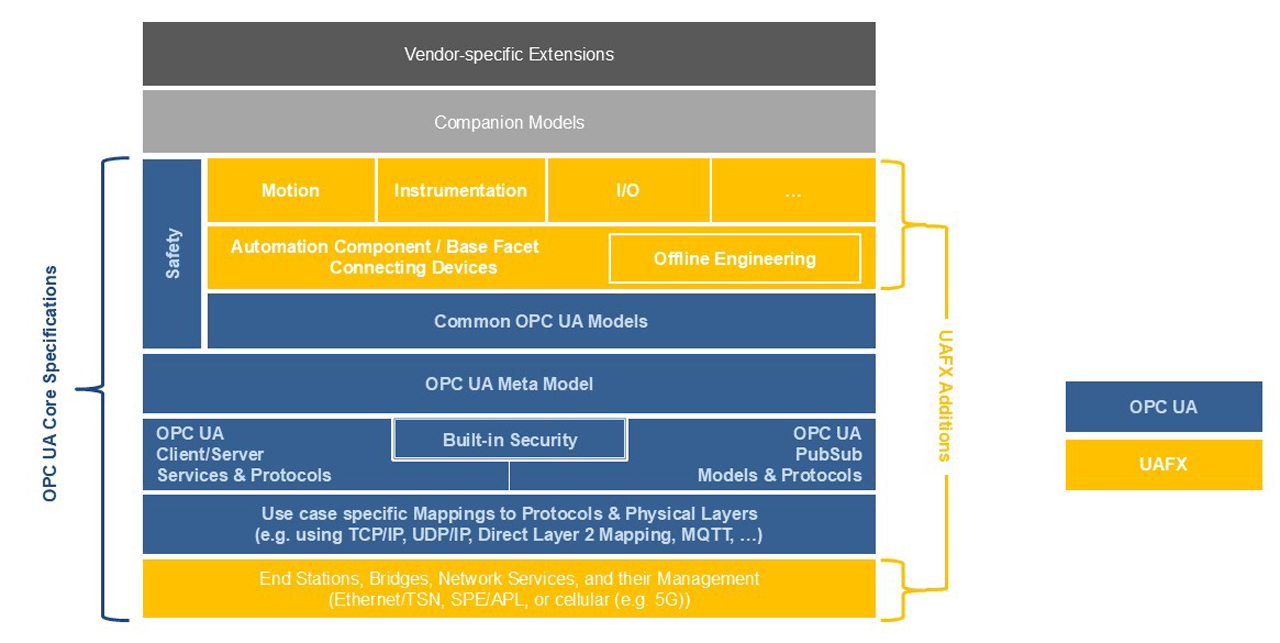
OPC UA FX System Architecture
Ethernet-APL and OPC UA
“The combination of Ethernet-APL, SPE and OPC UA is particularly powerful because it enables not only standardized and secure connectivity, but also vendor-independent semantic interoperability across all levels of a factory or process plant,” Lutz said.
Lutz said that OPC UA Companion Specifications ensure that data maintains a consistent meaning from source to destination, enabling seamless integration between field devices, controllers, edge systems, MES platforms, and cloud applications.
OPC UA FX extends the established OPC UA framework with deterministic, real-time communication capabilities required for industrial control and automation applications. While traditional OPC UA primarily focused on secure interoperability and information exchange between systems, OPC UA FX extends these capabilities down to the field level, enabling synchronized and secure controller-to-controller and controller-to-device communication.
Key technical benefits include simplified network architectures, reduced reliance on gateways and protocol converters, lower installation and maintenance costs, faster commissioning, improved interoperability, scalable communication, and seamless IT/OT integration. In addition, unified Ethernet infrastructures support more flexible production models, software-defined automation, and improved operational visibility across distributed manufacturing environments.
OPC UA with its built-in security mechanisms also strengthen industrial cybersecurity by supporting standardized security architectures, encrypted communication, authenticated device access, and alignment with industrial cybersecurity frameworks such as IEC 62443.
SPE technology innovations
“SPE developments are critical for the adoption of OPC UA and OPC UA FX because they provide the physical Ethernet infrastructure required for end-to-end industrial connectivity. SPE reduces cabling complexity and installation costs while extending Ethernet directly to field devices,” Lutz said.
Higher bandwidth supports real-time transmission of operational data, diagnostics, video streams, and AI-driven analytics applications. Combined with Ethernet TSN, SPE also enables low-latency and synchronized communication required for machine control, robotics, and motion applications.
In addition, SPE supports flexible and scalable architectures across discrete manufacturing, process automation, and hybrid production systems.
This accelerates IT/OT convergence and enables unified communication between devices, controllers, edge systems, cloud platforms, and digital twins.
“At the same time, adoption is expected to progress gradually, particularly in brownfield environments where legacy fieldbus and analog systems will continue to coexist with Ethernet-based architectures for many years. As a result, hybrid integration strategies and migration paths will remain important during the industry transition phase, Lutz added.
Marketplace Impact
Lutz said that OPC UA is already strongly adopted across many industrial sectors as a standard for interoperable industrial communication. With SPE, Ethernet-APL, and OPC UA FX, these technologies are now extending further into areas traditionally dominated by legacy fieldbus and analog communication systems.
Early adoption is expected in industries with strong digitalization requirements and high operational complexity, including chemicals, pharmaceuticals, oil and gas, food and beverage, energy, automotive, and advanced manufacturing. Typical applications include process automation, modular production systems, machine connectivity, predictive maintenance, asset management, and real-time production optimization.
Certification is essential for successful system integration because it ensures interoperability, cybersecurity compliance, deterministic performance, and reliable multi-vendor communication. Strong certification programs reduce engineering complexity, minimize compatibility risks, lower commissioning costs, and accelerate deployment across heterogeneous automation environments.
The next 1-3 years and beyond
“Over the next 1–3 years, Ethernet-APL standardization is expected to gradually accelerate Ethernet adoption in process industries as manufacturers modernize legacy fieldbus and analog systems while maintaining hybrid architectures during transition phases,´ Lutz said.
Initial adoption will primarily focus on new installations and modernization projects in industries such as chemicals, pharmaceuticals, oil and gas, food processing, and energy. Key benefits include simplified integration, improved diagnostics, reduced infrastructure complexity, and direct access to real-time operational data.
“Long term, Ethernet-APL \together with OPC UA FX and TSN is expected to enable highly digitalized and interoperable process plants with deterministic and secure communication from cloud to field level. This foundation will support modular automation, predictive maintenance, digital twins, AI-driven analytics, and more flexible production systems while reducing engineering complexity through standardized multi-vendor interoperability,” Lutz said. “Ultimately, unified industrial Ethernet standards are expected to form the communication foundation for scalable software-defined automation and data-centric manufacturing architectures.”

“Ethernet-APL and SPE unlock industrial digitalization by extending high-speed, IP-based Ethernet connectivity directly to field devices over long-distance, two-wire cables. Power and data are available on one cable, with APL for hazardous and SPE for non-hazardous areas. APL and SPE bridge the gap between OT and IT environments,” — Dr. Al Beydoun, ODVA President and Executive Director.
New Opportunities for Industrial Digitalization
Already successfully deployed in production environments and interest growing globally.
Dr. Al Beydoun, ODVA President and Executive Director, said that the new Unified Ethernet Standard (Ethernet APL and SPE) will unlock new opportunities for industrial digitalization in the automation industry.
“The Ethernet-APL Joint Working Group, a collaborative effort between FieldComm Group, ODVA, OPC Foundation and PI (PROFIBUS & PROFINET International), worked together with industry partners to develop the robust, long-reach (up to 1000m), 10 Mbit/s Ethernet Advanced Physical Layer (APL) designed for process automation,” Beydoun told Industrial Ethernet magazine recently.
“An extension for Ethernet-APL (10BASE-T1L) was recently announced that includes Power Class B to support devices up to 1.16 W, which has been specified and incorporated into the second edition of IEC TS 63444,” Beydoun added. “A new specification has also been introduced to contribute to the standardization of Single Pair Ethernet (SPE), as defined by IEEE 802.3. This SPE specification (10BASE-T1L, PoDL) includes Power over Data Line (PoDL), appropriate power classes, and the definition of suitable connectors.”
He said that the APL enhancement will allow for more complex, multifunctional Ethernet devices to be used in hazardous environments and the new SPE specification will enable cost effective Ethernet devices to be used in discrete, non-hazardous factory environments such as automotive and packaging.
Smart manufacturing innovations
According to Beydoun, Ethernet-APL and SPE unlock industrial digitalization by extending high-speed, IP-based Ethernet connectivity directly to field devices over long-distance, two-wire cables. Power and data are available on one cable, with APL for hazardous and SPE for non-hazardous areas. APL and SPE bridge the gap between OT and IT environments by enabling direct, transparent Ethernet communication from field devices to the cloud.
Faster communication and increased bandwidth allow for monitoring of device health and predictive maintenance to improve uptime. Additionally, APL allows for the re-use of existing two-wire Type A fieldbus cables, although testing is required for confirmation. The APL and SPE specifications support industry-standard protocols including EtherNet/IP, HART-IP, OPC UA, and PROFINET that ensures many different device options and prevents vendor lock in. Together, APL and SPE make digital transformation possible via Ethernet powered smart instruments and devices that are easy to commission and provide multiple process variables and diagnostics to improve production processes.
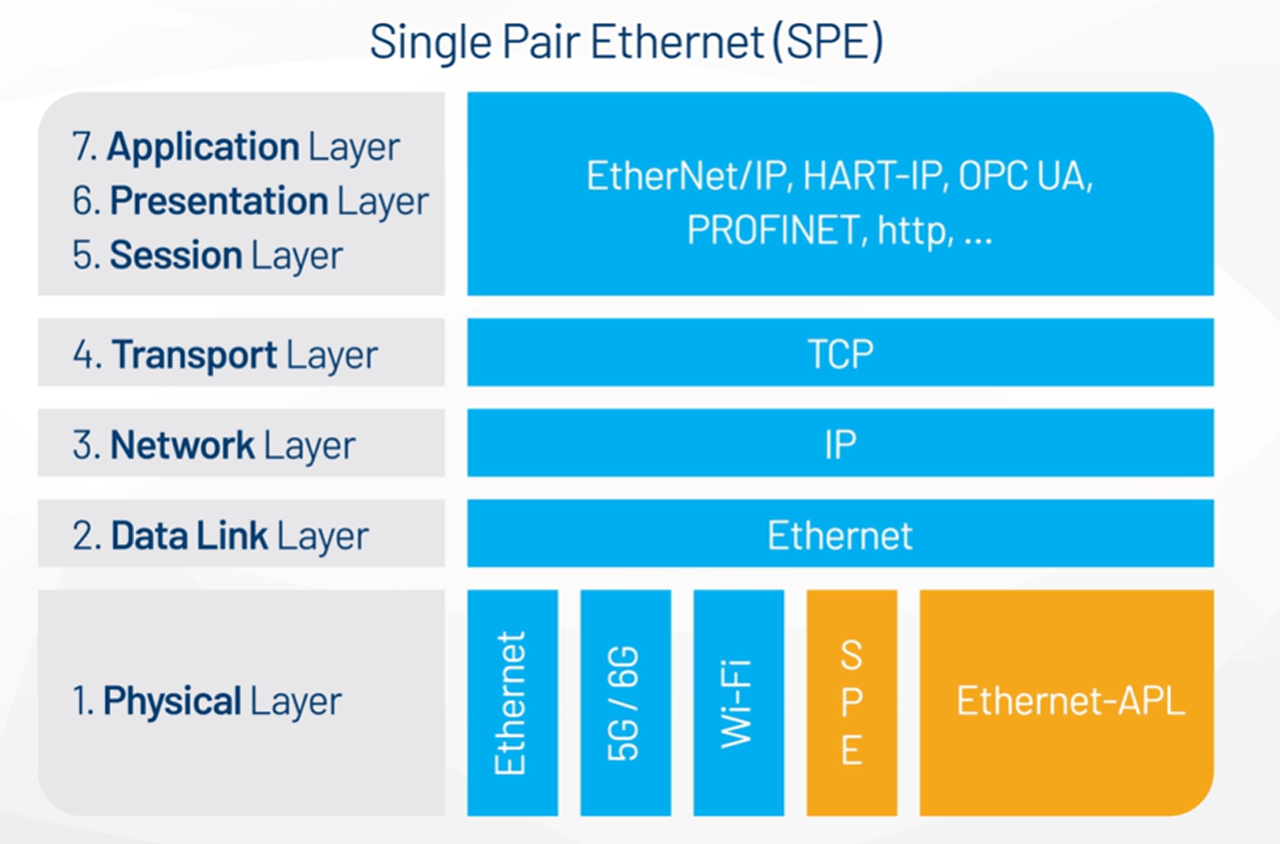
Ethernet-APL becomes a compelling physical layer addition to the Single Pair Ethernet (SPE) technology ecosystem.
SPE technology developments
Beydoun said that new specifications that allow for additional capabilities and expansive application coverage of automation industries across process, hybrid, and discrete are important to acceptance of SPE overall. An example of this is the EtherNet/IP In-Cabinet specification that utilizes 10BASE-T1S and a flat cable to connect contactors, push buttons, and motor starters via Ethernet to the network.
EtherNet/IP In-Cabinet enables quicker installation times via reduction in wiring, which is also beneficial from a sustainability perspective.
Furthermore, newly available diagnostic information for the simplest of devices will make troubleshooting much easier. EtherNet/IP In-Cabinet will also enable additional asset information and parameterization capability, automatic node topology discovery, and plug and play device replacement. The connection of devices with the smallest physical footprint and most limited hardware resources devices to the EtherNet/IP network can help reduce incidents of unplanned downtime, improve the efficiency of existing assets. and reduce the need for secondary lower-level networks.
Applications and markets
Beydoun said that heavy process industries such as chemical and oil & gas will see significant benefits from Ethernet-APL due to the intrinsic safety advantages afforded by 2-WISE (2-Wire Intrinsically Safe Ethernet). 2-WISE allows APL to be used in hazardous areas up to Zone 0/1 and eliminates complex safety calculations by setting predefined electrical limits based on device usage.
Hybrid markets such as food and beverage and pharmaceutical that have hazardous production areas will also see significant value from adopting Ethernet-APL. Additional industries such as woodworking, metalworking, mining, and recycling can also potentially benefit from Ethernet-APL due to the hazardous airborne dust, fumes, and/or particulate matter that can be generated during manufacturing, processing, and material handling.
“It’s important to note that each standard development organization in the Joint Ethernet-APL Working Group can test a devices Ethernet-APL physical layer and will accept the test results from any other organization,” Beydoun said. “This cooperation ensures a high standard of quality and physical layer interoperability while also streamlining the device development process to provide system integrators and end users with a broad choice of field devices. ODVA offers conformance testing for EtherNet/IP over Ethernet-APL, EtherNet/IP over SPE, and EtherNet/IP In-Cabinet devices.”
Anticipated Ethernet APL standardization impact
Beydoun said that Ethernet-APL has already been successfully deployed in production environments and interest is growing globally. Training sessions for end users have been taking place in Asia, Europe, and North America to meet the demand for education on this new technology. New Ethernet-APL devices are currently in development and in the next couple of years we will see a shift from early adoption to mainstream users as the incremental value and ease of use of Ethernet within field devices becomes clear.
“Plants that run on Ethernet-APL will be able to have will take advantage of quick and efficient commissioning with communication established automatically on power up, have newfound insight into device health, and be able to support more powerful and efficient devices that monitor multiple process variables,” Beydoun said.
“Enhancements are also underway that will improve the speed to 100Mbit/s for 2-wire Ethernet applications (100BASE-T1L) making Ethernet-APL even more powerful and capable of handling multifunction process devices with increased onboard processing capabilities in the future.”

“Ethernet-APL builds on the SPE standard 10BASE‑T1L by defining a complete and application-ready physical layer—covering power, cables, connectors, hazardous area protection, installation rules, and conformance testing—supported by a comprehensive engineering guide,” — Raj Rajendra, portfolio sales specialist, Siemens Industry.
Application-Ready Physical Layer
Power, cables, connectors, hazardous area protection, installation rules and conformance testing.
According to Raj Rajendra, portfolio sales specialist at Siemens Industry, IEEE Single Pair Ethernet (SPE) standards enable Ethernet communication at various speeds and distances for many applications including vehicles, manufacturing, buildings, data centers, and process automation.
“Ethernet-APL builds on the SPE standard 10BASE‑T1L by defining a complete and application-ready physical layer—covering power, cables, connectors, hazardous area protection, installation rules, and conformance testing—supported by a comprehensive engineering guide,” Rajendra said. “It also standardizes terminals, connectors, and even connection order, making installation simple and consistent for process industry deployments.”
New opportunities for industrial digitalization
“The Unified Ethernet Standard, encompassing Ethernet APL and SPE, is revolutionizing industrial digitalization by bridging the data gap between operational technology (OT) and information technology (IT),” Rajendra said. “This enables seamless, end-to-end IP communication from field devices to the cloud, fostering real-time insights and simplified architectures.”
“It’s foundational for the Industrial Internet of Things (IIoT), allowing massive connectivity and power over data line (PoDL) for efficient device integration. This enhanced data flow empowers data-driven decision-making, supporting predictive maintenance, optimized processes, and better energy management,” Rajendra said.
Furthermore, the standard future-proofs industrial networks with higher bandwidth, improved cybersecurity, and greater flexibility. Ethernet APL offers intrinsic safety and long reach for hazardous environments, while SPE provides compactness and cost-effectiveness for widespread device connectivity. In essence, it’s simplifying industrial networks and accelerating the adoption of smart factories.
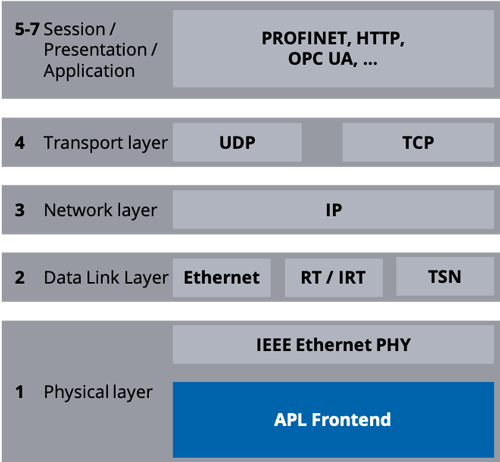
Ethernet-APL in Profinet Networks. https://us.profinet.com/digital/apl/
Technical benefits smart manufacturing operations
Rajendra said that the Unified Ethernet Standard (Ethernet APL/SPE) unlocks critical innovations for smart manufacturing. It enables hyper-connected, autonomous production systems by providing granular, real-time closed-loop control, allowing machines to communicate directly and adapt instantly.
It fosters ubiquitous edge intelligence, allowing devices to perform local analytics and make immediate decisions, reducing latency and enabling distributed control. This standard facilitates true digital twin realization and synchronization by feeding high-fidelity, real-time data to virtual replicas, leading to advanced predictive maintenance and process simulation.
Furthermore, it supports flexible and reconfigurable manufacturing through simplified “plug-and-play” integration, crucial for mass customization and rapid line changes. Finally, it enhances worker safety and human-robot collaboration by enabling dynamic safety zones and intuitive interfaces. This standard is the foundation for adaptive, resilient, and truly smart factories.
SPE technology developments
“The significance of SPE technology developments, potential bandwidth improvements, and support for a range of factory connectivity options is paramount for the widespread acceptance of these standards,” Rajendra said.
He said that SPE developments are game-changers for the “last meter” of connectivity. Its cost-effectiveness, compact cabling, simplified installation, and PoDL make it economically viable to connect vast numbers of simple sensors, which is crucial for ubiquitous IIoT. Without SPE, connecting these devices via Ethernet would be too expensive, hindering adoption.
“Potential bandwidth improvements are essential for future-proofing. While current SPE speeds suffice for many tasks, the inherent scalability of Ethernet ensures the standard can meet future demands from high-resolution vision, edge AI, and complex control, assuring manufacturers that their long-term investments are secure,” Rajendra said.
“Finally, supporting a diverse range of factory connectivity options (APL for process, SPE for discrete/edge, traditional Ethernet for higher levels) is critical for versatility. This comprehensive approach allows manufacturers to deploy the optimal Ethernet physical layer for each specific application, replacing fragmented fieldbuses with a unified, IP-based network. This flexibility and completeness are indispensable for broad industrial acceptance,” he added.
Technology Adoption
Rajendra said that the Unified Ethernet Standard (APL/SPE) will see significant adoption across various sectors. Process industries (Oil & Gas, Chemical, Pharma) will embrace Ethernet APL for hazardous areas, long distances, and intrinsic safety, replacing legacy fieldbuses. Discrete manufacturing (Automotive, Machine Building, Logistics) will rapidly adopt SPE for cost-effective, compact connectivity of countless sensors and actuators, enabling hyper-connectivity for IIoT. Additionally, building automation and even transportation will leverage SPE’s benefits.
Certification efforts are absolutely critical for successful system integration and widespread acceptance. They ensure interoperability between devices from different vendors, reduce risk and complexity for integrators by guaranteeing tested components, and build trust and confidence for end-users. Certification fosters a healthy, competitive market and simplifies maintenance, making the promise of a truly unified, seamless industrial network a reality.
Future of Ethernet-APL standardization
“The Unified Ethernet Standard (APL/SPE) is poised for broad adoption across diverse industries, as stated in the previous response,” Rajendra concluded. “As brownfield modernizers are upgrading old systems, greenfield innovators building new smart factories, machine builders integrating advanced connectivity, and system integrators implementing these solutions increasingly adopt Ethernet APL, it will speed up the entire commissioning process and simplify data movement from the plant floor to edge and cloud analytics systems.”