

TechnologyJune 8, 2026
AI-Driven Machine Vision Systems with NVIDIA GPU Performance
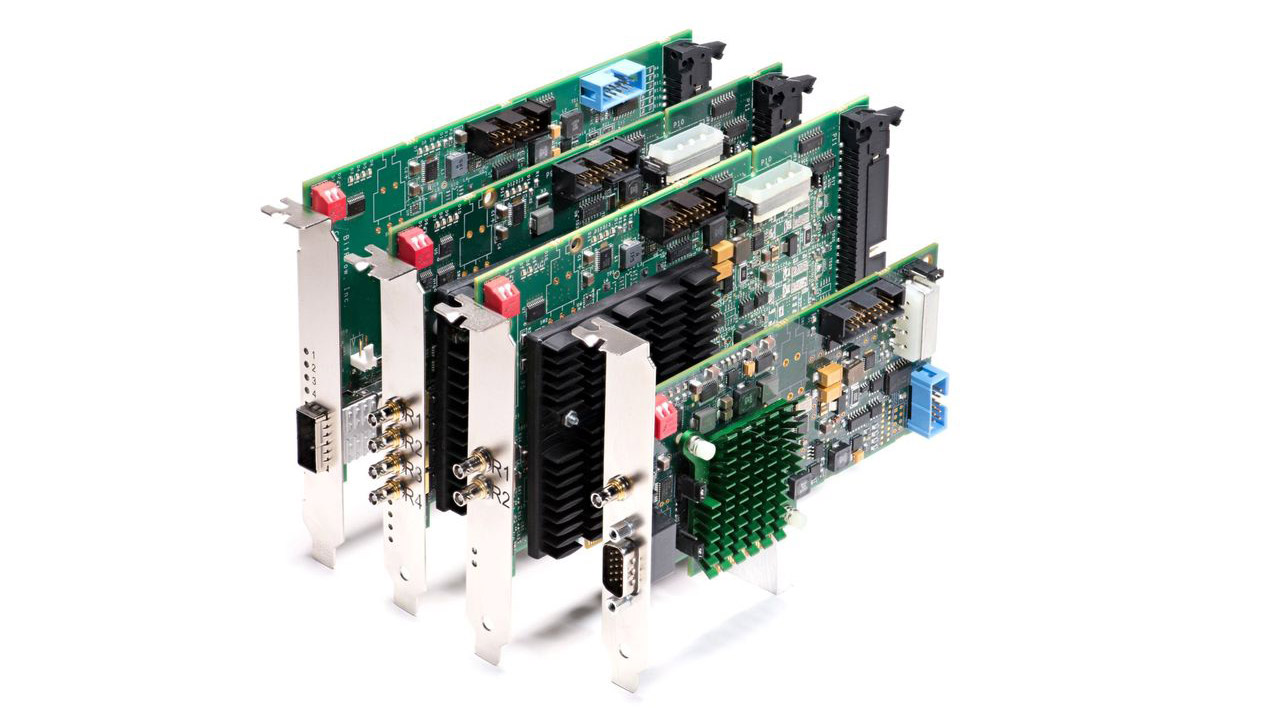
BitFlow Claxon Frame Grabbers accelerate AI-Driven machine vision systems with NVIDIA GPU performance. Full CoaXPress 2.0 throughput and direct GPU integration put real-time AI Inference within reach of vision engineers.
BitFlow Claxon CoaXPress frame grabbers (above) capture high-speed video and image data from machine vision cameras.
BitFlow, a world leading manufacturer of industrial frame grabbers and a division of Advantech, has announced the full production availability of its Claxon CXP-12 frame grabbers purpose-built for high-speed machine vision systems integrating NVIDIA GPU-accelerated AI inference. The Claxon lineup spans five models — from the single-link Claxon CXP1 and quad-link Claxon CXP4 to the long-reach Claxon Fiber — giving system designers flexible solutions for every deployment scenario.
Artificial intelligence vision pipelines running on NVIDIA GPUs can deliver hundreds to thousands of TOPS in low-precision inference, enabling hundreds of images per second on real-time models like YOLO, with somewhat lower throughput on models like RetinaNet depending on the specific GPU and optimizations. Yet even the fastest GPU will sit idle if image data cannot reach it quickly enough. Standard GigE Vision is limited to ~1 Gbps, while 10 GigE Vision tops out at 10 Gbps. USB3 Vision offers only a fraction of that. CoaXPress 2.0 (CXP-12), by contrast, delivers 12.5 Gbps per link over standard coaxial cable, with link aggregation scaling to 50 Gbps across four links — five times the throughput of 10 GigE Vision and without the variable latency and overhead of Ethernet network stacks.
BitFlow’s Claxon frame grabbers are built on the CXP-12 standard from the ground up. Each board implements the full CoaXPress 2.0 specification, not a subset, which means system designers gain access to every capability the standard offers: simultaneous multi-camera capture, Power Over CoaXPress (13W per link), a 41.6 Mbps low-speed uplink for camera control, and full GenICam support for standardized camera configuration. The result is a deterministic, high-bandwidth data path that feeds GPU memory at the rate modern AI models demand.
“A machine vision system designer can only experience the full potential of CXP 2.0 by having access to all its capabilities,” Donal Waide, Director of Business Development – iService, BitFlow. “With the Claxon family paired to an NVIDIA GPU platform, the image data path finally matches the inference engine’s appetite. There is no artificial ceiling on throughput.”
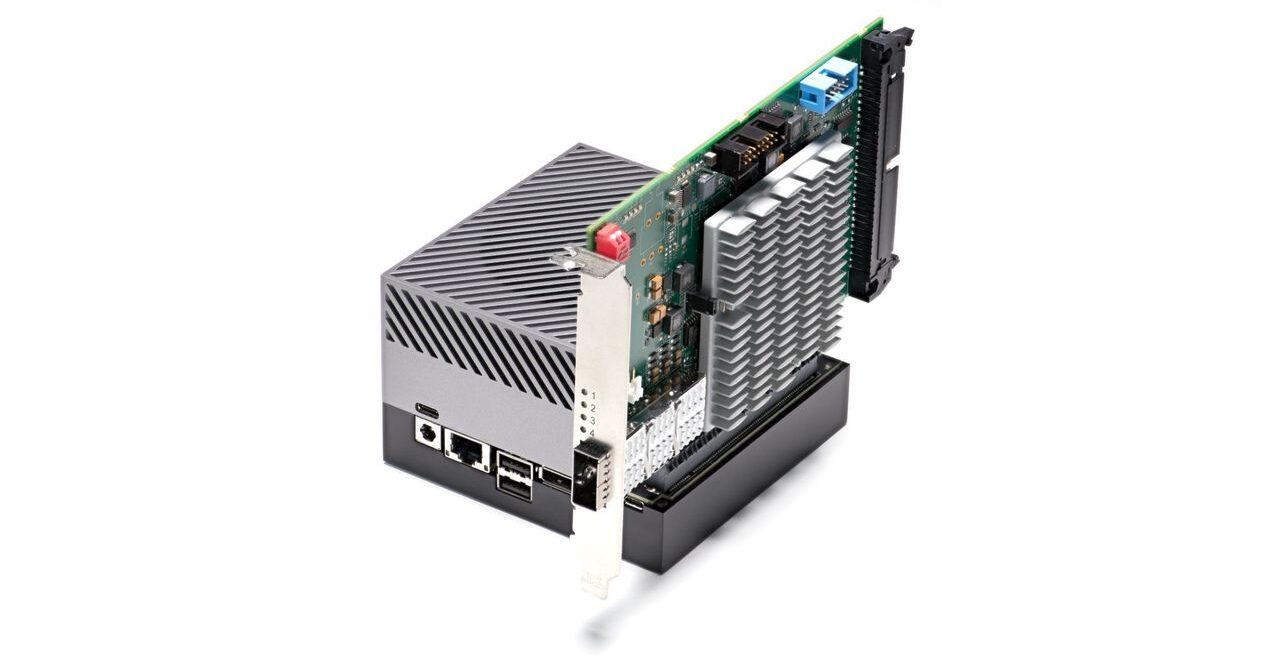
The BitFlow AArch64 (64-bit ARM) SDK enables integration of BitFlow Claxon frame grabbers with the NVIDIA Jetson AGX Orin Developer Kit.
One Architecture. Every Application.
The BitFlow Claxon family’s half-size, low-profile x8 PCIe Gen 3 form factor slots directly into standard workstations, compact industrial PCs, and NVIDIA GPU platforms. In addition, Advantech offers several AI inference systems and industrial computers that are designed to be compatible with BitFlow frame grabbers, particularly for high-speed machine vision applications. Several Advantech AI inference systems and industrial computers feature NVIDIA GPUs or support NVIDIA GPU expansion for processing.
Engineers selecting a Claxon board choose the channel count that matches their camera configuration, not a board constrained by arbitrary feature cuts:
Claxon CXP1 — Single-link CXP-12 at 12.5 Gbps. The right choice for high-resolution single-camera inspection cells where PCIe slot count is at a premium.
Claxon CXP2 — Dual-link CXP-12 supporting two single-link cameras simultaneously at 12.5 Gbps each, or one dual-link camera at a combined 25 Gbps. Ideal for stereo vision, dual-angle inspection, and 3D reconstruction workloads.
Claxon CXP4 — Quad-link CXP-12 supporting four single-link cameras (12.5 Gbps each), two dual-link cameras (25 Gbps each), or one quad-link camera at 50 Gbps aggregate. With four cables and four CXP-12 cameras active, the maximum data transfer rate reaches 5 GB/s — the highest single-board acquisition rate in the industry. This board is available in two options to accommodate current demand. Both options, while identical in format, make use of an Altera and a Xilinx FPGA design.
Claxon CXP4-V — Architecturally identical to the CXP4 but equipped with active ventilation to manage FPGA thermal output in small-form-factor, fanless industrial computers where natural airflow is insufficient. A field-proven design for embedded AI vision nodes deployed in harsh environments.
Claxon Fiber (CoF) — Extends CoaXPress over QSFP+ fiber cable assemblies, supporting one quad-link, two dual-link, or four single-link CoF cameras at distances exceeding one mile. Fiber is immune to electromagnetic interference, making the Claxon Fiber the preferred choice for vision systems operating near high-voltage equipment, in broadcast facilities, or within large-scale factory floors where coaxial cable runs are impractical.
From Camera to CUDA: Closing the Loop on AI Inference Latency
Claxon frame grabbers are engineered to integrate directly with NVIDIA GPU platforms, including systems built on the NVIDIA Jetson AGX Orin. In a validated reference design with Advantech’s MIC-733-AO AI edge computer, the Claxon CXP4 and Claxon Fiber boards connect to an optional PCIe x8 iModule that slots directly into the NVIDIA Jetson carrier, placing frame-accurate image data on the GPU memory bus with minimal CPU intervention. NVIDIA TensorRT inference pipelines then operate on live image buffers without the memory-copy overhead that plagues USB or GigE-based designs.
For data center-class GPU workstations running NVIDIA RTX or Data Center GPU families, the Claxon’s PCIe Gen 3 x8 bus interface feeds image data directly into GPU-accessible system memory via BitFlow’s SDK, which supports buffer management APIs in C, C++, C#, and Python. Computer vision engineers can pipe raw image buffers into CUDA processing kernels, PyTorch data loaders, or TensorRT execution engines with minimal latency added at the acquisition stage.
Software That Doesn’t Make Integration a Second Job
The BitFlow SDK supports both Windows and Linux, covering the breadth of operating environments found in modern AI vision deployments. Drivers are available for leading third-party vision environments including HALCON, LabVIEW, VisionPro, and MATLAB. Full GenICam compliance means any GigE Vision-standard camera configuration tool works with Claxon-connected cameras out of the box. Critically, the Claxon’s architecture is a direct evolution of BitFlow’s prior-generation Cyton CXP platform — users migrating from CXP 1.1 systems can swap in Claxon boards and retain existing software without rewriting acquisition code or reconfiguring triggering logic.
For integration support, technical documentation, and SDK download, visit www.bitflow.com.