

TechnologyNovember 21, 2026
The Real Cost of Getting Data off the Factory Floor
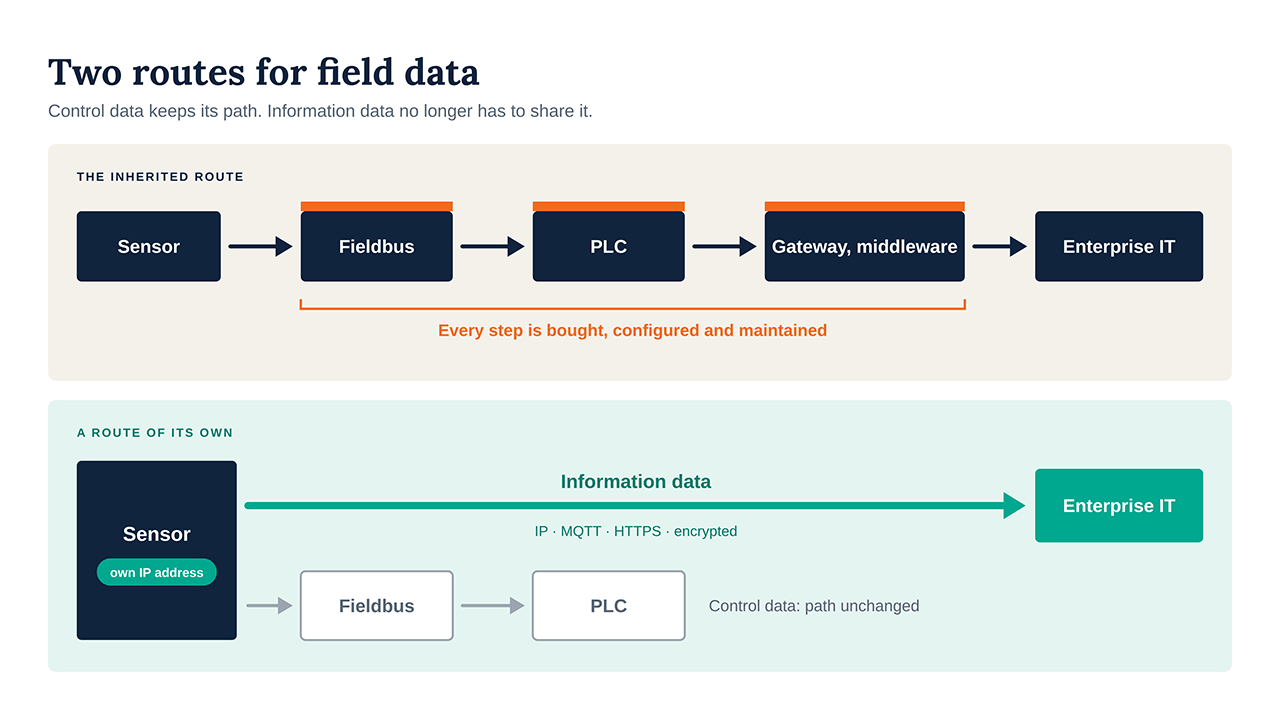
For thirty years the question was which architecture to use to move field data upward. Which fieldbus, which gateway, which middleware. There is now a prior question. Does this data need to enter the control architecture at all?
For a generation, industry has treated the cost of moving factory data as the natural price of automation. It was never natural. It was the price of having only one road.
Every automation project has a line item that nobody writes down. It is not the sensors. It is not the PLC. It is not the machine. Those costs are visible, budgeted and argued over. The line item nobody itemises is the cost of getting the data out: off the sensor, past the controller, and into the systems where it turns into a decision.
That cost is real. It is paid every year, on every line, in every plant. And because it has been paid for thirty years, most people have stopped seeing it as a cost at all. It looks like the weather. It looks like how things are.
It is not how things are. It is a tax. And for the first time, it is optional.
Where the tax comes from
The tax is collected in three places. The first is the ecosystem. Field-level communication is organised around a handful of industrial protocol families, each with its own governing body, conformance regime and installed base. By HMS Networks’ 2026 analysis, industrial Ethernet now accounts for 79 percent of newly installed nodes, led by PROFINET at 30 percent, EtherNet/IP at 25 and EtherCAT at 20. Fieldbus still carries 14 percent. But consolidation is not convergence. Those three are mutually incompatible, so a device maker selling across them still has to implement each stack, certify the products, maintain parallel variants of the same device and keep the expertise on staff to support all of them. None of that appears on the invoice a plant receives. It is priced into the hardware.
The second is integration. Industrial Ethernet shares more and more of its underlying technology with enterprise IT, but getting sensor data into business applications still usually means gateways, middleware or protocol translation, and the engineering time to configure and maintain them.
“Every translation step between the sensor and the IT system is something you have to buy, configure and maintain,” says Dr.-Ing. Karsten Walther, co-founder and CEO of Perinet. “If the device speaks the IT protocols itself, that step is not needed.”
The third is people. A proprietary ecosystem needs specialists, training, and spare parts that fit nothing else. Over a plant’s life, this is often the largest part of the bill and the hardest to see, because it is spread across salaries, service contracts and stock rooms rather than a single purchase order.
None of this was a mistake. Fieldbus technology solved a genuine and difficult problem. It brought deterministic, reliable control to the factory floor when nothing else could, and for that job it still works.
The point is not that the architecture was wrong. The point is that we quietly gave it a second job it was never designed to do.
Why it stayed invisible
A cost becomes invisible when there is no choice. If there is only one way to get data off a device, and that way runs through the control network in the control network’s language, then the price of it is not really a decision. It is just what data costs. It disappears into the baseline.
For most of industrial automation’s history, a sensor’s data travelled the same path as control: up through the fieldbus, into the PLC, across a gateway, and only then into IT. The cost of that route was invisible not because it was small, but because it was unavoidable.
What changed? Two things changed at roughly the same time.
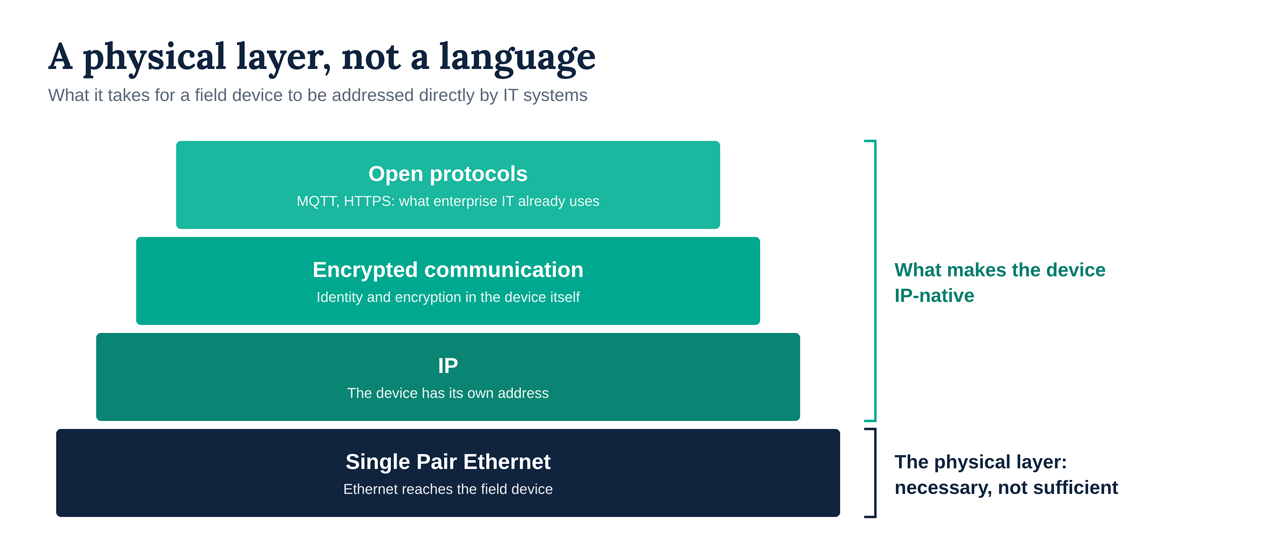
The first is Single Pair Ethernet, standardised by the IEEE. “The important thing about Single Pair Ethernet is the smaller electronics,” says Walther. “Now it is possible to bring the real network to smaller devices like sensors.” Ethernet spent two decades working its way down the automation pyramid level by level. SPE is the step that finally reaches the field.
But Ethernet at the field level is a physical layer, not a language. Getting Ethernet there does not, by itself, let a sensor speak to enterprise IT. The second change is what runs on top of it. When a field device carries a full network stack of its own, meaning an IP identity, encrypted communication and the open protocols enterprise IT already uses such as MQTT and HTTPS, it stops being something that must be polled and translated through a gateway. It becomes a device IT systems can address directly. That is where the tax actually falls away: not at the physical layer, but at the device becoming IP-native.
This is not one vendor’s reading of where things are going. HMS Networks, whose own business is built largely on bridging these protocols, describes the 2026 market as one where the protocol question is substantially settled, and where “the conversation shifts from ‘which protocol?’ to ‘what is running on top of it?’” Its regional analysis names Single Pair Ethernet in both Europe, for sensor-level connectivity, and North America, where it describes adoption as gaining clear momentum.
What changes as a result is narrower than it sounds. The existing sensors stay. The machines stay. The control logic stays, and so, in most plants, do the fieldbus, the PLCs and the IO-Link masters that run them. A direct IP path rips none of that out. What it removes is not equipment at all. It is an assumption: that every piece of field data has to travel through the control architecture before IT is allowed to use it. That assumption is the tax. It made sense when control was the only road. It stops making sense the moment the data has a road of its own.
The question has changed
For thirty years the question was which architecture to use to move field data upward. Which fieldbus, which gateway, which middleware.
There is now a prior question. Does this data need to enter the control architecture at all?
For control data the answer is usually yes, and should stay yes. A safety interlock, a motion command, a closed loop: these belong in the control path, running deterministically on the PLC where they always have. But much of the additional data a modern plant now wants is not control data. It is temperature, vibration, pressure, energy consumption, machine state: the condition and process data that feeds OEE dashboards, analytics and AI models. That data has been climbing the control hierarchy out of habit, not necessity, because until recently there was no other way out.
Much of that data is never used. When McKinsey examined an oil rig carrying 30,000 sensors in 2015, just 1 percent of the data was ever looked at, and that served mostly to detect anomalies rather than to optimise or predict. Better connectivity alone would not have solved that. But it is difficult to use data that cannot easily reach the systems capable of analysing it.
The line between the two kinds of data is not a wall. Some condition data does loop back into control: a vibration threshold that trips a shutdown, an edge model that adjusts a setpoint. Where it does, it belongs in the control path.
A direct IP path is not free. It still needs networking, security and device management, and where the existing controller already exposes the data, there may be little reason to change anything. The question is whether each new data requirement should automatically inherit the cost and complexity of the control architecture.
Security points the same way
When each device carries its own identity and encrypted communication from the field level up, security is built into the device rather than bolted onto a gateway. That matters now for a concrete reason. The vulnerability and incident-reporting obligations of the EU Cyber Resilience Act have been in force since 11 September 2026, and the regulation applies in full from 11 December 2027.
“Security has to start in the device,” says Walther. “If the data is only protected from the gateway upwards, the first part of the path is open.”
HMS Networks’ 2026 industry survey found cybersecurity now cited by nearly half of respondents as a top integration challenge, with 93 percent expecting OT cybersecurity to change substantially over the next five years. Device-level security does not make a plant CRA-compliant on its own. Compliance is a process, not a component. But an architecture in which security lives in the device is a stronger starting point than one in which it depends on a layer of translation the data has to survive first.
The tax was always going to end
The interesting thing about an invisible tax is what happens when it becomes visible. Once a cost has an alternative, it stops being the baseline and goes back to being a choice.
The industry is not about to abandon its control architecture. It is about to stop asking that architecture to carry data it was never meant to carry. The companies that see the distinction first will be the ones that stop paying for it first.
Ben Jones, Head of Marketing, Perinet GmbH