

TechnologyNovember 21, 2026
Security at the Edge: Balancing Cloud Intelligence with Control
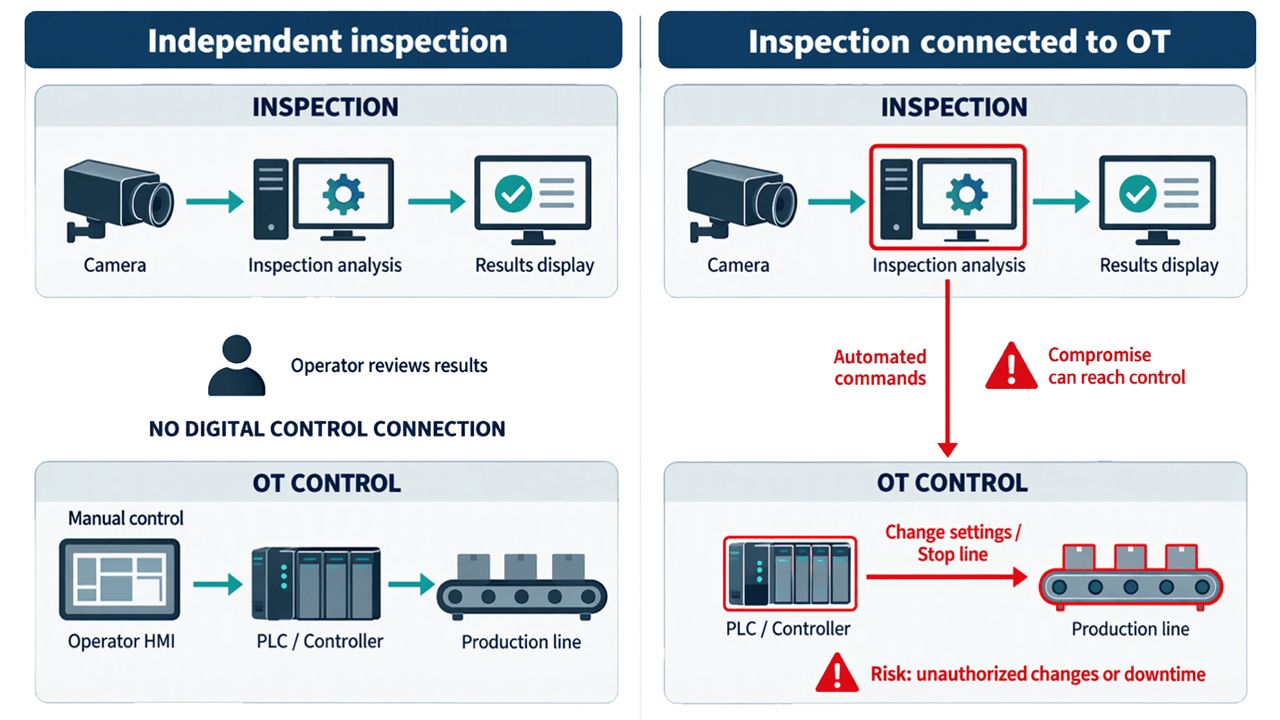
Edge computing puts processing close to the equipment or process generating the data. Cloud services provide another place for analysis, storage, and capabilities shared across operations. Neither approach, on its own, tells us whether a particular design is right for the plant.
For years, the security approach in many operational technology (OT) environments was straightforward: keep them isolated. As a security practitioner, I understood the appeal. Many legacy systems were difficult to patch, and connecting them to external networks introduced risks that plant teams had little reason to accept. Isolating OT made the security discussion simpler. It did not necessarily help the business do more.
Manufacturers now want better visibility into production, more effective processes, and information they can use across facilities. Those are reasonable goals. The people running a plant need to make an acceptable product, operate safely, and meet customer commitments. If edge and cloud capabilities can help them do that, our job in security is to help them understand the benefits and risks, not simply explain why connecting them is a bad idea.
That does not mean every integration should go ahead. It means starting with the process and asking useful questions. What decision are we trying to improve? How quickly does it need to happen? What happens to production if the service fails or provides the wrong answer? I would rather have those conversations while the design is still on a whiteboard than after the plant has come to depend on it.
Start With the Process, Not the Destination
Edge computing puts processing close to the equipment or process generating the data. Cloud services provide another place for analysis, storage, and capabilities shared across operations. Neither approach, on its own, tells us whether a particular design is right for the plant. The important question is what the operation needs from it.
I find it useful to separate those needs into three functions: analysis, advisement, and control. Keep time-critical control and safety functions within an appropriately engineered local architecture. Use edge applications where local advisement supports timely decisions. Consider cloud services where the value comes from comparing data across facilities, examining historical patterns, or developing analytical models. The point is not to pick a favorite technology. It is to put each function where it can best meet the process requirements.
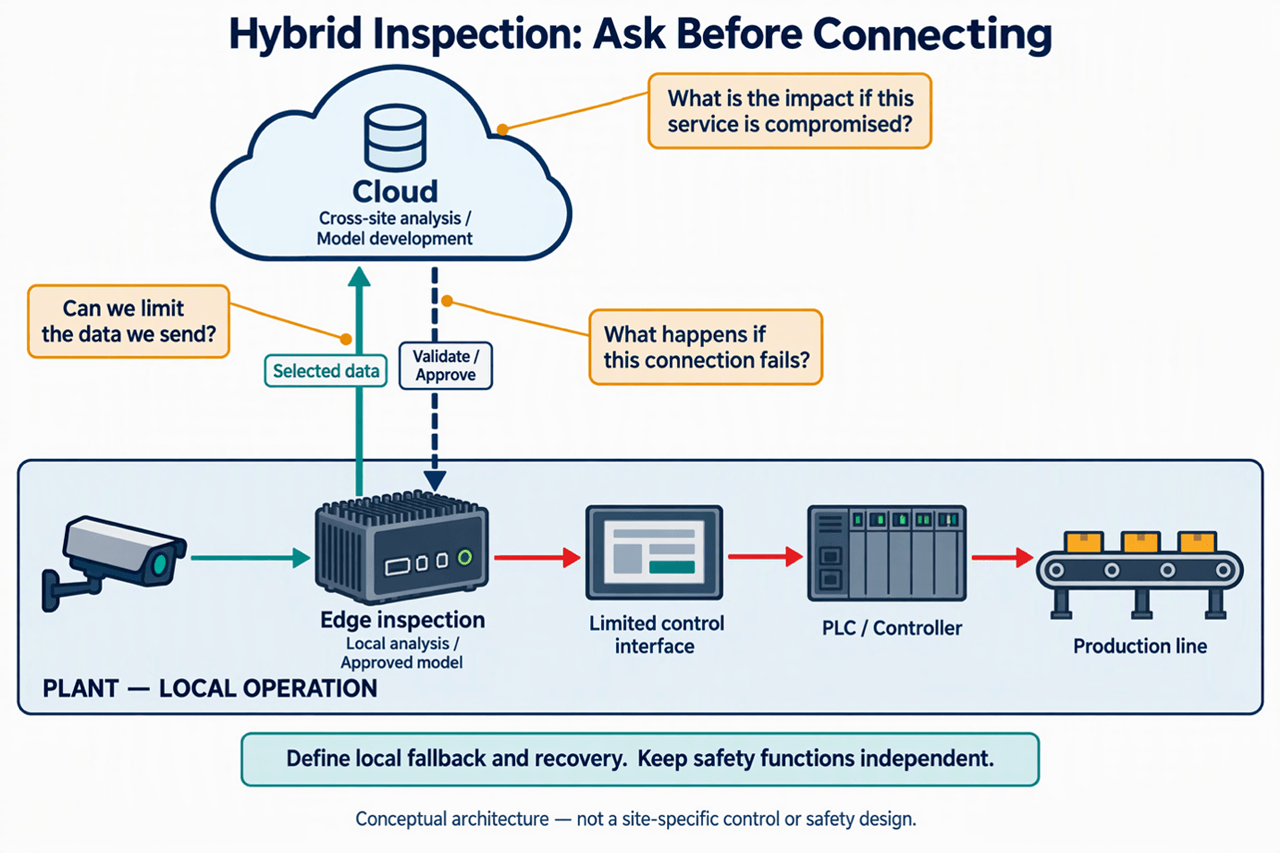
Figure 2. A hybrid inspection approach keeps analysis local while selected data supports cloud analysis and model development. The callouts highlight key design questions. Control commands pass through a limited local interface; safety functions remain independent. Conceptual illustration, not a site-specific engineering design.
One Inspection Use Case, Very Different Risks
Consider a hypothetical camera-based inspection system on a manufacturing line. The camera collects images independently of the control system and sends them to a cloud service for analysis. An operator reviews the results and decides whether to act. The inspection application does not have a digital connection that allows it to change the process. If the service goes down, the team loses that analysis. Whether production can continue depends on what the inspection is required to do and what alternatives are available.
Now give that same cloud application permission to send instructions to the controller. It can reject a product, change a setting, or stop the line. We may still call it an inspection system, but we have changed its role. It is no longer just providing information to a person. It has become part of the control path. An incorrect result, delayed response, or compromised service now introduces an entirely different set of risks.
A hybrid approach offers another option, and this is where edge solutions may fit. An edge application analyzes images locally using an approved model. Selected images and results go to the cloud for further analysis and model development. If the application needs to act automatically, its commands pass through a local interface with defined limits and appropriate validation. A candidate model from the cloud should be validated and approved before it is used locally. Safety functions remain independent of the analytical application.
I would ask the team to explain whether the application analyzes, advises, or controls. That simple distinction can tell us more about the risk than the fact that it uses AI. Moving from one role to another deserves a new review. Giving an application the ability to stop a line is not a minor enhancement simply because it takes only a small software change.
Three Questions to Ask Before Connecting
1. What if the external service is compromised?
I prefer to begin by assuming that a supplier account, application, or connection has been compromised. This is not a prediction about a particular provider. It is a way to test the design without relying on everything going as planned. What could an attacker actually see or change? Could they view images, alter results, distribute a model, or issue commands to production equipment? Explain the consequence to the people running the process, then discuss which controls would limit it.
Network separation and restricted access belong in that early discussion. ISA/IEC 62443 provides a risk-based framework for securing industrial automation and control systems. Part 3-2 addresses risk assessment, dividing systems into zones and conduits, and documenting security requirements. For an edge–cloud project, use that approach to make the boundaries and permitted communications clear. A cloud connection should have a defined purpose, not become an open invitation to the rest of the control environment.
Being allowed to read information is not the same as being allowed to change a process. If the application needs write access, ask why it is needed, what it can change, and what limits apply. Can it recommend a setting rather than apply it? Can a local interface restrict the commands it accepts?
Can the team disconnect the external service without losing necessary local control? An operator reviewing a recommendation creates a different boundary from an application acting automatically, but neither removes the need to examine what could go wrong.
2. What happens when the system goes down?
Moving an application to the cloud does not make the availability question disappear. It changes the dependencies we need to understand. A local failure might affect one line. The loss of a shared service or connection could affect several facilities. I would ask the team to walk through both situations rather than assume that a resilient cloud platform makes the whole process resilient.
In the hybrid example, can the edge application continue inspecting when the cloud connection is lost? For how long, and with which capabilities?
What happens if the edge device itself fails? The answer might involve manual review, slower production, holding product, or stopping safely. That decision belongs with the people who understand the process and its quality and safety requirements. Continuing to run without a required inspection is not a successful fallback.
Then test the agreed response under conditions approved by operations and engineering. Wanting to prove resilience is not permission to experiment on a running production line. Verify what operators see, what continues locally, and how recovery works. When the connection returns, what happens to stored data and old recommendations? Include continuity plans, backups, standby systems, and safe manual operation in those exercises. A recovery plan is more useful when the people expected to follow it have practiced.
3. What data actually needs to leave the plant?
Before sending information to the cloud, ask what the application actually needs. In our inspection example, selected defect images and results may be sufficient; a continuous stream of every image may not be necessary. Start with the business purpose, identify the minimum data needed to support it, and ask the team to explain any additional collection.
The discussion should go beyond storage and bandwidth. What could those images or process records reveal about products, production methods, or operations? Who can access them, how long will they be kept, and when will they be deleted? Local filtering can help enforce the boundary, but it does not make the business decision for us. The organization still needs to understand what it is sharing and why.
Start Early, Collaborate Often
These are easier conversations to have before anyone has spent months building a solution. Bring IT, OT, security, and integration partners together while the design can still change. Having been in the CISO’s position, I know how difficult it is to tell a team that a project they have worked hard on poses risks the organization cannot accept. No one wants that conversation to be the first meaningful discussion between security and the project team.
Early collaboration does not guarantee approval, and not every risk can be engineered away. It does give the team more options. A change in scope, a limit on control authority, or a workable local fallback may preserve the benefit while reducing the exposure.
You do not need everyone to become a controls engineer or security specialist. You need people who understand their part of the operation, are willing to listen, and can agree on what the design must protect. That is a better foundation for innovation than hoping the difficult questions will go away.
Chris McLaughlin, Vice Chairman of the ISA Global Cybersecurity Alliance (ISAGCA)