

TechnologyJuly 24, 2026
Edge AI as Operational Nervous System of Manufacturing
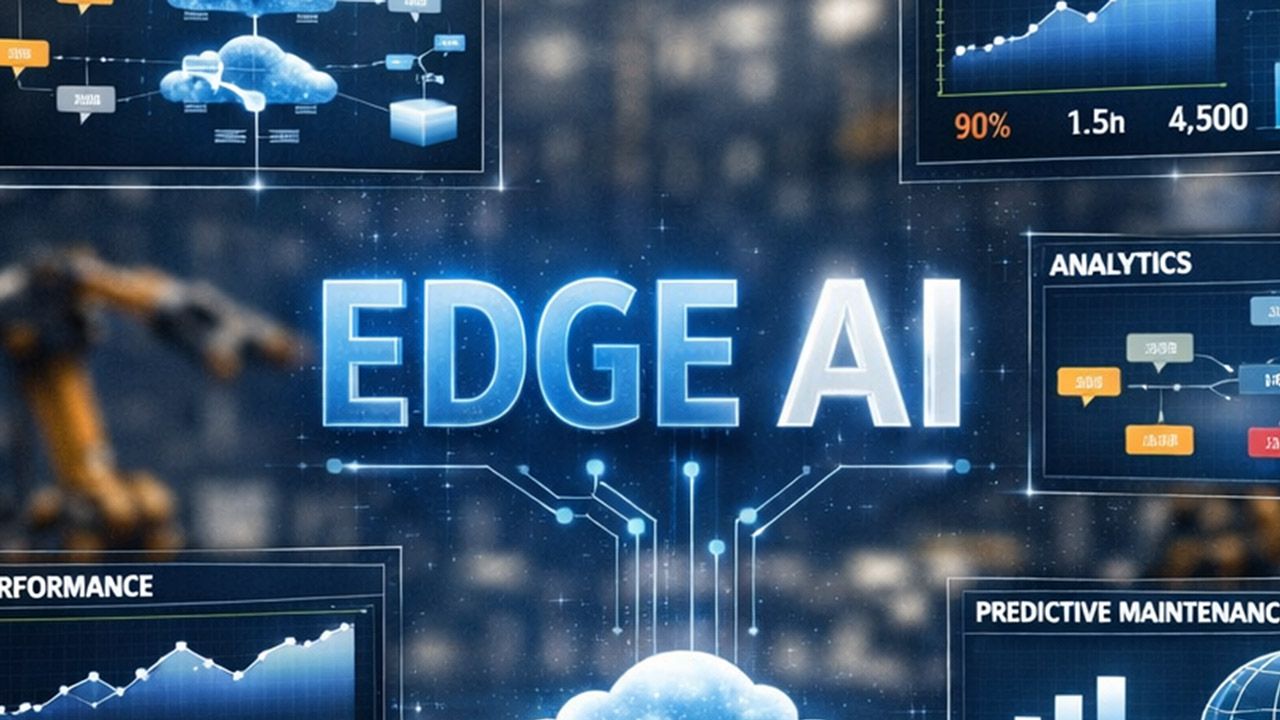
Edge AI is reshaping manufacturing by pushing intelligence directly onto machines, sensors, and production lines—unlocking faster decisions, lower costs, higher quality, and more autonomous operations. The shift is driven by latency constraints, labor shortages, rising costs, and the need for real‑time factory floor insights.
Edge AI is reshaping smart manufacturing by pushing intelligence directly onto machines, sensors, and production lines — enabling faster decisions, lower costs, and more autonomous operations. The core impact is real‑time responsiveness and reduced dependence on cloud infrastructure, which transforms how factories detect problems, optimize processes, and maintain equipment.
The key ways that Edge AI is impacting smart manufacturing include real‑time decision‑making, reduced latency and higher productivity and operational efficiency. But the bottom line is that Edge AI is becoming the operational nervous system of smart manufacturing, enabling factories to learn faster, respond instantly, and operate more sustainably.
In this special report, Industrial Ethernet magazine reached out to industry experts to get their perspectives on the current state Edge AI technology and what promises to be a bright future.
From Pilot to Production
Edge AI impact set to accelerate as manufacturers operationalize industrial AI with repeatable lifecycle processes.
According to Christian Zillner, Head of AI & Robotics Deployment at Siemens, “Edge AI is already making a measurable impact by enabling AI inference and analytics close to machines, where latency is low and production data can remain on-site. In practice, this shows up as faster root-cause identification, higher throughput, and reduced downtime- without heavy changes to existing automation.”
He said that, for example, Inpro (a joint company of Volkswagen and Siemens) monitored the healthiness of thousands of pneumatic clamps and classified failure cause by utilizing the Siemens Industrial Edge and AI architecture, reducing unplanned downtimes and increasing production availability.”
Zillner said that Industrial AI running on Siemens Industrial Edge is scaling beyond pilots through standardized deployment and monitoring. For example, Audi developed an AI model that reliably detects weld splatters on car bodies and implemented an easily scalable AI infrastructure using Industrial Edge and the Industrial AI Suite from Siemens.
Over the next few years, the impact will accelerate as manufacturers operationalize industrial AI with repeatable lifecycle processes—packaging, deployment, versioning, and monitoring—so industrial AI becomes a governed shopfloor capability rather than a one-off project.
Focus on Technology Solutions
Edge AI is expected to deliver new solutions wherever manufacturers need real-time decisions, scalable rollout, and robust operations. The most active technology areas include:
AI-based quality inspection at scale
- Audi’s weld spatter detection highlights automated inspection with standardized data flow, versioning, and secure deployment from cloud to shopfloor.
- In food production, Coppenrath & Wiese uses an AI-powered visual monitoring approach (Visual Inspection Cockpit on Industrial Edge) to handle highly variable natural products and scale across lines.
Predictive maintenance/condition monitoring
- Inpro created predictive maintenance for pneumatic clamps by monitoring the healthiness of the individual clamps and classifying failure cause with AI. This helps to reduce unplanned downtimes and increase production availability.
- Tetra Pak uses Predictive Service Analyzer on Industrial Edge to combine real-time condition monitoring with AI-driven analysis to predict failures and detect anomalies.
When asked about how Edge AI will provide technology that offers stronger cybersecurity solutions, IT/OT integration or influence real time decision making in factory applications, Zillner offered an optimistic outlook.
“Edge AI strengthens cybersecurity by keeping sensitive manufacturing data on-premises and reducing the attack surface through minimal network transmission. For secure operations the orchestration of devices as well as standardized connectivity, runtime and life cycle management are key,” Zillner said.
“This also enables IT-like standards to be applied in OT environments. Siemens Industrial Edge is specifically designed to bridge this critical gap between IT and OT, connecting shop floor devices seamlessly with enterprise systems while maintaining the reliability requirements of operational technology.”
For real-time decision making, Edge AI enables low-latency processing directly on the factory floor, allowing autonomous operations without cloud dependency and facilitating predictive maintenance through immediate failure prediction and prevention.
Edge AI delivers substantial additional impacts: It significantly reduces bandwidth costs by transmitting only relevant data to cloud systems while increasing operational availability since factories can continue functioning even without cloud connectivity. The technology offers a modular and scalable approach, allowing manufacturers to start with specific use cases and expand across the entire facility. Siemens’ app-based ecosystem provides pre-built AI solutions that accelerate deployment and time-to-value.
“Furthermore, Edge AI enables real-time digital twin integration for continuous optimization and drives sustainability improvements through optimized energy consumption and waste reduction. Essentially, Edge AI serves as a foundational technology that transforms traditional factories into intelligent, increasingly autonomous, and resilient production environments,” Zillner added.
Edge AI Adoption
Zillner said that “adoption is strongest where there’s clear ROI and a need to scale across many assets, especially automotive, consumer packaged goods, electronics, and machine building/OEMs.”
He said that automotive is moving quickly because quality and throughput gains are immediate: Audi’s AI-based weld spatter detection targets automated inspection across multiple lines and sites.
Consumer packaged goods is adopting Edge AI for inspection and OEE: Coppenrath & Wiese applies AI-powered visual monitoring for bakery products, while Perfetti Van Melle uses edge-based OEE monitoring and diagnostics across multi-vendor PLC environments.
OEMs/machine builders adopt Edge AI to create scalable digital services: Machine Builder Schuler uses Industrial Edge for centralized rollout of software/firmware across large installed bases, enabling new service models.
As far as timeframe Is concerned, many customers are implementing now via targeted use cases (inspection, condition monitoring, performance analytics), then scaling across lines/sites once governance and rollout processes are proven—typically a phased approach over months, not years.
From Pilot to Production
“In the next years, Edge AI’s biggest impact will be the shift from isolated pilots to repeatable, scalable industrial AI operations across factories and fleets. The “superior” advantage versus traditional architectures is the combination of low-latency local inference plus centralized lifecycle management,” Zillner said.
He said that Siemens’ Industrial AI on Industrial Edge portfolio supports this operationalization with AI Software Development Kit (packaging), AI Asset Manager (deployment + monitoring), and AI Inference Server (runtime) – helping standardize AI on the shopfloor.

“Edge AI already outperforms traditional rule-based automation in several areas because machine learning models can identify hidden patterns, detect anomalies earlier, and continuously optimize processes using live operational data. Compared with cloud-only AI approaches, edge-based AI offers lower latency, higher determinism, stronger cybersecurity, and improved resilience,” — Tom Hammerbacher, Manager Digital Factory at Phoenix Contact.
Enabling Technology for Smart Manufacturing
Bringing intelligence directly into the machine and production environment.
From the Phoenix Contact perspective, Edge AI is becoming a key enabler of smart manufacturing because it brings intelligence directly into the machine and production environment. Instead of sending all operational data to a cloud platform, Edge AI processes and analyzes data locally on industrial edge devices and controllers. This reduces latency, enables determined real-time reactions, and improves operational resilience.
Phoenix Contact’s PLCnext Technology and industrial edge portfolio support this convergence of automation, AI, and IT/OT integration by combining control, analytics, and open software environments within one ecosystem.
“Today, Edge AI already creates measurable value in predictive maintenance, anomaly detection, machine condition monitoring, intelligent energy management, and AI-supported quality inspection,” Tom Hammerbacher, Manager Digital Factory at Phoenix Contact, told Industrial Ethernet recently.
“In the future, we expect Edge AI to become a standard component of industrial automation architecture. Manufacturers will increasingly use AI at the edge to optimize production processes autonomously, reduce downtime, increase flexibility, and compensate for skilled labor shortages.
Combined with software-defined automation and open industrial communication standards, Edge AI will accelerate the transformation toward more adaptive, data-driven, and sustainable factories.”
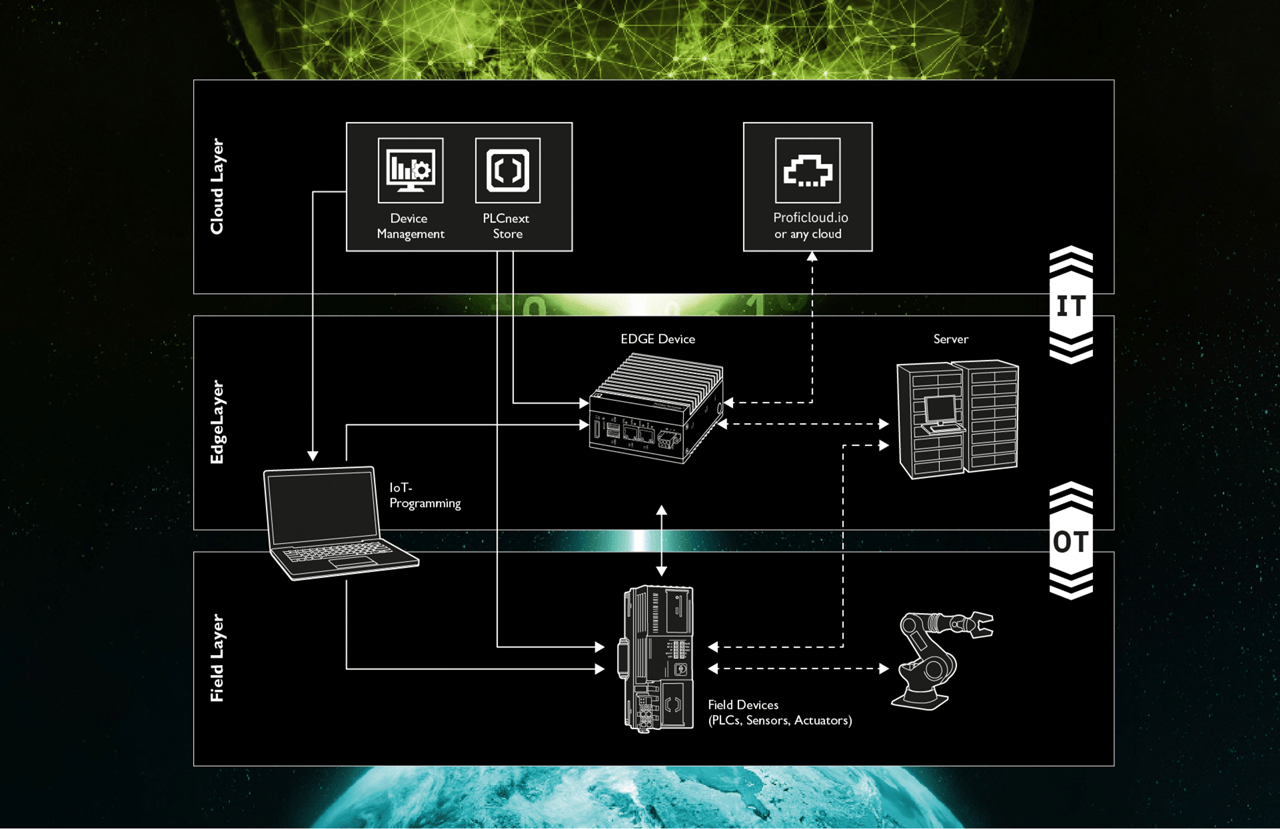
Edge AI provides a system architecture that coordinates activity between the Cloud Layer, the Edge Layer and Field Devices.
New Solutions for Smart Manufacturing
According to Hammerbacher, Edge AI is expected to drive innovation across several key areas of smart manufacturing. One major field is predictive maintenance and condition monitoring, where AI models running directly on industrial edge devices continuously analyze sensor and machine data to identify abnormalities before failures occur. This helps manufacturers minimize unplanned downtime, optimize maintenance schedules, and extend machine lifetime. Another important area is AI-based quality inspection, where vision systems and machine learning algorithms perform real-time defect detection directly on the production line without relying on cloud connectivity.
Open platforms like PLCnext Technology allow machine builders and plant operators to integrate PLC functionality, industrial communication, AI frameworks, and cloud connectivity within one scalable ecosystem. Additional growth areas include digital twins, virtualized control systems, and brownfield modernization where Edge AI enables intelligence to be added to existing production systems without replacing legacy equipment.
Potential Impacts
Edge AI provides technology that promises to offer stronger cybersecurity solutions, IT/OT integration and influence real‑time decision‑making in factory applications.
Hammerbacher said that, from a Phoenix Contact perspective, Edge AI significantly strengthens IT/OT integration, cybersecurity, and real-time operational intelligence. One major advantage is that sensitive process and production data can remain inside the factory instead of continuously being transferred to external cloud infrastructures. This improves data sovereignty and helps manufacturers address cybersecurity requirements. Open edge platforms additionally enable secure integration between industrial automation systems, enterprise software, and cloud-based analytics environments.
“Edge AI also has an impact on real-time decision-making because AI models can analyze live operational data directly at machine level and react immediately to changing process conditions. This enables faster diagnostics and autonomous response mechanisms that are difficult to achieve with centralized cloud-only approaches,” Hammerbacher said. “Beyond technical improvements, Edge AI can also help manufacturers address broader industrial challenges such as sustainability goals, energy efficiency requirements, supply-chain resilience, and shortages of qualified personnel by supporting operators with AI-assisted recommendations and automated optimization.”
Applications, Markets and Customers
Hammerbacher said that adoption of Edge AI is accelerating across industries where real-time operation, high system availability, and process optimization are critical business requirements. Early adopters include automotive manufacturing, machine building, semiconductor production, food and beverage, and pharmaceuticals. Phoenix Contact also sees increasing momentum within integrated energy solutions like renewable energy systems where decentralized intelligence and local data processing are becoming increasingly important.
Typical applications include predictive maintenance, AI-supported visual quality inspection, and anomaly detection in complex production environments. Machine builders are especially interested because Edge AI enables new digital service models such as remote diagnostics, condition-based maintenance, and “features on demand.” In addition, manufacturers operating brownfield facilities can integrate Edge AI without replacing existing machines by adding modern edge devices and open connectivity solutions. Many companies are currently moving from pilot projects toward scalable implementation. Phoenix Contact expects Edge AI to become a mainstream technology component in industrial automation over the next one to three years as deployment becomes simpler, more secure, and more cost-efficient through software-defined automation platforms.
The next 1-3 years
“Over the next three years, Edge AI is expected to evolve from isolated proof-of-concept deployments into a standard capability within industrial automation systems,” Hammerbacher said. “From a Phoenix Contact perspective, the biggest impact will come from combining AI-enabled edge computing with open automation platforms. This enables manufacturers to build more flexible, scalable, and autonomous production systems while reducing engineering complexity and improving operational transparency.”
He added that Edge AI already outperforms traditional rule-based automation in several areas because machine learning models can identify hidden patterns, detect anomalies earlier, and continuously optimize processes using live operational data. Compared with cloud-only AI approaches, edge-based AI offers lower latency, higher determinism, stronger cybersecurity, and improved resilience because decisions can be executed directly at machine level even without permanent network connectivity.
Phoenix Contact expects the strongest near-term advantages in predictive maintenance, intelligent quality assurance, cybersecurity monitoring, adaptive manufacturing, and energy optimization. These capabilities will help manufacturers transition from reactive production environments toward predictive and increasingly autonomous operations with higher efficiency, sustainability, and competitiveness.

“Much of today’s edge AI technology stems from the push for IoT generating more data. Today we have lots of systems that have access to loads of data, but many of them are siloed. As we build smarter data pipelines, especially through unified data fabrics, that data can move through edge devices and nodes, giving more systems access to rich data,” Joshua Nixon, Sr. Product Marketing Manager, Emerson.
Advantages of Edge AI
Higher fidelity and lower latency helps generate actionable inputs into the process.
According to Joshua Nixon, Sr. Product Marketing Manager – IPCs, Operator Interfaces, and Edge for Emerson, “much of today’s edge AI technology stems from the push for IoT generating more data. Today we have lots of systems that have access to loads of data, but many of them are siloed. As we build smarter data pipelines, especially through unified data fabrics, that data can move through edge devices and nodes, giving more systems access to rich data.”
Nixon said that modern solutions, built around contextualized data via a seamless data fabric, allow richer AI inputs in the cloud or at the edge. The advantage the edge provides, however, is that when the data is closer to where it has been generated, it provides higher fidelity and lower latency which allows teams to use it to generate actionable inputs into the process. Essentially, this can mean the difference between generating an alert from analytics in the cloud versus being able to react locally in real-time as part of a closed loop.
“We already see this happening today through applications such as vision, predictive maintenance, and condition monitoring. Often this is happening in remote sites where expert personnel are scarce and maintaining uptime is an even bigger challenge, but even some of the early technology adopters—life sciences companies, for example—are implementing these solutions in large plants,” Nixon said.
Edge AI Technology
“Reliability is probably the most obvious area where Edge AI is rapidly expanding. We’re already seeing edge AI devices that can take rich, contextualized reliability data from devices and process it in analytics software like Emerson’s PACEdge™ platform, close to where that data was generated. This gives teams visibility into equipment health so technicians can intervene at the earliest stages of failure, armed with actionable information to help them make the best decisions to save time and increase efficiency,” Nixon added.
He said that vision-based AI technologies are also fairly common in discrete applications, but also more and more in hybrid and process industries. Leak detection, flare monitoring, facility safety, and similar applications allow organizations to put cameras on certain areas of the plant or specific assets and get feedback if there is a functionality or safety issue.
Large language models (LLMs) at the edge are another area where Nixon expects to see massive movement in this space. Users, and especially less experienced ones, can benefit greatly from automation-specific LLMs for upskilling, and fast, intuitive answers to help them be more effective. These systems empower organizations to capture the critical knowledge about their systems and operations in a vast, local knowledge source that can be used with natural language queries. And they don’t have to operate exclusively in the cloud. New technologies like Emerson’s AI-ready industrial PCs are increasingly making it possible to localize LLMs on site for faster response, more targeted, mission specific-training, and higher security.
Nixon said that process optimization will also be a target for edge AI. However, traditional advanced process control is still the leader in this area right now. In coming years, though, AI will be an incredible tool for non-steady-state optimization. When teams enter upset conditions or manage more complex and unusual operations like startup and shutdown, it will help to provide decision support to keep operators safer and drive better outcomes.
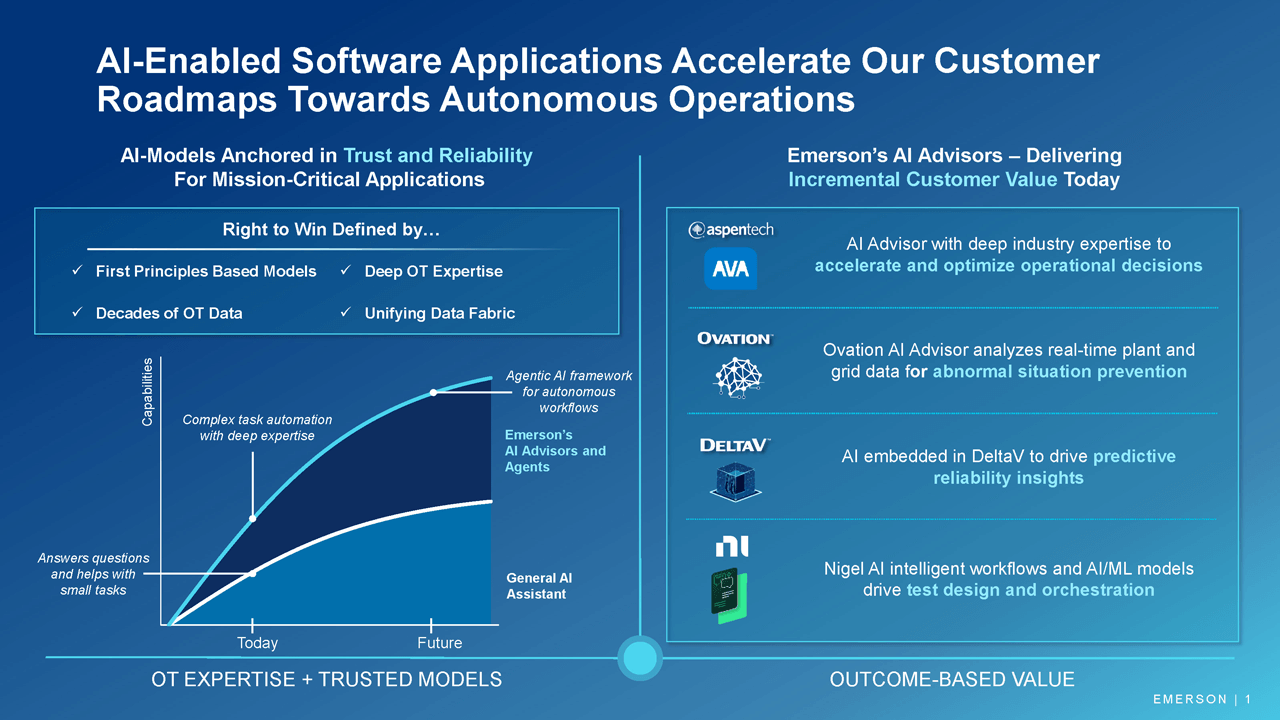
AI-enabled software applications provide a wide range of solutions for real-time decision making and predictive insights that improve the performance of smart manufacturing operations.
Edge AI solutions
Nixon’s viewpoint is that many of the modern AI tools available are designed to be deployed in the cloud. However, as those tools are increasingly impacting real-time operations and decision making, having the AI deployed closer to where the process is will naturally be safer. From a cybersecurity perspective, deployments at the edge, closest to the process, are often the safest implementations. Fortunately, for most operational technology teams, this is also where they feel safest in deploying these solutions.
Early adopters are most often the remote locations, smaller plants, and offshore operations where assets are running without lots of personnel readily available. Those sites are always looking for ways to increase safety and optimization, but it is harder than it would be at a large facility with lots of people and easy access to resources.
In areas like reliability, Nixon said they’re already seeing edge AI being applied and lots of automation suppliers are embedding LLM technology in the automation tools they supply. AI advisors are becoming much more common. Vision applications are also becoming more popular. So, for many companies, the time to get started has already come. They’re implementing these technologies—both in pilots and in actual production systems—and are figuring out how to integrate them seamlessly into their processes, and will continue to do so over the next 2 to 3 years.
“The more process optimization focused solutions will likely take longer. Teams not only need access to solutions, they need to trust them to take action. Regardless of the robustness of AI, a human-in-the-loop will be the reality for the foreseeable future,” Nixon said. “Many organizations will be more likely to take advantage of these technologies as they are rolled out as updates to the existing automation tools they already trust. AI tools thoughtfully built into known automation solutions will be designed around domain expertise that will help teams avoid many of the most common challenges rapidly evolving AI solutions present.”
Anticipated Edge AI impact
“The trajectory of these technologies will likely stay the same in the next few years; however, implementation will likely increasingly move more from the remote locations where the technology is a necessity to more widespread use-cases in line with what early adopters are doing today,” Nixon said.
He said that the biggest changes will come first in predictive maintenance and reliability. This will likely be followed closely or in parallel by edge-deployed LLMs and edge AI technologies for non-steady state systems like skids and modular units.
“AI and the insights it can generate and the data it can analyze will provide us with massive benefits in these coming years. There is a lot of data out there—the result of decades of digital transformation—ready to be analyzed and put to use for significant optimization,” Nixon concluded.