

TechnologyJuly 24, 2026
Industrial Edge Shifts Toward Decentralized Intelligence
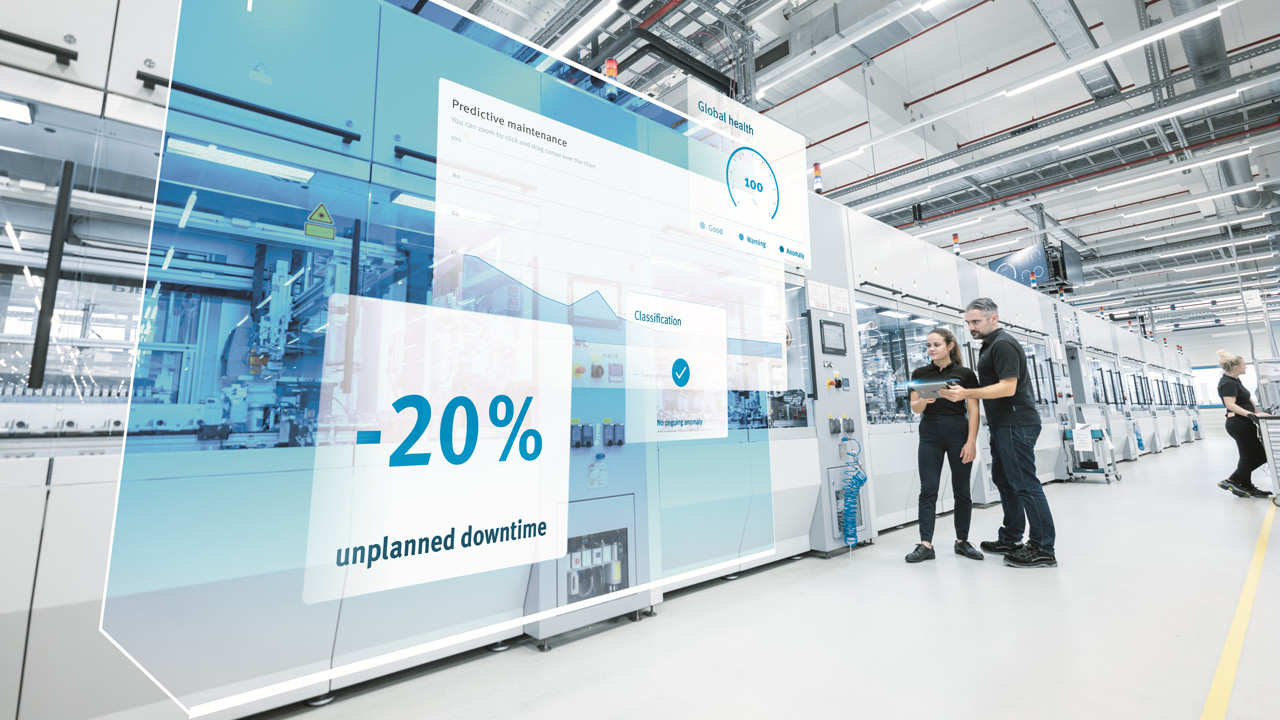
Industrial edge technology has become a foundational layer of modern smart manufacturing networking architectures by enabling real‑time responsiveness, operational continuity, and secure local processing in environments where cloud‑only models cannot meet physical constraints.
The biggest trends in industrial edge computing reflect a decisive shift toward decentralized intelligence, AI‑driven autonomy and resilient architectures built for real‑world factory conditions.
Edge‑first architectures are becoming more and more the norm as manufacturers are moving decisively toward designs that process data locally at machines, gateways and use of on‑premises servers. More factories are adopting structured three‑layer models — Device, Edge and Cloud — where each tier has distinct responsibilities.
In this special report, Industrial Ethernet magazine reached out to industry experts to get their perspectives on the current state if Industrial Edge technology, and also look to the future for decisive trends.
Read how our panel of industry experts is breaking down the latest technology trends and how they are shaping industrial network design and performance.
Coordinating Data Sources in Real-Time
Optimization decisions based on multiple data sources and use of Docker containers to ensure flexibility and seamless connectivity between multiple machines and applications.
Dipl. Ing. Eberhard Klotz, Global Sales Director Industry 4.0 and Digitalisation at FESTO, said that key technology trends in edge and cloud computing technology are driving new solutions for manufacturing.
“Inside machines, many optimization decisions are based on multiple data sources, such as component data available via PLCs or, in part, via Ethernet-based fieldbuses, and product and maintenance information provided by the MES. The data often needs to be correlated and analyzed in real time,” Klotz said.
“This requires powerful edge computers (or on-premises systems) and data analytics — today often AI applications — that focus on specific tasks, such as predictive maintenance for a component type or technology family. A second trend is using Docker containers to ensure flexibility and seamless connectivity between multiple machines and applications while also addressing IT/OT requirements and cybersecurity (for example, regulatory frameworks such as the CRA).”
Klotz said that cloud-based solutions typically focus on use cases that require access by many distributed users, or where trend analytics and non-real-time predictions are needed — for example, energy trends, production planning optimizations, or trend comparisons across multiple machines and factories.
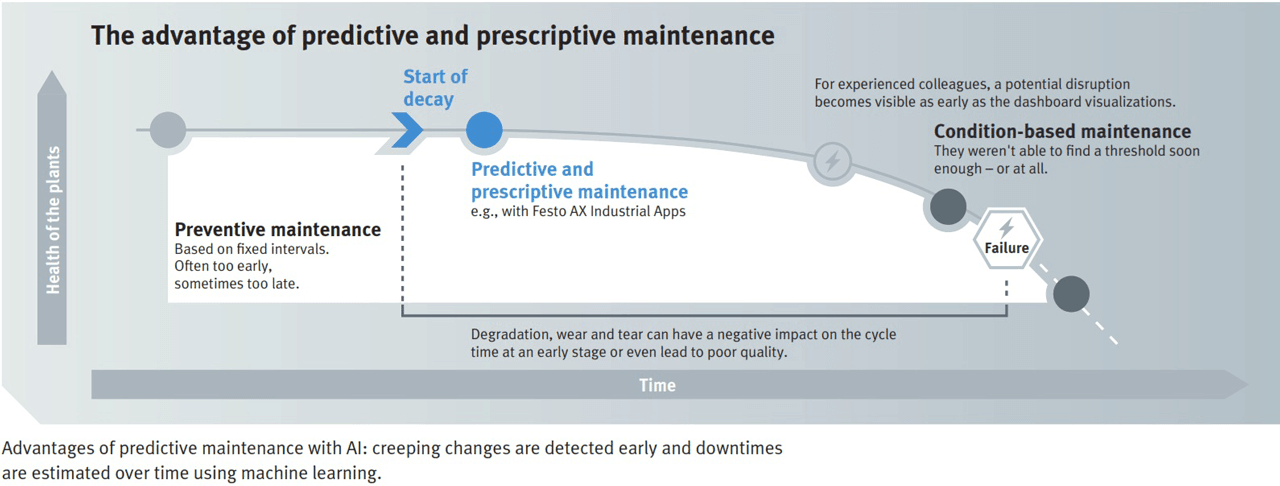
Advantages of predictive maintenance with AI: creeping changes are detected early and downtime is estimated over time using machine learning.
Value for smart manufacturing
“Predictive maintenance is a key area where edge computers provide substantial value today. In addition, digital maintenance systems (CMMS — computerized maintenance management systems) add significant value to manufacturers. To achieve this, standardized AI apps such as Festo AX Motion Insights Pneumatic and Motion Insights Electric enable monitoring of cylinders and electromechanical axes (servo drives) in a machine and can predict significant deviations and impending maintenance needs — typically about two weeks before a component fails,” Klotz said.
He said that this can reduce unplanned downtime by up to 25%. With qualified feedback from maintenance teams (human-in-the-loop), the AI can learn and evolve into a prescriptive maintenance solution. A CMMS such as Festo Smartenance can improve maintenance team efficiency by roughly 50%. The software combines maintenance and repair management, a machine logbook, and spare-part management into a single cloud-based solution. The web application for maintenance and production managers, and the mobile app for maintenance staff and operators, ensure that all relevant machine information is accessible anytime, anywhere. Messages from the AI can be integrated via an API to directly trigger maintenance tasks and seamless digital workflows.
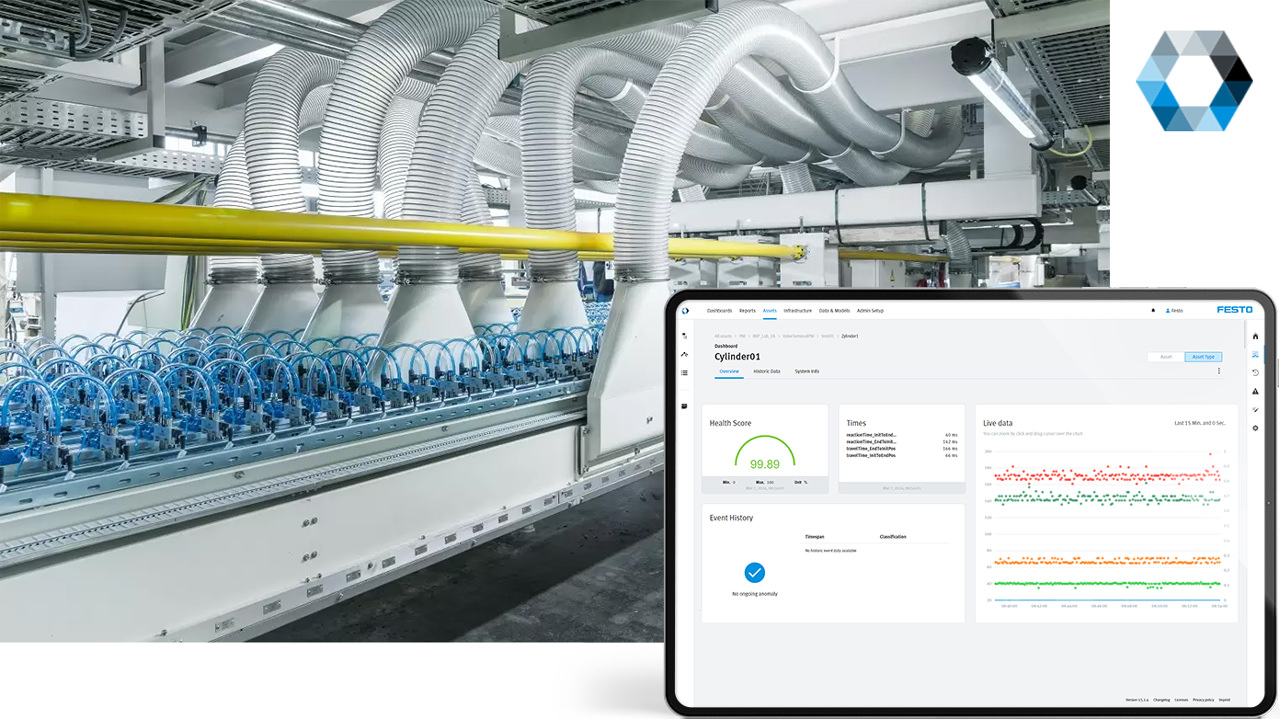
Dashboard of a Motion Insights Pneumatic AI-Application.
More Advanced Solutions
Klotz said that standardized AI applications provide benefits to end users (manufacturers) as well as to machine builders (OEMs). Making the right decisions based on data — for example, using machine learning (AI) — first requires substantial training data. Machine builders typically do not have those data because they do not operate the machines. Historically, end users often did not store the data — first because of the cost and second because they lacked the expertise to use them.
This is where Festo provides an advantage: the company collects data from many test cycles of its own products (before release and through decades of endurance testing). It also gathers data from its own production operations. Third, Festo develops the AI algorithms in-house and retains the application knowledge and data science expertise necessary to deploy them.
“Thirty years ago, PLCs were the bottleneck for data: limited and expensive memory/storage, a shortage of specialized programmers, proprietary diagnostic concepts per vendor, and limited options for ubiquitous visualization,” Klotz said.
Until recently, PLC data and data from servo drives were often not available in standardized formats. A key difference today is that required data is provided in Industry 4.0 standard formats such as MQTT and OPC UA. Second, ‘big’ data can be processed outside the PLC performance bottleneck.
As computing systems and storage have become broadly accessible, this is no longer a practical limitation. Third, data is processed using standardized IT/OT tools such as Docker containers, standardized and specialized AI applications, and edge computers. This enables standardized
Festo AI applications, such as Motion Insights Pneumatic, to gather data from cylinders of different brands and visualize results on any computer dashboard.
Engineers at OEMs benefit from a predictive maintenance solution that is globally available and compatible with common hardware (pneumatic cylinders, vacuum grippers, servo drives). They can integrate a Festo application and offer it as an added-value feature in their systems. This gives them a much faster time-to-market than developing their own application and allows them to showcase an innovative digital machine concept. Alternatively, they can prepare their machines as ‘AI ready’ and let the end user integrate or activate the Festo applications.
The same applies to the Festo CMMS (maintenance tool), Smartenance, which can also be customized as an OEM-branded version with different colors and logos. End users, on the other hand, can retrofit these applications into existing production systems at any time. Because the applications include AI analytics, data connectivity, and a dashboard, they are plug-and-work solutions even for organizations without in-house AI specialists or data scientists. The only prerequisite for an end user is a modern PLC with an Ethernet interface or fieldbus.
Anticipated Impact
“Over the next 1–3 years, smart factories will increasingly connect machines, automation systems, software, and data to make production more transparent, flexible, and efficient. They will use real time information, intelligent control, and analytics to optimize processes, reduce downtime, and support faster decision making. This will enable greater flexibility and the ability to produce, for example, more customized goods,” Klotz said,
“Therefore, edge computers are likely to become standard on larger machines — provided the end user is not exclusively requiring on premises solutions and central data lakes. Edge computers not only enable data analytics during operation but, when used for control and motion tasks (as with the Festo CEPE range), also provide access to higher level programming environments for machine builders,” he added.
He said that these innovations leverage open source operating systems and real time platforms on edge computers, enabling:
- and secure connection between IT and OT environments and the cloud.
- real time control using standard programming according to IEC 61131 3 (for example, CODESYS) and high level languages such as C/C++, C#, and Python.
- monitoring, data analysis, and a broad set of IoT functions.
- expandability and scalability of applications.
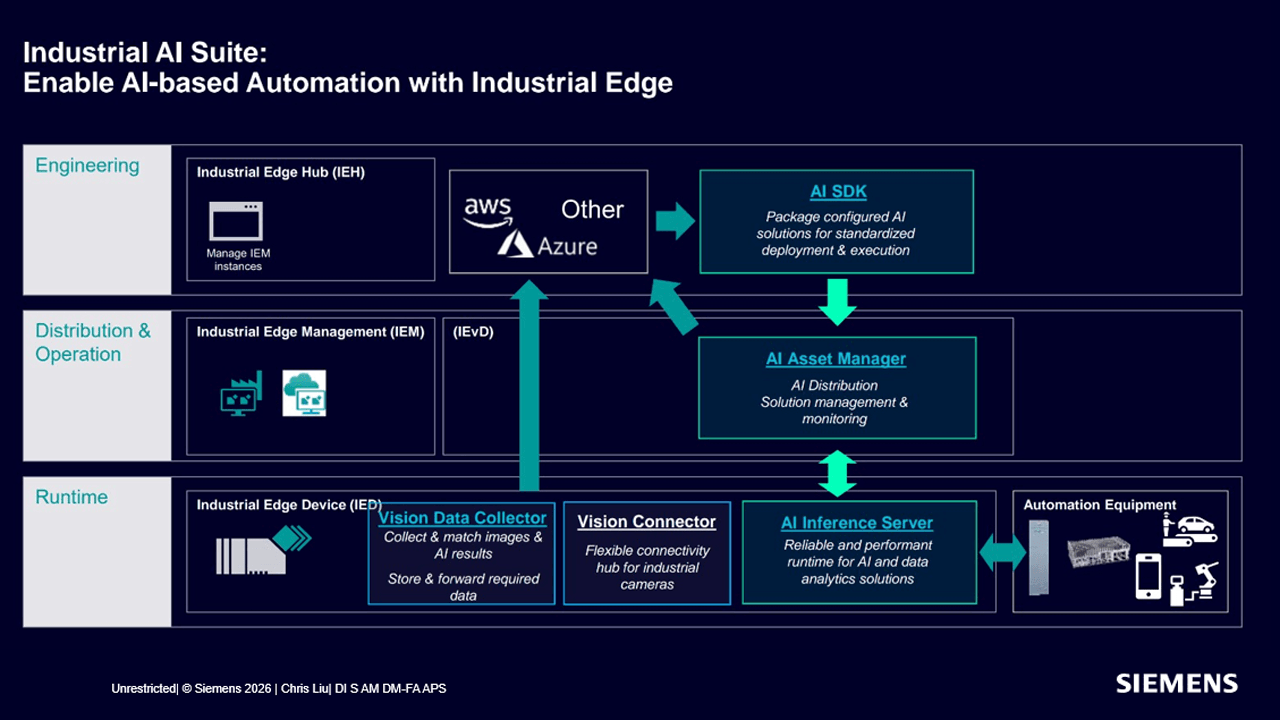
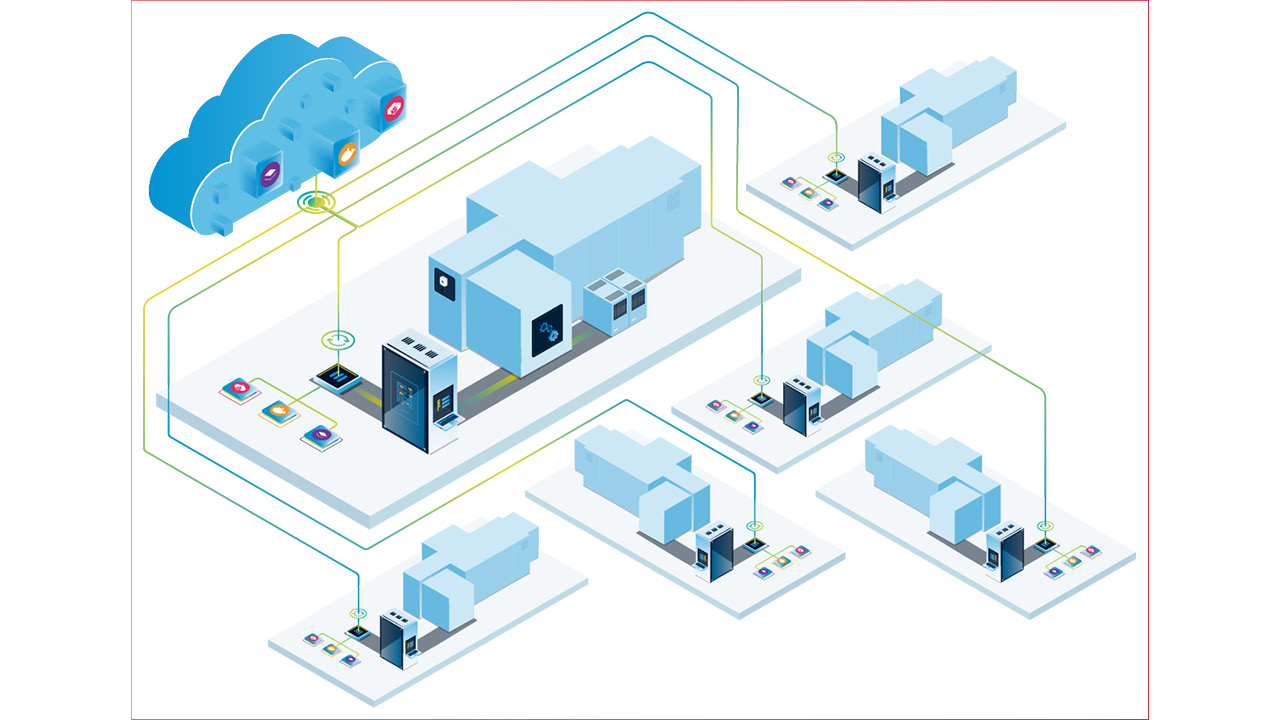
Figure 1: An Edge and AI architecture, like this one powered by Siemens Industrial Edge, powers AI-based automation.
Move to Hybrid Architectures
Cloud platforms play central role in scaling analytics, standardizing data access and enabling enterprise-wide learning, while edge resources support local responsiveness.
Chris Liu, architecture and portfolio sales (APS) manager for the Americas, Siemens, said that “Edge AI is shifting AI from a centralized analytics tool to a real-time operational technology assistant. Today, we already see measurable impact in areas such as visual quality inspection, predictive maintenance, anomaly detection, energy optimization, and machine assistance. By running AI directly on the shop floor right at the edge in near real-time where data is captured and processed, manufacturers can make decisions much faster (within milliseconds) for time-critical tasks, while further improving both efficiency and quality.”
“Looking ahead, Edge AI will become a key enabler of autonomous operations. Factories will increasingly use AI at the edge to continuously optimize production, identify process deviations before they create scrap, and help operators resolve issues faster,” Liu said. “The combination of Industrial Edge, operational data, and AI models creates a feedback loop that enables smarter and more responsive manufacturing systems.”
Liu said that Edge AI is expected to offer new solutions for a wide range of smart manufacturing operations:
- Machine vision: Automated quality inspection, defect detection, safety monitoring, and object recognition
- Predictive and Prescriptive Maintenance: Detecting abnormal machine behavior before failures occur and recommending corrective actions
- Process Optimization: Continuously optimizing machine parameters, throughput, quality, and energy consumption
- Asset Performance Management: Monitoring fleets of machines and identifying performance degradation across multiple sites
- Executable Digital Twins and Simulation: Combining real-time operational data with AI models to predict outcomes and optimize production scenarios
“The most immediate impact is in real-time decision-making ability. Manufacturing environments often require high-speed data collection for both time-series and image data acquisition down to the millisecond, and Edge AI enables local processing without cloud latency. This is critical for quality control, machine protection, process optimization, and autonomous responses,” Liu said.
He said that, for IT/OT integration, edge computing platforms, such as Siemens Industrial Edge, can collect OT data from all industrial sensors, PLCs, drives, and machines while contextualizing and synchronizing the data to IT systems, enterprise applications, analytics, and cloud services in a structured and secure way.
“In the cybersecurity realm, Edge AI helps identify and detect unusual network behavior, ransomware, anomalous device activity, and deviations from expected operating conditions. While AI is not a replacement for cybersecurity frameworks, it can significantly improve threat detection and operational resilience.”
Other major impacts that Liu identified include:
- Reduced cloud bandwidth, storage, and costs
- Improved data compliance and ownership
- Democratization of AI through low-code and no-code tools
- Improved workforce productivity through AI-assisted troubleshooting and knowledge management
Applications and markets
Liu said that Edge AI can be deployed in any industry where data and compute is required. Early adopters include automotive, EV battery, food & beverage, CPG, semiconductor, and aerospace. He thinks that the timeframe depends on the actual use cases. Machine vision, data visualization, and data integration are common edge applications today, while software-defined control (virtual PLC) and broader adoption of autonomous production systems and AI-assisted operational decision-making will also become more popular.
He added that Edge AI will continue its trajectory as one of the most impactful technologies in industrial automation. Key areas include:
- Faster response times that enable decisions in real time
- Enhanced data Privacy and security – sensitive production data can remain on-premises while still benefiting from advanced AI capabilities
- Reduced costs associated with data transmission, cloud processing, and storage requirements, delivering faster business value
- Faster scale-up and app deployments on the shopfloor by distributing intelligence across the manufacturing environment
TTTECH Industrial’s IIoT platform for machine builders, Nerve, provides a software backbone for the machine, which combines edge runtime, industrial connectivity, application management, and cybersecurity in one platform.
From Connected to Software-Defined Machines
More powerful industrial edge platforms that shost both automation and digital applications in a controlled, secure and maintainable way.
According to Marián Hönsch, Director Product Management Industrial IoT at TTTECH Industrial, “a key trend in manufacturing is the shift from connected machines to software-defined machines.”
“In the past, automation architectures often relied on several separate hardware components: PLCs, IPCs, bus couplers, gateways, remote access devices, and dedicated computers for visualization, analytics or cloud connectivity. This created complexity, higher hardware cost, fragmented maintenance, and a larger cybersecurity attack surface. The current trend is to consolidate these functions onto fewer, more powerful industrial edge platforms that can host both automation and digital applications in a controlled, secure, and maintainable way,” Hönsch said.
“At the same time, edge computing and cloud computing are becoming complementary. The edge is used for real-time data processing, local autonomy, reduced latency, and operation during limited connectivity, while the cloud or central management layer is used for fleet-wide deployment, monitoring, updates, and analytics.”
Hönsch went on to say that another important trend is the containerization of industrial software. Classical automation software providers are increasingly decoupling real-time runtimes from dedicated hardware and making them available as containerized or software-defined runtimes. This accelerates the convergence of real-time control, non-real-time applications, and data services onto one hardware platform.
And finally, AI is changing the speed of software development. Software developers at machine builders can now create, test, and iterate digital applications much faster. Google’s 2025 DORA research found broad AI adoption among software professionals, with more than 80% of respondents reporting productivity improvements, although trust, quality and governance remain important concerns.
This increases the need for repeatable, secure edge platforms such as Nerve from TTTECH Industrial, where new applications can be deployed and managed consistently at scale.
Consolidation of Machine Software
“One specific area creating strong value is the consolidation of machine software onto one secure industrial edge platform. Instead of distributing functionality across many separate hardware components, machine builders can host real-time control, data connectivity, analytics, visualization, remote access, and digital service applications on a common platform,” Hönsch said.
The argument is that this creates value in several ways. First, it can reduce hardware cost by lowering the number of IPCs, gateways, couplers, and dedicated devices required in the machine. Second, it simplifies engineering because the machine architecture becomes clearer and easier to maintain. Third, it improves cybersecurity because fewer devices need to be protected, patched, and monitored separately.
TTTECH Industrial’s IIoT platform Nerve is also designed for this architecture. It provides edge node software and a management system that can run in the cloud or on-premises, enabling remote device management, application deployment, and real-time data access.
A key advantage is that machine builders do not necessarily need to rewrite all existing software when moving to this architecture. Existing applications from previous IPCs or platforms can often be containerized or virtualized and executed on Nerve with limited or no migration effort. This makes the transition practical: machine builders can preserve proven software while creating a more scalable and secure platform for future digital services.
Advanced Technology Solutions
Nerve provides a more advanced solution by combining edge runtime, industrial connectivity, application management, and cybersecurity in one platform. On the edge device, Nerve can host different types of workloads, including Docker containers, virtual machines, and CODESYS-based applications. This enables machine builders to run both real-time-oriented automation workloads and non-real-time applications such as analytics, visualization, data preprocessing, protocol conversion, or remote service tools on the same hardware platform.
“A central benefit is isolation. Real-time and non-real-time workloads have different requirements. Control applications need deterministic behavior and protection from interference, while data, analytics and service applications need flexibility and frequent updates,” Hönsch said. “Nerve’s platform approach allows these workloads to coexist while maintaining separation between application domains. This helps machine builders converge software onto one hardware system without losing control over reliability and maintainability.”
Another key feature is remote lifecycle management. Both real-time and non-real time applications can be managed remotely through the Nerve Management System. This allows machine builders to deploy software updates, patches, or new applications continuously and on demand.
From a cybersecurity perspective, consolidating applications on a managed platform can be more secure than distributing them across many unmanaged devices. Nerve is positioned with IEC 62443-4-2 certification at product level. The result is a machine architecture that is easier to maintain, easier to patch and easier to protect.
Technology Advancing
In the past, Hönsch said that traditional machine architectures were often built from many dedicated hardware and software components. A PLC handled real-time control, an IPC hosted visualization or analytics, a gateway translated protocols, a separate remote access box enabled service, and additional hardware was often required for cloud connectivity or customer-specific applications. On top came the safety controllers. Each component had its own operating system, firmware, update process, security model, and maintenance cycle. This fragmented approach worked, but it became difficult to scale, secure, and manage over the full machine lifecycle.
TTTECH Industrial’s IIoT platform Nerve changes this approach by acting as a software backbone for the machine. It provides a common edge platform where different workloads can run side by side, while being managed through a common lifecycle management system. Nerve’s node software runs at the edge, while its management system can run in the cloud or on-premises, and the system can also operate offline where required.
“The other major difference is that modern automation runtimes are becoming less tied to proprietary hardware. Real-time runtimes from established automation ecosystems are increasingly being made available as software components, including containerized deployments. This allows programmable logic to move toward open edge platforms. Over time, this convergence can also include safety-related workloads, where safety control, real-time control, and non-real-time digital applications are hosted on one protected hardware platform,” Hönsch said.
“This is fundamentally different from the past because the machine is no longer defined only by fixed hardware functions. It becomes a managed software system that can be updated, extended, and secured throughout its lifecycle,” Hönsch added.
Addressing Real-world Issues
To meeting modern manufacturing needs, machine builders must reduce hardware cost, shorten development cycles, meet cybersecurity requirements, support remote service, and create new digital services — without compromising reliability, real-time behavior or safety. Engineers need a repeatable platform architecture instead of forcing them to build each IIoT solution as a one-off project.
By hosting real-time and non-real-time applications on one protected edge platform, this helps to reduce the number of IPCs, gateways, bus couplers, and auxiliary devices. This simplifies machine design, commissioning, spare parts handling, documentation, and cybersecurity hardening. Fewer devices also mean fewer systems to patch, monitor, and maintain.
For software teams, cloud managed edge platforms provide a practical runtime for modern application development. Machine builders are increasingly using AI-assisted development to create analytics, dashboards, predictive maintenance tools, optimization services, and customer-specific applications faster than before.
However, faster software development only creates value if deployment and lifecycle management are scalable. Our IIoT platform Nerve provides an environment where applications can be tested, deployed, updated, and managed consistently across many machines. It behaves the same in development and productive scenarios. Existing software can also be containerized or virtualized, reducing migration effort. This supports faster innovation while preserving proven automation assets and maintaining a secure, manageable machine platform.
Impact of Industrial Edge Computing
“In the next one to three years, Industrial Edge Computing will become a standard part of advanced machine architecture. The differentiator will no longer be whether a machine is connected, but whether it is software-defined, securely manageable, and its software is covered by a lifecycle-management,” Hönsch said.
One major impact will be hardware convergence. Machine builders will increasingly reduce separate IPCs, gateways, couplers, and service devices by consolidating workloads onto industrial edge platforms. This can reduce hardware cost, simplify machine architecture, and make cybersecurity management more effective. A second impact will be the convergence of real-time, non-real-time, and, where applicable, safety-related software domains. As automation runtimes become more portable through containers and virtualization, programmable logic, data applications, visualization, analytics and service tools can increasingly run on common hardware platforms with proper isolation.
A third impact will be faster digital innovation. AI-assisted software development will help machine builders create more applications and services in less time. But these applications need a secure home at the machine edge, plus a scalable way to deploy and manage them across fleets. Our IIoT platform Nerve is positioned for this role: it combines edge application hosting, remote software lifecycle management, industrial data connectivity and IEC 62443-oriented cybersecurity.
“The result will be machines with lower hardware complexity, stronger cyber resilience, faster serviceability, and a clearer path toward recurring digital service revenue,” Hönsch said.
“Industrial systems are textbook examples of closed-loop physical systems, where tough constraints from the physical world – latency, power, variability, and noise – are all at play when it comes to computing applications at the physical edge, and of course applications of Artificial Intelligence in smart manufacturing,” Dr. Massimiliano Versace, VP Emergent AI, Analog Devices.
Decision-Making at the Physical Edge
Decision-making needs to happen closer to sensors, actuators, and the machines themselves.
According to Dr. Massimiliano Versace, VP Emergent AI at Analog Devices, key technology trends in edge and cloud computing solutions are helping to shape the future of industrial edge computing.
“Industrial systems are textbook examples of closed-loop physical systems, where tough constraints from the physical world – latency, power, variability, and noise – are all at play when it comes to computing applications at the physical edge, and of course applications of Artificial Intelligence in smart manufacturing,” Versace told Industrial Ethernet recently. “While cloud computing remains essential for aggregation and large-scale model training, the locus of decision-making needs to happen at the physical edge, closer to sensors, actuators, and the machines themselves.”
Several converging trends are underlying this choice of compute location. To be ubiquitous, AI needs to live at the location where data originates, without requiring sizeable compute resources (smaller and low-power compute is required) and high communication bandwidth to either central AI processors/cloud. Ultra-efficient AI compute is required for these applications to enable intelligence to run within strict constraints, including novel architectures inspired by the brain, such as event-driven (neuromorphic) processing and in-memory computation, which dramatically reduce the energy cost of inference.
“On the algorithmic side, we are seeing the rise of on-device learning, where systems not only infer but also continuously adapt in situ,” Versace said.
“This enables machines to deal with variability, noise and drift conditions that are endemic to manufacturing environments but simply impossible to capture fully in the traditional AI training pipeline process, with pre-recorded centralized datasets.
These trends are driving computing and AI architectures that tightly integrate sensing and actuation into real-time feedback loops to enable intelligence embedded within industrial machines, leading to more resilient, autonomous, and efficient manufacturing systems.
Predictive and Adaptive Maintenance
Versace said that one of the most important areas of application is predictive and adaptive maintenance at the physical edge.
“While traditional predictive maintenance relies on cloud aggregation and offline analysis, limiting responsiveness to rare or evolving fault modes that are pre-identified, edge-based approaches enable machines to continuously interpret their own sensory signals, such as vibration, acoustics and temperature, in real time,” Versace said.
He added that the real value emerges when these systems move beyond static (mostly cloud-based) models to incorporate on-device learning and adaptation. Industrial environments are inherently dynamic: machines age, loads change, and operating conditions vary: an AI system trained in a factory in Sweden might not work for the same machine in Indonesia. AI models pretrained once in the cloud are often insufficient to capture these nuanced and evolving industrial realities.
By embedding intelligence directly at the edge, systems can learn the specific operating condition of a machine in their environment, detect subtle deviations from normal behavior and update their internal representations over time. This enables AI to detect faults earlier, continuously optimize machine configurations, and minimize unplanned downtime.
AI that can close the loop between perception, reasoning, and action directly on-device allows manufacturers to move from reactive monitoring to proactive, self-adjusting systems, a key step toward more autonomous manufacturing.
Emerging Edge AI Solutions
Here are a few technical features that Versace said differentiate these emerging AI solutions at the edge:
- Event-driven computation: Instead of processing all data uniformly, computation is triggered by changes in signals, mirroring the efficiency of biological systems and significantly reducing power consumption.
- In-memory processing: much of the brain’s computation occurs at a neuron’s synapses, where information is simultaneously stored and computed. AI systems that adopt this intuition dramatically reduce data movement, which is a major contributor to energy and latency in traditional systems.
- On-device learning and adaptation: there are families of AI models designed to be trained and updated “on-the-fly”, which allows them to respond to drift, new conditions, or rare events without requiring cloud retraining.
- Tight integration with sensing: Rather than treating sensing as a separate stage, these solutions co-design sensing and compute, enabling more efficient and context-aware processing.
The benefits are substantial: lower power consumption, reduced bandwidth requirements, improved reliability in disconnected environments, and the ability to handle edge cases that are difficult to anticipate in centralized models.
All the above leads to systems that are more efficient, robust, context-aware, and ultimately useful to manufacturers and machine operators.
Technology Distinctives
“This approach is a clear break with respect to cloud-centric paradigm, where data is collected at the edge, transmitted to the cloud, processed in large-scale compute environments, and then insights are sent back to the machine,” Versace said. “We have already witnessed a growing trend in the opposite direction, with AI-powered systems being deployed directly on devices, e.g., for visual quality inspection, where training occurs in the camera itself, without requiring cloud compute.
Versace added that while the old cloud-centric approach works well for aggregate analytics, it breaks down when low power, low-latency, autonomy, or adaptability are required.
When intelligence is pushed down to the edge, decisions are made locally and immediately. The cloud still plays a role, but primarily for coordination, training, and fleet-level optimization, rather than managing individual decisions and inferences.
Crucially, traditional systems are largely open-loop, namely, they analyze data but do not directly influence the physical system in real time. These new approaches are inherently closed-loop, continuously sensing, interpreting, and acting within tight latency constraints.
“Another key difference is the adaptability of AI algorithms. Previous systems relied on fixed models, whereas modern approaches incorporate continuous learning, allowing machines to evolve over time,” Versace said.
Addressing Engineering Challenges
Versace said that modern industrial systems are operating under increasingly tight constraints (and competitive landscapes!) where more complex insights are required, while machines need to remain reliable in unpredictable environments. AI-powered edge-native approaches address these needs by reducing dependence on data movement, easing bandwidth limits, and improving robustness under intermittent connectivity. Coupled with ultra-efficient compute, where emerging AI compute architectures come into play, these systems can today meet the tough constraints and demands of distributed sensing and embedded systems.
Low-latency/low-power inference enables true real-time control, allowing machines to respond immediately to changing conditions; something cloud-only approaches are not designed to deliver.
Beyond hardware, AI algorithms innovations such as on-device learning, allow for managing variability and uncertainty directly, sidestepping the need of exhaustive upfront modeling, allowing systems to adapt as they operate, learning from the physical world they are embedded in.
For industrial machine builders this translates into more reliable, increasingly autonomous machines.
Anticipated Industrial Edge Impact
Mirroring the rise of robotics in manufacturing, Versace said that we will witness an increase of autonomy at the physical edge in industrial machines. In a sense, these machines will increasingly adopt similar technologies that autonomous systems, e.g. humanoid robots, are adopting today.
Like humanoid robots, we will see intelligence and AI move closer to where data is created in complex industrial machines, this time embedded directly in sensors and actuators to enable real-time perception, decision, and action without relying on the cloud.
“This increase will mark the emergence of Physical Intelligence for industrial machines, with systems finally able to operate autonomously under real-world constraints of power, time, and uncertainty, and can adapt continuously to changing conditions,” Versace said. “For customers, this will mean less downtime, more efficient operations, and ultimately more profitable outcomes.”
Right-Sized SCADA Solutions
Operational visibility without the cost and complexity traditionally associated with supervisory control systems.
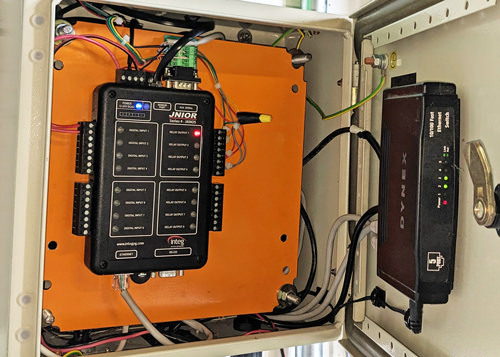
For many smaller applications, the INTEG JNIOR provides a right-sized and easily usable all-in-one Industrial Edge Computing platform for control, visualization, and streamlined connectivity to higher-level computing resources.
Bruce Cloutier, CEO/Founder of INTEG Process Group, said that “one of the most valuable applications of Industrial Edge Computing is the creation of right-sized SCADA solutions that provide operational visibility without the cost and complexity traditionally associated with supervisory control systems.”
“Many commercial, manufacturing, and industrial facilities already possess reliable automation assets, including PLCs, sensors, motor controls, and other specialized equipment. The challenge is often not only controlling the process, but also obtaining meaningful operational information from systems that were never designed to share data with enterprise software, remote operators, or cloud-based services,” Cloutier told Industrial Ethernet recently.
Cloutier said that Industrial Edge Controllers address this challenge by bridging operational technology (OT) and information technology (IT), with the flexibility to operate independently of continuous cloud connectivity.
“Positioned close to the equipment, they can fulfill the control role while also collecting data from multiple sources, perform local processing, generating alarms and notifications, and delivering visualization, presenting actionable information to operators,” Cloutier said. “Rather than transmitting large volumes of raw data to external systems, edge devices can filter and organize information locally, forwarding only the events, metrics, and status information that are useful for decision making.”
Recognizing this need, INTEG Process Group developed the JNIOR as a right-sized edge computing solution offering a practical and scalable path forward for many types of users and applications. JNIOR is an easy-to-use, flexible, and compact automation controller with up to 16 on-board I/O (expandable with remote I/O), and with Ethernet and serial connectivity, providing an effective way to deploy Industrial Edge Computing without unwanted effort and overhead.
“Today’s engineers and machine builders are expected to deliver far more than just basic control functionality, even though that remains essential,” Cloutier added. “End users for all types of consumer, commercial, and industrial systems increasingly require remote monitoring, alarm notification, data collection, energy reporting, enterprise integration, cybersecurity, and cloud connectivity. While these capabilities create value, they also introduce additional software layers, communications dependencies, and maintenance requirements that can significantly increase lifecycle risk.”
Cloutier said that carefully selected Industrial Edge Computing solutions can provide the necessary functionality while simplifying the system architecture and minimizing engineering effort. Our approach with the JNIOR edge controller was to establish a purpose-built multi-tasking platform, running an optimized Java Virtual Machine (JVM), so users can develop, debug, and run dependable programs. JNIOR is an Industrial Edge Computing solution for smaller applications, providing responsive control, supporting edge networking/communications, and even includes a full-featured web server. This combination of control and computing in a compact footprint provides reliable and predictable performance, without the need for users to manage multiple computing resources.
“Industrial equipment often remains in service for decades, while software platforms, communications technologies, and business requirements change continuously. Any Industrial Edge Computing technologies should maintain a focus on being supportable over the long haul. This preserves investment, reduces obsolescence risk, and extends the useful life of both equipment and engineering effort,” Cloutier said.
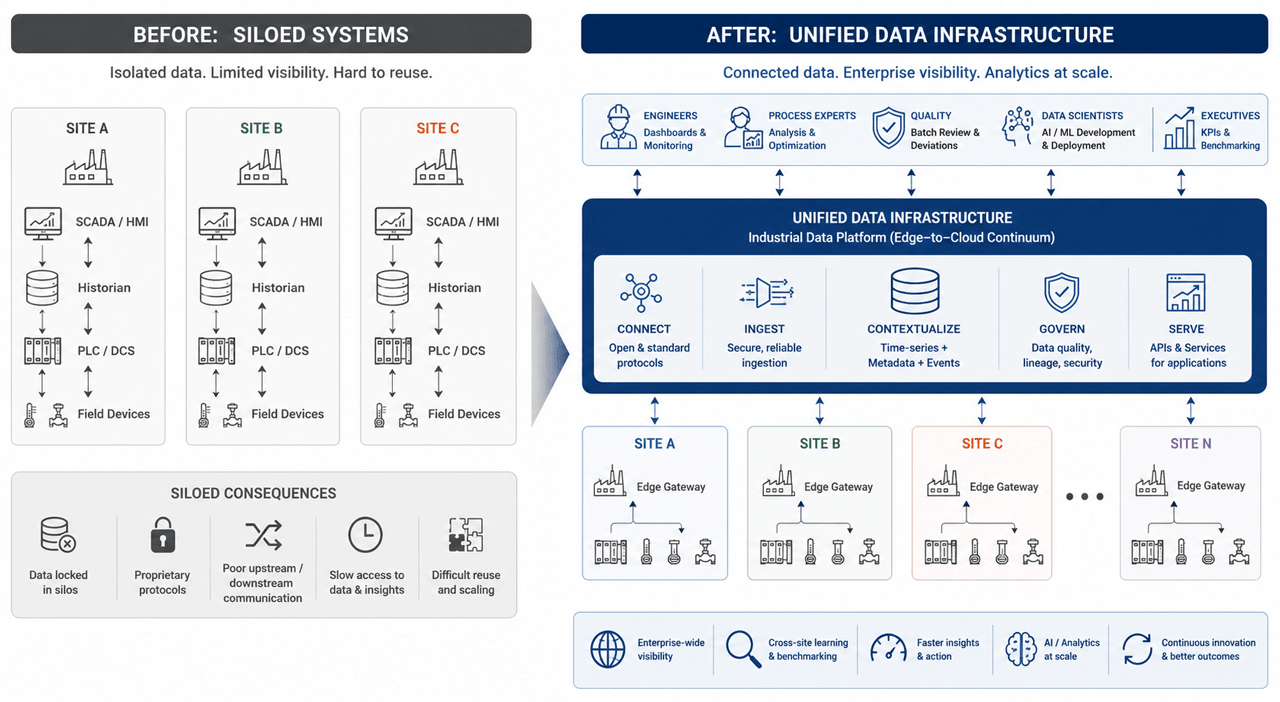
While site-isolated SCADA, historian, and PLC stacks once locked data in proprietary silos with poor upstream/downstream communication, a unified data infrastructure now connects, contextualizes, and governs data across every site through a common edge-to-cloud platform, such as Seeq. This provides engineering, quality, and data science teams with shared access for batch review, deviation monitoring, and AI-scaled analytics instead of one-off, site-by-site integrations.
Move to Hybrid Architectures
Cloud platforms play central role in scaling analytics, standardizing data access and enabling enterprise-wide learning, while edge resources support local responsiveness..
According to Paolo Braiuca, Life Sciences Industry Principal at Seeq, “The biggest trend is the move away from a binary ‘edge versus cloud’ mindset toward hybrid architectures where cloud platforms play the central role in scaling analytics, standardizing data access, and enabling enterprise-wide learning, while edge resources support local responsiveness where needed. Manufacturers are no longer treating plant-floor data as isolated historian or SCADA data; they are increasingly building shared industrial data foundations that connect machines, sensors, manufacturing execution systems (MES), and business systems into a common analytical framework.”
Braiuca said that a second trend is stronger OT/IT convergence. The old automation pyramid with standalone applications and siloed communication is giving way to more decoupled, interoperable architectures with broader connectivity and more transparent data flow.
And third, manufacturers are embedding more analytics and AI into these environments, with cloud-based industrial analytics platforms becoming increasingly important for contextualizing data, scaling advanced analysis across sites, and supporting AI-assisted decision-making from diverse operational data sources.
“Finally, the market is placing greater emphasis on resilience, security, and manageability across distributed operations, because smart manufacturing increasingly depends on connected assets, mixed protocols, and the ability to govern data and applications consistently across sites,” Braiuca said.
Cloud-based Industrial Analytics
“One especially valuable area is cloud-based industrial analytics built on a unified enterprise data infrastructure across multiple sites. In practice, this means creating a common layer that collects, contextualizes, and distributes operational data from plant equipment, automation systems, historians, and enterprise applications into an analytical environment that can be used consistently across the organization,” Braiuca said. “This matters because modern manufacturers do not struggle from a lack of data, but from fragmented data spread across protocols, systems, and locations.”
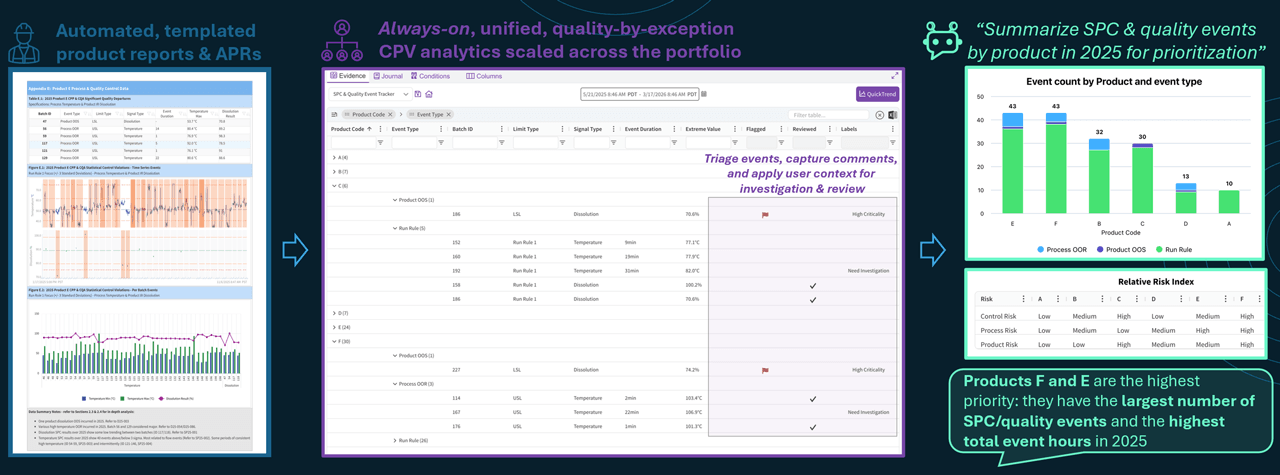
Templated advanced pattern recognition (APR) with AI-assisted analytics provides a view of statistics and quality events from products and sites in a unified always-on dashboard, empowering teams to query and prioritize risk in seconds, instead of compiling and interpreting static reports.
Cloud-enabled industrial analytics platforms create value by turning that fragmented data into a shared resource for monitoring, cross-site benchmarking, predictive maintenance, quality analysis, and process optimization. This is where Seeq-style capabilities are especially relevant: the value is not just storing data in the cloud, but contextualizing it, making it accessible to engineers and subject matter experts, and scaling analysis and best practices across facilities (See figure above).
For regulated sectors such as pharmaceuticals, the benefit is even greater because the enterprise gains standardized visibility, stronger governance, and reusable analytics across facilities, while still preserving local operational responsiveness where needed.
Technical Benefits
Braiuca said that a cloud-centered industrial analytics solution built on a unified data infrastructure is more advanced because it combines capabilities that were once fragmented across historians, reporting tools, custom integrations, and site-specific applications. First, it supports broad connectivity to industrial assets and protocols, allowing data collection from legacy and modern systems without costly rip-and-replace programs.
Second, it contextualizes raw industrial data, turning tags into meaningful process, asset, batch, and production information, which are critical for scalable analysis and collaboration across teams and sites.
Third, cloud deployment makes advanced analytics easier to scale enterprise-wide, enabling users to apply common calculations, visualizations, and monitoring strategies consistently. Fourth, cloud architectures support centralized governance and rapid rollout of analytical improvements, while hybrid deployment supports low-latency and site autonomy needs where required with local infrastructure.
The benefits include faster insight generation, easier analytics reuse, stronger cross-site consistency, reduced engineering effort, and a clearer path from raw data to operational improvement. This provides a more scalable and usable operating model for industrial analytics.
“Historically, manufacturers worked inside a rigid automation hierarchy, consisting of standalone applications, data silos, poor upstream/downstream communication, and proprietary protocols that limited reuse of information beyond the immediate control context,” Braiuca said. “Local systems were optimized for control, rather than enterprise-wide visibility, cross-site learning, or modern analytics deployment.”
The new model decouples data access from individual applications and supports a more fluid edge-to-cloud continuum. Time-critical processing stays close to the machine or line, while larger-scale analytics, benchmarking, and AI development occur centrally, with information relayed to the field or production floor as needed. Platforms like Seeq are built for this shift: instead of requiring a custom integration layer for every historian, SCADA, and MES, Seeq connects directly to the data sources and contextualizes the information, giving engineers, process experts, and quality teams faster access to consistent analytics without waiting on a new point solution each time.
In manufacturing environments, teams are using these platforms to apply the same analytical approaches across processes and sites, which improves batch review, enables earlier deviation identification, and provides better operational context. This methodology supports continuous innovation by breaking down conventional barriers in place with static, siloed environments, creating a shorter path from industrial data to operational action.
Application Challenges
“Engineers and machine builders face a recurring set of problems: integrating new and legacy equipment, dealing with different protocols, supporting low-latency decisions, organizing large volumes of disparate data, securing operational assets, and scaling solutions across multiple devices and sites. Unified edge-cloud data infrastructure addresses these issues directly,” Braiuca added.
At the connectivity level, this approach reduces integration friction by creating a common layer between equipment and higher-level applications. At the compute level, it lets designers place logic where it belongs: local processing for immediacy and resilience, central processing for coordination and advanced analytics. At the lifecycle level, centralized management of edge devices and applications simplifies updates, configuration control, and cybersecurity across fleets rather than box-by-box maintenance.
For machine builders, this means they can design more modular and reusable automation solutions. For plant engineers, it reduces time spent stitching together infrastructure, providing more time to focus on performance, quality, and innovation. Particularly in regulated industries, this architecture helps balance innovation with governance by supporting standardization without sacrificing local operational needs.
Anticipated impact
“Over the next one to three years, we expect the conversation to shift from proving the value of edge-cloud architectures to governing them at scale. Regulatory and quality expectations, especially in pharma and other validated environments, will push vendors toward analytics platforms that support data integrity, audit trails, and reproducibility natively, rather than as bolt-ons,” Braiuca said. “Additionally, AI will move from pilot projects to embedded, contextual assistance, where engineers increasingly query operational data in natural language and receive answers grounded in validated process context, not generic model output.”
He added that workforce dynamics will be impacted as well. As experienced process experts continue to retire, analytics platforms that capture and apply institutional knowledge—not just raw data—become increasingly critical.
“We will also see a procurement shift, with buyers evaluating platforms based less on edge-versus-cloud considerations, and more on time-to-insight and ease of adoption for non-programmers. The companies that win will be those that make advanced analytics usable by subject matter experts, not just data scientists, closing the gap between having data and acting on it,” Braiuca said.
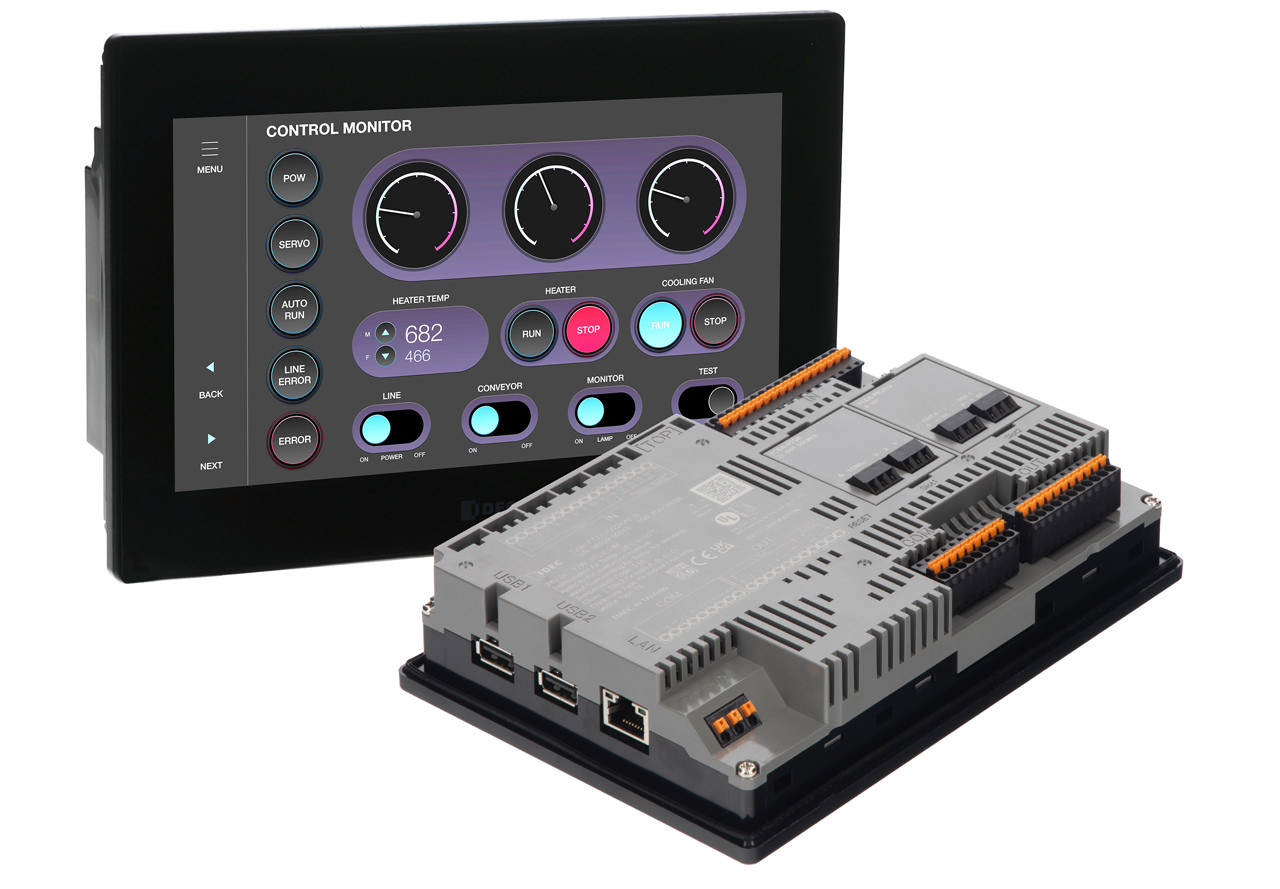
While there are many approaches to implement smart manufacturing, IDEC has evolved their proven PLCs, HMIs, and now the hybrid FT2J PLC+HMI (shown here) to maintain the same rigorous OT performance that users expect, while adding in easy-to-use IT and cloud connectivity, so users can create reliable edge/cloud computing solutions.
MQTT, OPC UA, Modbus TCP or EtherNet/IP Connectivity
End users are striving to extract more data, in easier ways, from their automation assets.
Linda Htay, Automation Product Marketing Manager at IDEC Corporation said: “For many years, manufacturing automation users recognized that the technologies used for control, visualization, and connectivity/data-handling were a bit segregated; often using programmable logic controllers (PLCs), human-machine interfaces (HMIs), and PCs, respectively. Even though these roles are different, they all work closely together. For industrial and even commercial use, users demand absolute reliability from these products, while they hoped for them to be reasonably easy to use. Unfortunately, a growing hardware/software technology stack tends to add cost and complexity.”
She said however that expectations have shifted over the years, as end users are striving to extract more data, in easier ways, from their automation assets. They need this data not only for monitoring purposes, but also to support operational optimization and proactive maintenance efforts.
Today’s designers have a range of hardware and software options available to them, ranging from inexpensive consumer-grade microcontrollers to more complex platforms running an assortment of open-source software.
“When designing new systems or enhancing existing installations, manufacturers typically deploy edge devices, PLCs, HMIs, gateways, or controllers that can communicate with both legacy equipment and modern Industrial IoT platforms. These devices help collect, normalize, and securely transmit operational data using standards such as MQTT, OPC UA, Modbus TCP, or EtherNet/IP,” Htay said.
An example is how IDEC’s FC6A PLC, FT1J/FT2J PLC+HMI, and HG1J/HG2J HMIs can serve as a bridge between industrial control systems and modern data architectures. With support for MQTT, Modbus TCP, EtherNet/IP, FTP, email, web server functionality, and custom web pages, these devices provide multiple ways for end users to increase the value of equipment while enabling greater visibility and connectivity.
Addressing Engineering Challenges
Htay said that, based on deep experience in supplying automation for the manufacturing sector, IDEC understands that industrial product lifecycles need to be 10+ years, and that machines can run for decades. Modern IT-centric software and consumer-grade products move at a much faster pace, making it both difficult and risky to maintain these over the timeframes needed by industry.
“To create automation solutions that will survive the manufacturing environment over the long haul, designers need access to proven products featuring a compact size, low power consumption, a wide operating temperature range, and industrial certifications such as UL and CE. For these and other reasons, IDEC has continually advanced the PLC (FC6A), HMI (HG1J/HG2J), and hybrid PLC+HMI (FT2J) platforms to deliver the always-on reliability expected by end users, but with enhancements making them easier to use and ideal for connecting OT with IT. Depending on the product line, common OT and IT protocols ensure developers can build reliable systems using these IDEC products, while enabling direct integration with SCADA, cloud, building, and other host systems.
“Security and lifecycle management at scale are becoming decisive differentiators. As edge deployments grow, customers need centrally managed updates, role-based access, and resilient operations. Siemens Industrial Edge is designed for industrial-grade security and operational resilience, including IEC 62443-aligned capabilities and secure update management,” — Marc Fischer, Global Marketing Manager Industrial Edge, Siemens.
Multi-protocol Connectivity and Data Standardization
Support for broad industrial connectivity (OPC UA, MQTT, PROFINET, Modbus TCP, Ethernet/IP) provides a foundation to structure and harmonize shopfloor data for downstream IT and cloud use.
According to Marc Fischer, Global Marketing Manager Industrial Edge at Siemens, “manufacturers are moving quickly from isolated ‘pilot’ architectures to scalable edge-to-cloud platforms that can be rolled out across lines and sites.”
Fischer said that three technology trends stand out:
First, open, multi-protocol connectivity and data standardization are becoming non-negotiable. Plants need to connect both greenfield and brownfield assets and normalize data so it can be reused across applications rather than building and maintaining point-to-point integrations. Siemens Industrial Edge supports broad industrial connectivity (e.g., OPC UA, MQTT, PROFINET, Modbus TCP, Ethernet/IP) and provides a foundation to structure and harmonize shopfloor data for downstream IT and cloud use. Complementing this, a unified data layer that bridges OT and IT is emerging as the backbone for analytics and industrial AI. Edge Apps like Siemens Industrial Information Hub (IIH) create an OT data model and enable standardized publishing (e.g., via MQTT, Unified Namespace [UNS]), while supporting semantic access patterns through GraphQL/REST.
Second, security and lifecycle management at scale are becoming decisive differentiators. As edge deployments grow, customers need centrally managed updates, role-based access, and resilient operations. Siemens Industrial Edge is designed for industrial-grade security and operational resilience, including IEC 62443-aligned capabilities and secure update management. This ensures that edge infrastructure remains protected and maintainable as deployments expand across multiple plants and facilities.
Third, cloud-native analytics and AI multiply value from unified data. Once manufacturers establish a unified data foundation and secure edge-to-cloud infrastructure, cloud-native SaaS applications transform standardized operational data into competitive advantage. Cloud-based Insights Hub from Siemens provides a powerful, scalable platform for data-driven manufacturing, offering key functionalities like Insights Hub Monitor, Intelligent Energy Management, Quality Prediction, and our Production Copilot.
These offerings are designed to optimize asset uptime, enhance predictive quality, and improve overall throughput. The Siemens Production Copilot, integrated within Insights Hub, uses natural language processing to make advanced analytics accessible to frontline workers. Siemens Predictive
Analytics applies machine learning to forecast equipment failures weeks in advance, while Quality Prediction and Energy Optimizer continuously optimize production parameters. By eliminating custom integrations and leveraging standardized data models, manufacturers deploy new analytics use cases in weeks rather than months – and these applications improve continuously as they learn from growing datasets.
Predictive Maintenance at Scale
Fischer said that one specific area creating immediate value is predictive maintenance at scale, combining edge-based data integration and preprocessing with cloud-based analytics.
“With Siemens Industrial Edge and Industrial Information Hub, manufacturers can connect heterogeneous shopfloor assets, harmonize and contextualize data locally, and decide which data stays on premises versus what is securely sent to the cloud. This is especially important for high-frequency signals and sensitive production data, where edge processing reduces bandwidth needs and supports data sovereignty,” Fischer said.
“On top of that data foundation, cloud applications such as Senseye Predictive Maintenance turn equipment data into actionable insights – helping maintenance teams focus on the right assets at the right time without manual analysis. The result is measurable operational impact: Healthcare company Octapharma, for instance, achieved a 50% reduction in unplanned downtime and a 10% increase in Overall Equipment Effectiveness (OEE) by implementing these technologies. This integrated approach enables manufacturers to harness real-time data insights at the edge, reducing latency and empowering predictive maintenance strategies that optimize production efficiency and minimize downtime. This is particularly crucial in highly regulated industries like pharmaceuticals, where continuous quality monitoring, faster responses to process deviations, and greater transparency across production lines are paramount,” he added.
Advanced Solutions
On the edge, Fischer said that Siemens Industrial Information Hub running on Industrial Edge enables connectivity to a wide range of industrial protocols and systems, helping manufacturers collect and harmonize data from heterogeneous shopfloor environments. It supports local data storage and harmonization using an MQTT data broker, and provides secure data transmission to cloud and IIoT platforms—while allowing customers to decide which data remains on-premises and which data is shared to the cloud. This reduces integration effort, supports data sovereignty, and lowers bandwidth requirements by enabling preprocessing close to the machines.
In the cloud, Senseye Predictive Maintenance applies AI that automatically learns from machine and maintainer behavior, generating models that help direct maintenance attention to where it is most needed. It delivers monitoring, diagnostic, and prescriptive insights and is designed for enterprise-scale deployments—from hundreds to 10,000+ machines—without requiring manual analysis.
“In the past, many maintenance approaches relied on fixed-interval preventive schedules or isolated condition monitoring systems that generated large volumes of alarms and required significant manual interpretation,” Fischer said. “Insights were often trapped in individual plants, and scaling beyond a few critical assets typically meant repeating custom integrations and analysis work.”
“Today’s approach works differently in three key ways. First, data can be connected and prepared at the edge, close to the machines, using gateways and edge computing for secure connectivity and preprocessing—so manufacturers can use existing signals from PLCs, drives, motors, and sensors without redesigning their automation environment.”
Fischer said that industrial AI is also shifting the workload from humans to the system. For example, Senseye Predictive Maintenance uses AI to automatically learn from machine and maintainer behavior, continuously improving diagnostic accuracy and reducing the need for manual inspection.
It also uses an Automated Attention Index to prioritize what truly needs action, rather than overwhelming teams with raw data and alerts.
Third, the solution is designed to scale enterprise-wide. Instead of being limited to a single line or site, it is built to deliver value across 100 to 10,000+ machines, enabling consistent maintenance practices and shared learning across plants.
New Automation Solutions
“Engineers and machine builders are under pressure to deliver smarter machines faster—while dealing with heterogeneous shopfloor interfaces, customer-specific IT requirements, and increasing cybersecurity expectations. Industrial Edge and cloud connectivity address these challenges by standardizing data integration and simplifying lifecycle management, so OEMs can focus engineering effort on differentiation rather than plumbing,” Fischer said.
With Siemens Industrial Edge and Industrial Information Hub (IIH), machine builders can connect to a broad range of controllers and devices using flexible Siemens, third-party, or self-built connectivity, including support for upgrading brownfield environments via OPC UA companion specifications.
Data is then structured in a consistent way—using IIH as a central data layer and OT data model—so each asset only needs to be connected once, and multiple applications can reuse the same standardized data foundation. This reduces custom point-to-point integrations and makes solutions easier to scale across lines and sites.
In addition, IIH enables data preprocessing, historic capture, live access, and easy synchronization between edge and cloud, including semantic access via an automatically generated graph exposed through GraphQL/REST APIs—bridging OT usability with IT-friendly interfaces. Finally, centralized app and device management supports cost-efficient rollouts and secure data handling with continuous updates by Siemens, helping OEMs meet lifecycle and security expectations across distributed installations.
Looking Ahead
Over the next 1–3 years, Fischer said that Industrial Edge computing will shift from “select use cases” to becoming a standard layer of industrial operations—because manufacturers need faster deployment of digital applications, stronger cybersecurity, and scalable lifecycle management across distributed production.
First, we expect a major acceleration in scalable rollouts of edge applications across machines, lines, and sites. Industrial Edge is designed for real-time local processing and cost-efficient rollouts, with centralized management so deployments remain manageable as they grow.
Second, cybersecurity and compliance-driven update management will become a primary adoption driver. With regulations such as the EU Cyber Resilience Act increasing lifecycle security obligations, manufacturers and machine builders will need practical ways to roll out security updates not only for their own apps, but also for third-party apps, operating systems, and device firmware. Industrial Edge supports this with secure update management, job tracking, and vulnerability management processes.
Third, edge will increasingly serve as the bridge between heterogeneous OT environments and cloud analytics. With Industrial Information Hub (IIH), customers can collect and standardize data from diverse shopfloor systems, harmonize it locally using an MQTT-based data layer, and securely transmit selected data to major cloud platforms—while keeping control over what stays on-premises.
“We anticipate broader adoption of managed, cloud-hosted edge management to address IT resource constraints. Industrial Edge Management Cloud provides centralized management as a Siemens-hosted SaaS option, reducing the burden of installing, hosting, and maintaining the management infrastructure internally,” Fischer concluded.