

TechnologyJuly 27, 2026
OPC UA FX: The Future of Industrial Communication Is Taking Shape
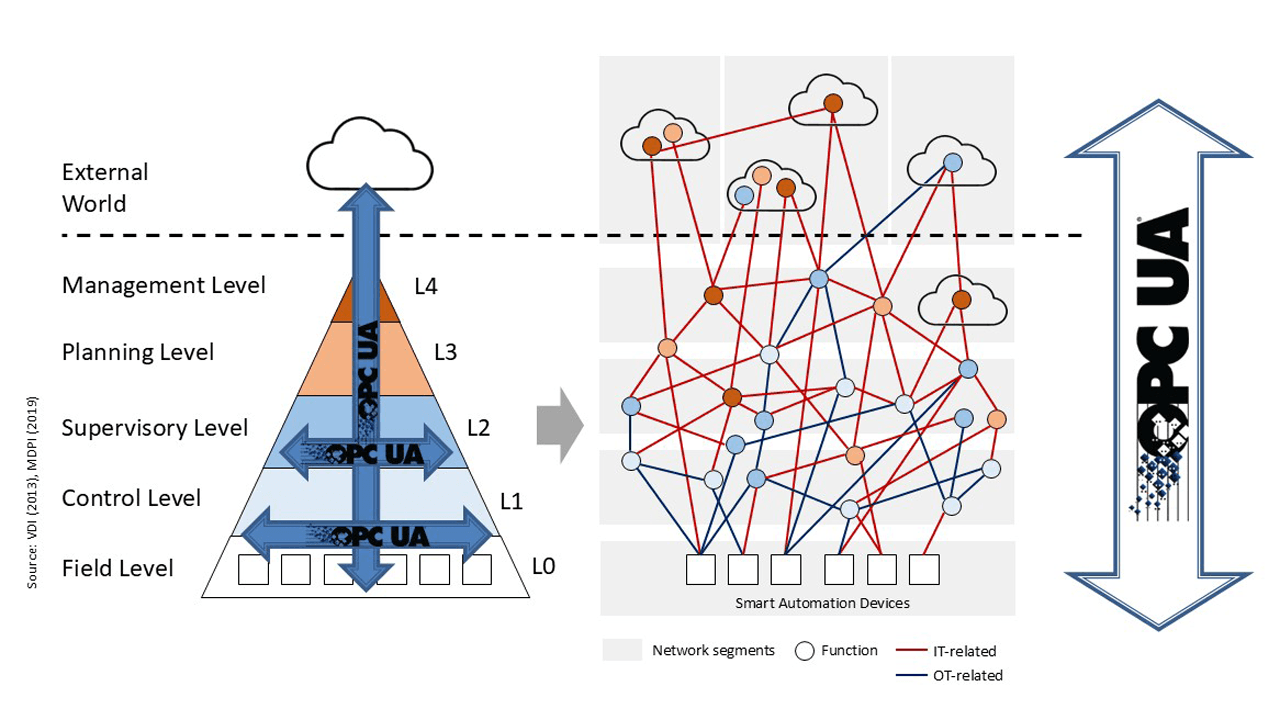
A new generation of technologies is reshaping this landscape. OPC UA FX together with Time-Sensitive Networking, Ethernet-APL, and wireless technologies such as 5G, is paving the way for a unified communication infrastructure — from sensors and actuators, industrial control systems to edge and cloud platforms.
Caption: From Automation Pyramid to Open Industrial Network, scalable Industrial Internet of Things (IIoT) deployments.
For decades, industrial communication has evolved around proprietary fieldbuses and vendor-specific ecosystems. While these technologies enabled reliable real-time communication, they also created fragmented networks and limited interoperability across automation systems.
Today, a new generation of technologies is reshaping this landscape. OPC UA FX (Field eXchange), together with Time-Sensitive Networking (TSN), Ethernet-APL, and emerging wireless technologies such as 5G, is paving the way for a unified communication infrastructure —from sensors and actuators, industrial control systems to edge and cloud platforms.
What once seemed like a long-term vision is now becoming tangible reality.
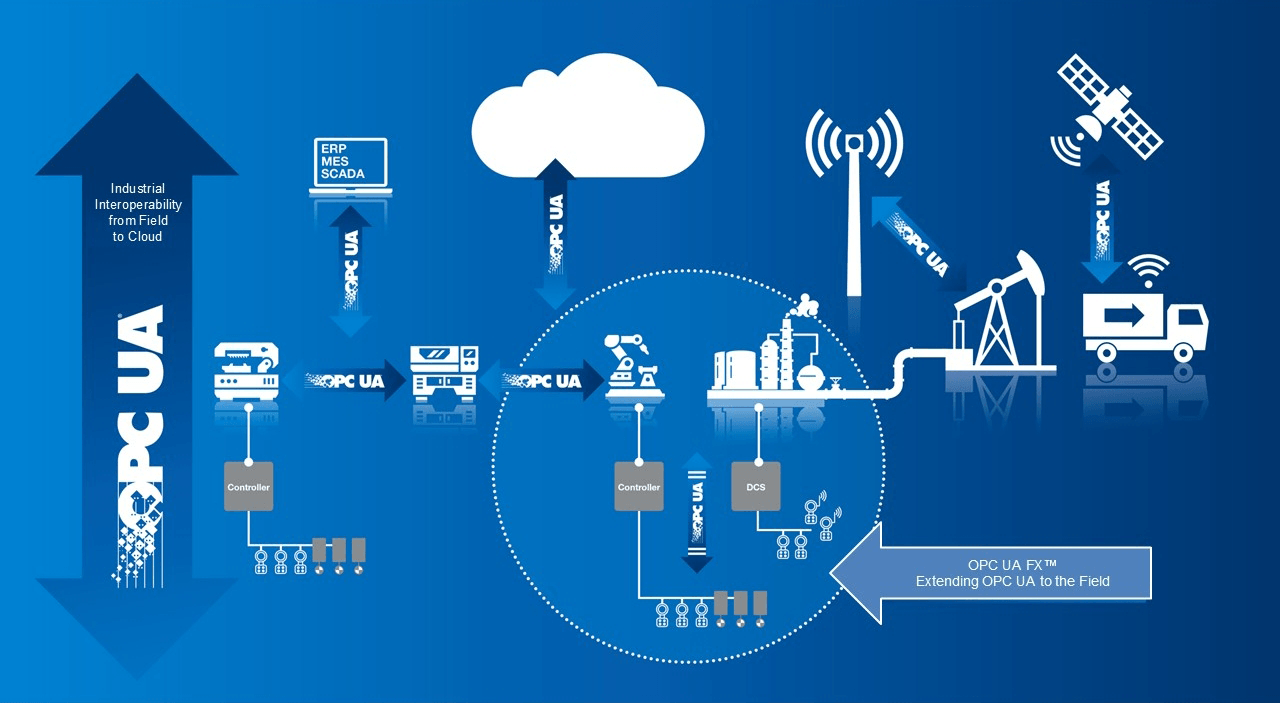
OPC UA (FX) Ecosystem.
From Vertical Integration to Real-Time Field Communication
OPC UA (Open Platform Communications Unified Architecture) has already established itself as the de facto standard for secure, platform-independent data exchange in industrial automation. For many years it has been successfully used to securely exchange data between machines, devices, and software systems, and this across multiple industrial sectors from manufacturing and process automation to energy and infrastructure.
The key components of OPC UA are:
Information Modelling: OPC UA doesn’t just send raw data – it structures it. Devices expose data as rich, object-oriented models (with variables, methods, and relationships), making information meaningful and standardized across systems.
Built-in Security: Security is a core feature, not an add-on. OPC UA includes encryption, authentication, and authorization to ensure that data is transmitted safely and only accessed by trusted parties.
Transport-Agnostic Communication Services: OPC UA can operate over different communication protocols (like TCP, UDP, HTTPS, or WebSockets). This flexibility allows it to work across various networks and applications – from embedded devices to cloud systems – without being tied to a single transport method.
However, traditional OPC UA was never intended to replace fieldbuses responsible for deterministic control communication. OPC UA FX closes this gap.
By extending OPC UA down to the field level and combining it with deterministic transport, OPC UA FX enables real-time communication between controllers, drives, I/O systems, and other field devices – across vendor boundaries.
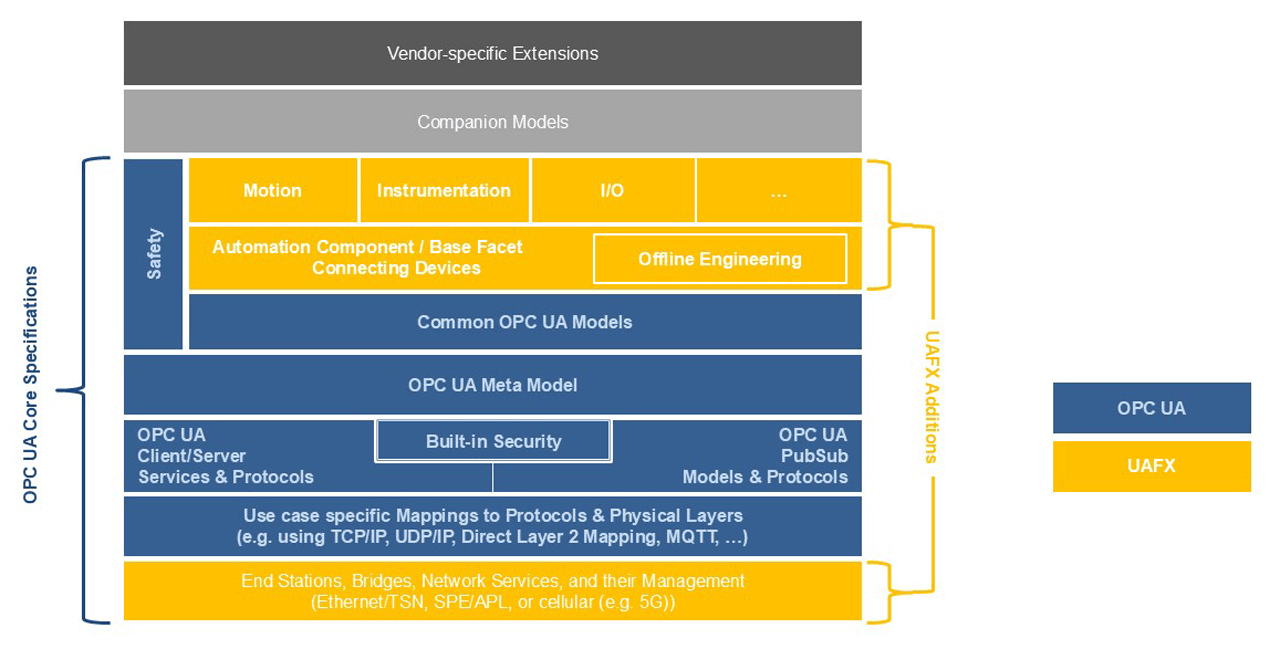
OPC UA FX System Architecture.
The key innovation lies in the Publish/Subscribe communication model, which enables efficient real-time data distribution across industrial networks – either via UDP/IP routable across networks or Raw Ethernet for shorter cycle times and higher efficiency within a network segment. Combined with TSN, this architecture provides deterministic communication with guaranteed latency and synchronized timing. And since OPC UA FX is based on OPC UA, connectivity is not limited to the field level, but scales up to the edge and the cloud.
The result is a single communication framework that can serve the entire automation pyramid based on OPC UA.
Enabling Technologies: TSN, Ethernet-APL and 5G
The transformation towards a unified industrial network is enabled by several complementary technologies.
- Time-Sensitive Networking (TSN) provides deterministic Ethernet communication. Through mechanisms such as precise time synchronization, traffic scheduling, and bandwidth reservation, TSN enables predictable real-time behavior on standard Ethernet networks.
- Single Pair Ethernet (SPE) provides Ethernet communication over a single twisted pair, enabling lightweight, cost-effective connectivity for field devices.
- Ethernet Advanced Physical Layer (Ethernet-APL) builds on SPE technology and extends Ethernet connectivity into process automation environments. It supports long cable distances, intrinsic safety for hazardous areas, and simple installation, making Ethernet a practical and robust solution even in demanding process plants.
- 5G complements wired infrastructure by enabling deterministic wireless communication. This is particularly relevant for mobile equipment, flexible manufacturing, and modular production environments.
Together, these technologies enable converged networks, where IT and OT communication can coexist on a single infrastructure.
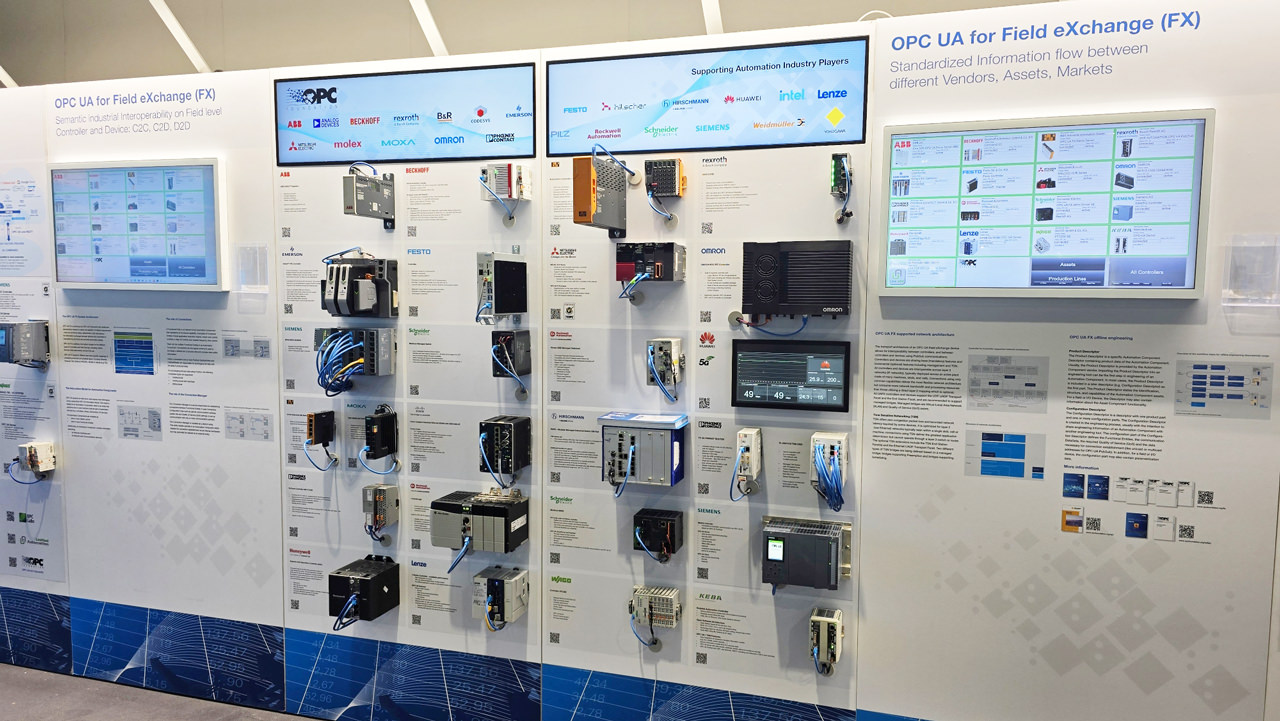
OPC UA FX C2C Demowall.
OPC UA FX Specification Status
The OPC UA FX specification has reached an important milestone with the completion of the Controller-to-Controller (C2C) use case which is at the same time the foundation for the Controller-to-Device (C2D) and Device-to-Device (D2D) use cases.
What OPC UA FX adds to OPC UA
Automation Component (AC): A standardized, modular representation of devices (like PLCs, drives, I/O). Each component includes its data, functions, and interfaces – making devices easier to integrate and reuse across systems.
Connection Manager: Handles how controllers establish and manage communication relationships with other controllers and/or field devices. It automates connection setup (who talks to whom, how, and with which parameters), reducing manual configuration effort.
Offline Engineering: Allows engineers to design and configure systems before hardware is physically connected. Complete setups (devices, connections, parameters) can be planned, simulated, and later deployed.
Profiles: Define standardized feature sets and capabilities for controllers and field devices. Profiles ensure interoperability – devices from different vendors behave consistently if they support the same profile.
In short. OPC UA FX brings real-time capability, easier integration, and standardized engineering to OPC UA, making it suitable for field-level communications.
OPC UA FX Controller-to-Controller (C2C) defines how controllers exchange cyclic data in real-time across vendor boundaries. It includes the architecture, information models, networking mechanisms, and engineering concepts required for interoperable communication.
This foundation enables the next phase of development which is currently ongoing:
- Controller-to-Device (C2D) communication
- Device-to-Device (D2D) communication
These extensions will bring OPC UA FX directly to drives, I/O devices, and field instruments.
In parallel, OPC UA Safety supports functional safety communication over the same network infrastructure. This allows safety-related signals to be transmitted over OPC UA FX while maintaining compliance with industrial safety standards.
Ethernet TSN and IEC/IEEE 60802: A Common Network Profile
While TSN (Time-Sensitive Networking) provides a toolbox of deterministic Ethernet mechanisms, interoperability requires a common profile consisting of a set of rules and constraints.
This is the role of IEC/IEEE 60802, a joint standardization effort defining how TSN should be applied in industrial automation networks.
The profile specifies:
- Time synchronization mechanisms
- Traffic scheduling rules
- Network configuration procedures
- Interoperability requirements
OPC UA FX is aligned with this profile, ensuring that devices from different vendors can communicate deterministically on the same TSN network.
The convergence of OPC UA FX and IEC/IEEE 60802 represents a major step toward vendor-neutral real-time Ethernet networks.
Growing Ecosystem of SDKs and Protocol Stacks
Another important indicator of maturity is the rapidly growing ecosystem of OPC UA FX implementations. Automation vendors, software providers, and specialized stack suppliers are actively developing SDKs and communication stacks supporting OPC UA PubSub and early OPC UA FX profiles. The offers include commercial as well as open source solutions.
These solutions enable:
- Integration of OPC UA FX stacks into controllers and devices
- Development of interoperable applications
- Evaluation and prototyping by system integrators and OEMs
Although many implementations are still evolving, the ecosystem is clearly gaining momentum as the specifications stabilize.
Prototyping and Interoperability Demonstrations
Interoperability demonstrations have played a key role in validating OPC UA FX concepts. One of the most prominent examples is the C2C Demo Wall, where controllers from multiple vendors communicate over a shared network. These systems exchange cyclic process data in real time while maintaining deterministic communication behavior.
Another highlight is the Cable Robot Demonstrator, which showcases coordinated motion control across distributed controllers. The system demonstrates precise synchronization and low-latency communication, key requirements for advanced automation scenarios.
These prototypes demonstrate that OPC UA FX is not just a specification – it is already working in practice.
Conformance Testing and Certification
As industrial users adopt OPC UA FX, interoperability and reliability must be guaranteed through formal certification.
The OPC Foundation is therefore developing comprehensive testing tools, including:
- Compliance Test Tool (CTT) for OPC UA FX
- OPC UA Safety Compliance Test Tool (UASCTT) for safety communication
These tools enable automated verification of protocol implementations and ensure that certified devices behave consistently across vendors. Certification programs play a critical role in building confidence and accelerating market adoption.
Current Work: Completing Field-Level Integration
The current phase of development focuses on completing the field-level communication scope. Key areas of work include how controllers (e.g., PLC, DCS) communicate with motion devices (e.g. frequency converters, servo drives), remote I/O systems and field instruments (sensors, actuators, process devices). The goal is to standardize the real-time data exchange (cyclic communication), the acyclic services (configuration, diagnostics, parameterization) and the device behavior and interfaces by means of standardized information models.
The long-term goal is clear: a fully interoperable automation architecture where devices from different vendors communicate seamlessly.
Outlook: What to Expect This Year
The coming months are expected to mark a turning point for OPC UA FX.
Several milestones are anticipated:
- The first certified OPC UA FX controller products
- Expanded interoperability demonstrations combining C2C, C2D, and edge/cloud connectivity
- Integration of OPC UA Companion Specifications into live demonstrations
- A multi-vendor demonstrator machine showing realistic production scenarios
At the same time, TSN standardization and certification activities will continue to mature. Together, these developments signal the transition from technology validation to industrial deployment.
From Vision to Industrial Reality
OPC UA FX represents one of the most significant developments in industrial communication in recent decades. By combining OPC UA with deterministic Ethernet networking, standardized information models and open interoperability, it enables a new generation of flexible, scalable automation systems.
While the journey is still ongoing, the progress achieved so far demonstrates that the industry is understanding the benefits and is moving toward a common communication foundation for the digital factory.
Peter Lutz, SPE Technology Evangelist, OPC Foundation