

TechnologyNovember 23, 2026
Industrial Wireless Expands Role in Connected Factory

Industrial wireless technology is entering a new phase as established solutions such as WirelessHART evolve alongside LoRaWAN, cellular IIoT and private cellular. Each offers distinct advantages depending on update rates, data requirements, infrastructure and application needs
Industrial wireless technology has spent years moving from an alternative to wired connectivity toward a fundamental part of the industrial communications landscape. Today, the conversation is becoming less about whether wireless belongs in industrial environments and more about selecting the right wireless technology for a particular application.
That shift is being driven by advances on several fronts. Established technologies continue to improve in performance, capacity and reliability, while newer options are expanding the range of assets and applications that can be economically connected. WirelessHART continues to address process monitoring requirements where reliability and relatively fast updates are important.
LoRaWAN and low-power cellular technologies are extending connectivity to widely distributed sensors and assets that may only need to communicate periodically. Meanwhile, Wi-Fi 6/6E and emerging Wi-Fi 7 technologies are increasing wireless capacity and performance for industrial applications requiring higher bandwidth and mobility. Private 5G adds another option for applications requiring wide-area mobility, high device density and managed quality of service.
Rather than producing a single dominant industrial wireless technology, these developments are creating an increasingly diverse connectivity ecosystem. The requirements of a process instrument are very different from those of an autonomous mobile robot, machine-vision system, corrosion sensor or remotely located asset. Update rate, bandwidth, mobility, range, reliability, security, infrastructure and cost can therefore determine which wireless approach makes the most sense.
That diversity is also opening applications that once could not justify connectivity. Reducing the infrastructure associated with traditional wiring can make it practical to instrument measurement points that previously went unmonitored or were checked manually. Wireless connectivity can also simplify communications with moving equipment and support production environments that need to be reconfigured without repeatedly changing network cabling.
The result is an expanding range of applications. Wireless networks are supporting everything from traditional process measurements and condition monitoring to asset tracking, predictive maintenance and remote diagnostics. At the other end of the performance spectrum, higher-bandwidth wireless is supporting automated guided vehicles, autonomous mobile robots, connected workers, machine vision and video.
But greater connectivity brings another set of challenges. Industrial environments remain difficult places for radio communications. Metal structures, moving equipment and crowded spectrum can affect performance. As wireless networks expand, engineers also have to consider cybersecurity, network management and how to turn significantly larger volumes of sensor data into useful information. New wireless points only create value when the information they provide can be securely managed and translated into better operational decisions.
The emerging picture, therefore, is not a contest to determine which wireless technology wins. It is one of coexistence. Industrial organizations increasingly have a spectrum of wireless options that can be matched to the technical and economic requirements of individual applications. The challenge for automation engineers is understanding where each technology fits and where its limitations begin.
So where is industrial wireless headed next, and how should automation professionals evaluate this growing range of technologies? Here is what industry experts are saying about the advances, applications, challenges and opportunities shaping the next generation of industrial wireless.
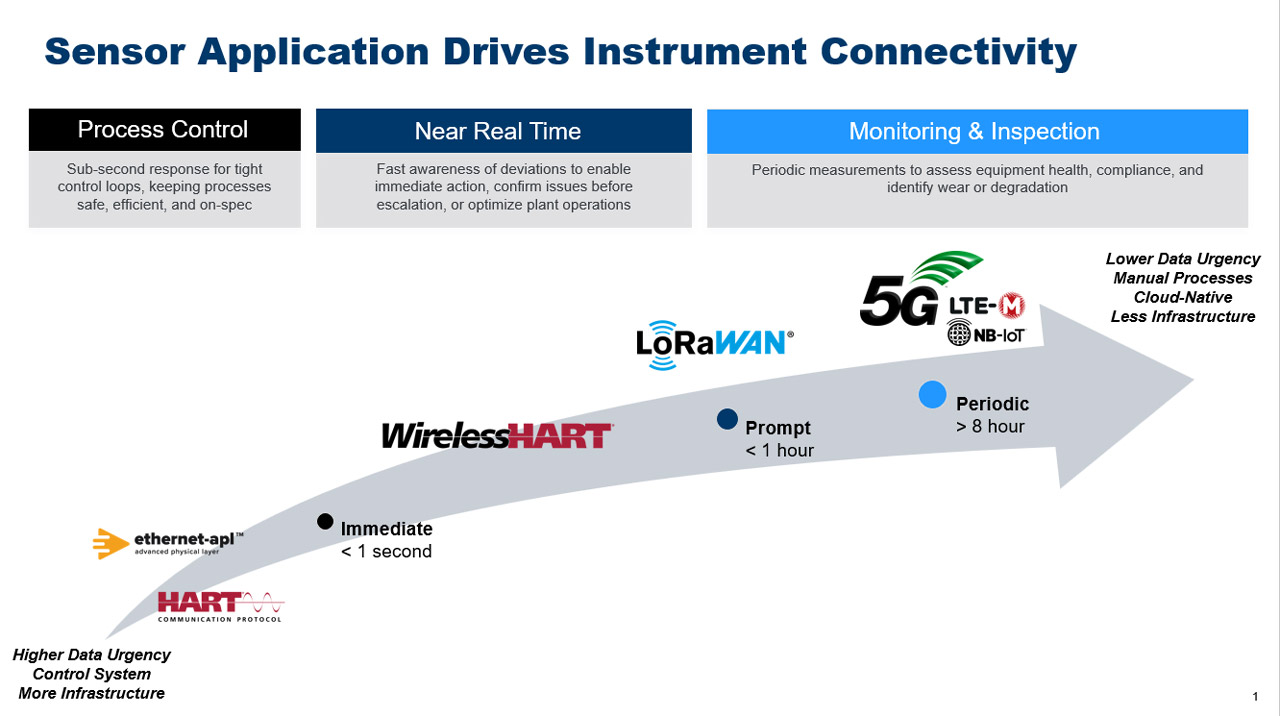
Sensor application requirements determine the right connectivity approach, from high-speed process control to periodic monitoring and inspection.
Advancements on Two Fronts
Continuous improvement of proven technologies and a growing set of fit-for-purpose options.
According to Jimmy Ji, Instrument Connectivity Platform Manager with Emerson, “industrial wireless is advancing on two fronts: continuous improvement of proven technologies and a growing set of fit-for-purpose options. Established standards, such as WirelessHART™, continue to evolve with greater range and higher gateway capacity, while newer communication options to the industrial space, such as LoRaWAN® and cellular IIoT, extend coverage to widely distributed assets where updates are needed in minutes or hours rather than seconds.”
Ji said that these newer options in the industrial wireless market have introduced lower cost entry points for wireless devices and infrastructure. Measurement points once left without instrumentation or checked manually can now be monitored continuously at a cost that fits monitoring and inspection budgets. Easier installation, longer-life battery powered devices, and simpler commissioning reduce the deployment effort. This helps users prove return on investment (ROI) on a small number of points, then scale across the plant or facility.
“Together, these trends let users match connectivity to how quickly data must be acted upon. They can select the right technology to meet the needs of the measurement application, whether that be near-real-time measurements with WirelessHART, hourly update rates with LoRaWAN, or daily measurements with cellular,” Ji said.
In addition, cellular backhaul is becoming an increasingly more common practice to bring industrial wireless data directly into enterprise networks. By using a cellular modem on the back end of a wireless gateway, the aggregated data can be streamed directly to a user’s cloud environment for visualization and further analytics.
Wireless Technology Advances
For Industrial Internet of Things (IIoT) measurements, Ji said that NB-IoT and LTE-M are the primary low-power cellular technologies used to transmit measurement data via a battery powered device. Much of the industry’s attention goes to high-bandwidth applications, such as robotics and cameras, but for devices that send a few hundred bytes per day, the proposition is simpler: existing cellular coverage lets dispersed assets securely report without the need to deploy or maintain a site wireless network.
The applications where cellular IIoT sensors make the most sense are low-cost, large scale, and infrequent measurement updates—like chemical tote monitoring, pipeline monitoring, or corrosion monitoring—where a more traditional industrial wireless network would be costly and complex to deploy. This makes cellular IIoT sensors a complement to technologies such as LoRaWAN and WirelessHART, rather than a replacement for IIoT measurement applications.
Private cellular is a growing technology for high-bandwidth, high-power applications such as those mentioned earlier. For IIoT measurements, the cost and complexity of installing the private cellular infrastructure heavily outweighs alternatives such as LoRaWAN and WirelessHART, which can get network infrastructure installed at a fraction of the cost compared to private cellular.
“Overall, industrial cellular is enabling simpler monitoring of remote assets with IIoT sensors by leveraging public cellular networks, whereas private cellular is enabling high-bandwidth applications,” Ji said. “These high-bandwidth applications can have a significant positive impact on smart factory operations due to their ability to remotely operate and monitor a factory in its entirety.”
Industrial Wireless Solutions
According to Ji, industrial wireless measurement applications fall into two groups, process monitoring and IIoT sensing. The distinction lies in what the data is used for, where the data lands, and who is looking at that data.
Process monitoring, led by WirelessHART, targets process applications where fast update rate, high data reliability, and control system connectivity are needed. Traditional process measurements like pressure, temperature, level, or flow fall into this category. These measurements require updates in seconds to minutes to feed control, alarm, and/or safety systems.
IIoT wireless sensing, led by LoRaWAN and cellular, targets monitoring and inspection applications, where data is needed in minutes, hours, or days rather than seconds. Typical applications include vibration on rotating equipment, valve position, corrosion or erosion monitoring, and asset tracking, to name a few. Reliability, maintenance, and corrosion teams often use this data to replace manual checks and catch developing problems earlier than without monitoring, or with manual monitoring. Low cost measurement points of pressure, temperature, level, flow, and others can also fall into this category at the expense of update rate, reliability, or control system connectivity. Using traditional process measurements with IIoT sensing is typical when optimizing plant operations. Because IIoT wireless sensors tend to be at a lower cost to procure and install, additional data points can be useful, as long as users are aware of the limitations of this wireless technology.
The three industrial wireless technologies identified—WirelessHART, LoRaWAN, and cellular—all have a fit in the industrial wireless solutions space. It is up to the user to define the application, often by working with a supplier, which will then dictate which technology will provide the best solution, rather than the other way around.
Challenges for Automation Engineers
“Advances in industrial wireless are helping to address the stranded measurement problem, where automated measurements were not made due to challenges with justifying the wiring and infrastructure costs,” Ji said. “Wireless collapses the cost per point by reducing the amount of infrastructure needed to support those measurement points. The infrastructure cost decreases as one moves from wired, to WirelessHART, to LoRaWAN, to cellular.”
In addition, Ji said that the ability to monitor these hundreds, if not thousands of new points, creates a new problem: how to manage the large amount of data and create value from it. To address this issue, cloud solutions are emerging in the industrial wireless space that allow fleet management, mass aggregation, and data visualization. These new tools allow engineers to easily manage, distribute, and view the large amount of data flowing into their systems.
He also added that industrial wireless solutions help reduce worker risk by shifting the workforce from being present on-site to one that can perform many standard tasks remotely. Low-cost wireless measurements are how the fully remote plant or “smart factory” gets created. By having an automation strategy that understands the different strengths and weaknesses of all connectivity solutions, automation engineers can create an environment where minimal physical presence is needed at the lowest cost of implementation.
Outlook for Industrial Wireless
“The outlook for industrial wireless is one of coexistence, not competition,” Ji said. “No single technology will serve every need, and the future lies with end users and their supplier partners understanding which technology fits the application at hand.”
He noted that WirelessHART will continue to serve process monitoring, where data reliability matters most. LoRaWAN, cellular, and possibly new emerging low power technologies will keep growing for IIoT sensing. LoRaWAN will increasingly grow into the industrial wireless space with new sensors and technologies that fit closer to industrial applications. Cellular technology for industrial wireless applications is still early and growing, but as the industry gets more comfortable with cloud-connected solutions, the adoption of cellular devices is expected to increase.
The right choice will depend on three things: the application, the end user, and the site. The application sets the update rate, data volume, and criticality. The end user brings their own preferences on where data lives, how it is secured, and who manages the network. The site adds practical limits such as layout, existing infrastructure, spectrum availability, and hazardous area requirements.
“As costs continue to fall and technologies mature, more measurement points will become practical to connect,” Ji said. “The winners will be end users who match connectivity to the need, and suppliers who help them do this with open, interoperable solutions.”
Converging Technology Trends
Industrial wireless networks faster, more reliable, and easier to deploy.
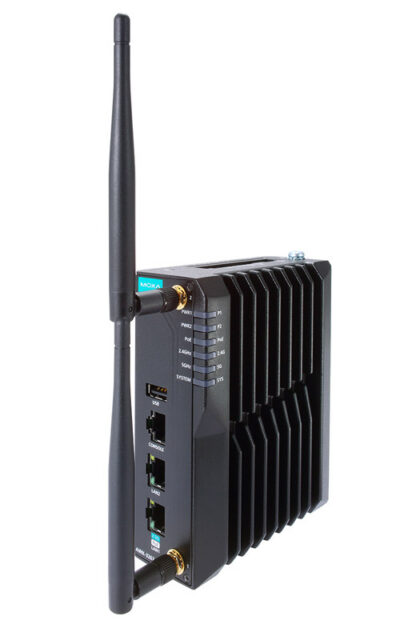
Moxa’s AWK-3262A Series industrial Wi-Fi 6 wireless AP/bridge/client supports reliable wireless connectivity and fast roaming in demanding industrial environments.
Marty Wachi, senior product marketing manager with Moxa Americas, said that “several converging technology trends are making industrial wireless networks faster, more reliable, and easier to deploy. Wi-Fi 6/6E, and increasingly Wi-Fi 7, add capacity, reduce latency, and improve performance in dense environments through OFDMA, multi-user MIMO, and the cleaner 6 GHz band.”
Wachi said that for mobile applications such as automated guided vehicles (AGVs), autonomous mobile robots (AMRs), and handheld devices, three IEEE 802.11 amendments work together to improve roaming. 802.11k helps clients identify nearby access points, 802.11v allows the network to steer them to a better connection, and 802.11r Fast BSS Transition shortens handoffs by pre-establishing security keys. The result is faster, more consistent roaming with fewer dropped sessions.
Private 5G complements Wi-Fi with wide-area mobility, high device density, and managed quality of service. In some deployments where customers have exhausted the available Wi-Fi spectrum, private 5G has proven to be a valuable upgrade. Because private 5G is complex and costly to deploy, however, ROI remains the key factor driving its adoption.
Industrial Wireless Applications
Industrial wireless solutions continue to target applications where traditional network cables are impractical, costly, or limit flexibility. Mobile automation is one leading area: AGVs, AMRs, overhead cranes, rail-guided vehicles, and rotating machinery require continuous, low-latency connectivity for navigation, control, and safety communications. Wireless also supports flexible manufacturing, facilitating movement in production cells, mobile workstations, and reconfigurable lines without rewiring.
Condition monitoring and asset tracking are another key focus. Wireless sensors support predictive maintenance, while location tracking helps manage tools and materials. Connected workers use tablets, scanners, and AR headsets for maintenance, inspection, and logistics, and higher-bandwidth Wi-Fi and private 5G now support machine vision and video. Wireless also reaches remote sites in water and wastewater, oil and gas, mining, ports, and transportation. All these use cases share a common thread: environments where wired cabling is impractical or too costly, and where mobility, flexibility, and lower installation costs are essential.
Challenges for Engineers
“Automation engineers face connectivity challenges that wired networks alone cannot solve, or cannot solve cost-effectively,” Wachi said. “Wireless gives engineers more freedom in machine and plant design: it reduces cabling and maintenance on moving equipment, speeds commissioning, and supports reconfiguring lines without rewiring. It also connects mobile and hard-to-reach assets, giving engineers real-time data for remote diagnostics and predictive maintenance.”
He added that wireless also brings its own challenge, however: metal structures, moving machinery, and crowded spectrum cause reflections, interference, and dropped connections. Advances such as Wi-Fi 6/6E and Wi-Fi 7, access to the less congested 6 GHz band, and fast roaming with 802.11k, 802.11v, and 802.11r are helping provide the reliability and low latency that mobile control applications require (shown).
Beyond connectivity, security and manageability are equally pressing. Many plants still run legacy wireless with weak encryption, creating risk as OT and IT networks converge, but WPA3, Protected Management Frames, and IEC 62443-aligned network designs are helping close these gaps. Engineers also contend with limited RF expertise and poor visibility into wireless performance, and centralized management, site-survey tools, and AI-assisted diagnostics now make it easier to plan, monitor, and troubleshoot networks. Together, these advances make wireless reliable, secure, and manageable enough to deploy with confidence, not just for convenience.
Outlook for Industrial Wireless
“The outlook for industrial wireless is positive, but growth will be driven by practical results rather than hype. Wi-Fi 7 is moving quickly into the enterprise mainstream, accounting for nearly a third of enterprise access point revenue in Q3 2025, according to IDC. It also raises the security baseline: devices must use WPA3 and Protected Management Frames to unlock full Wi-Fi 7 performance, making robust security the default rather than an option,” Wachi said. “That enterprise momentum, combined with the WPA3 requirement, should speed the transition to Wi-Fi 7 in industrial networks as manufacturers align plant-floor wireless with proven, more secure enterprise infrastructure.”
Manufacturers are also increasingly evaluating both private and public cellular: private 5G for on-site control, low latency, and on-premises data, and public 5G with network slicing for wide-area coverage, backup, and mobile assets that leave the plant.
Looking ahead, most plants will run a mix of Wi-Fi, private and public cellular, and low-power sensor networks—supported by AI-driven network management and IEC 62443 security—with ROI guiding every decision.