

TechnologyNovember 23, 2026
The Future of Factory Connectivity
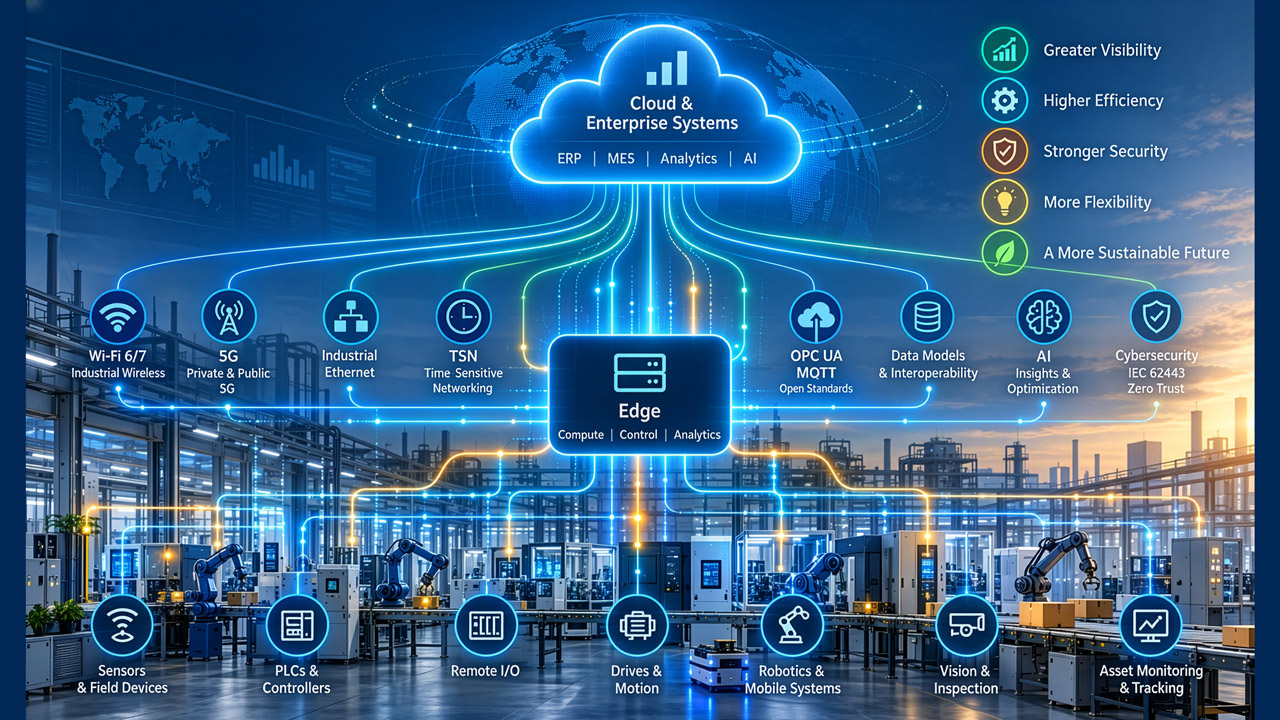
Factory connectivity is evolving as Industrial Ethernet, edge computing, interoperability and AI reshape industrial networks. This report explores how open, secure and flexible architectures are helping manufacturers integrate legacy systems, improve data access and build a foundation for connected manufacturing.
Factory connectivity is undergoing a fundamental transformation. Industrial Ethernet continues to extend deeper into automation systems, while edge computing, wireless technologies, standardized information models and software-defined architectures are changing how information moves from field devices and controllers to plant-level and enterprise applications.
At the center of this evolution is a move toward more open, layered and multi-protocol architectures. Manufacturers continue to operate plants containing equipment from different vendors and generations, making wholesale replacement neither practical nor economically desirable. Instead, emerging connectivity strategies are designed to integrate legacy and new systems while allowing manufacturers to modernize their networks incrementally.
But connectivity increasingly means more than simply moving data. The growing importance of analytics, edge computing and artificial intelligence is placing new demands on industrial networks. Data needs to be accessible, contextualized and understandable across systems if it is going to support applications ranging from predictive maintenance and production optimization to increasingly sophisticated AI tools.
These developments are also elevating cybersecurity, interoperability and network management. As OT networks become more connected to enterprise applications, cloud platforms and remote services, manufacturers must improve visibility and security while maintaining the availability and deterministic performance required by production.
The result is a broader definition of factory connectivity. Technologies including Industrial Ethernet, TSN, Single Pair Ethernet, Ethernet-APL, OPC UA, MQTT, industrial wireless and edge platforms increasingly form parts of a larger connectivity architecture rather than isolated solutions.
For automation engineers, the challenge is to take advantage of these capabilities without introducing unnecessary complexity. The goal is not connectivity for its own sake, but an infrastructure that makes industrial information more accessible, secure and useful while providing a practical path for future expansion.
For this Factory Connectivity Special Report, industry experts offer their perspectives on the technologies, architectures and engineering strategies shaping the next generation of connected manufacturing.
Connecting disparate systems is a common challenge to implementing modern technologies like AI. Automation solutions built for seamless integration as part of an enterprise operations platform leverage a unified data fabric to help move data freely from the field, through the edge, and into the cloud.
Evolution of Factory Connectivity Solutions
Edge tools can further distribute control and intelligence across an application or plant.
Alan Mathason, senior product manager for Emerson’s controls and software business, said that some of the most interesting changes in factory connectivity is how edge tools can further distribute control and intelligence across an application or plant without inherently risking security.
“Modern edge technologies will deliver value across all industrial sectors, and we see this resonating with both DCS and related PLC applications. Qualified non-commodity hardware enables flexibility in a wide range of applications at modest and high performance,” Mathason said. “Adding to this flexibility, software defined tools will continue evolving to simplify and anticipate application needs. This careful and intentional use of AI will unlock performance and implementation speed.”
Mathason said that properly layered, multi-protocol architectures are enabling outcomes well beyond what the industry is used to. Though there is a risk to over-selling infinite flexibility feature sets, thoughtful use of multi-protocol architectures allows a system to interconnect at a basic level, ensure security in both IT and OT perspectives, and segment a control problem to make use of critical process data that may be sensitive to deterministic behavior in addition to external advisory data from disparate systems or the web.
“A challenge to keep in mind is that when a system depends on data that must traverse protocol boundaries for the core control, designers must consider the associated latency, configuration complexity, and network stability, which have the potential to make the system seem unpredictable both during and long after commissioning,” Mathason said. “As such, care must be taken to understand these factors deeply so that the resulting system is only as complex as necessary. Complexity is easy to add, but simplicity takes deep thought.”
Impact of AI
He added that “we are in the time when AI has achieved many ‘straightforward tasks’ with amazing speed. Network load balancing, anomaly detection, cybersecurity monitoring, and more can leverage AI to streamline dashboards and prevent easily foreseeable problems.”
He said that one opportunity for AI to further develop factory automation connectivity is in contextual suggestions and, longer term, to give AI more of the control to implement those suggestions without intervention. Similarly to how AI tools have been used in the last few decades, the AI – like a person – can find a solution to a problem. The expert has context to be able to quickly assess second and third order implications to those solutions and adjust accordingly. This is an area where data connectivity will be key.
Disparate systems that aren’t connected must be considered. Some of these connectivity challenges are straightforward to overcome, while others have inherent boundaries because of issues like corporate and human privacy. Unlikely sources can end up contributing to an outcome, which intensifies the challenge. Like humans, AI will build heuristics and trust to manage a deeper problem space and drive systems to ultimately be simpler to execute and maintain.
Integrated Solutions
“As every segment of factory automation connectivity evolves and becomes more capable, a key challenge is to find the right balance of AI tools to organize and simplify workflows so the engineer can see more of the big picture of application performance,” Mathason said. “Much like running an entire company, the engineer will have enough of the low-level work managed outside of their day-to-day thought process and can consider what is needed to continue application growth and scalability.”
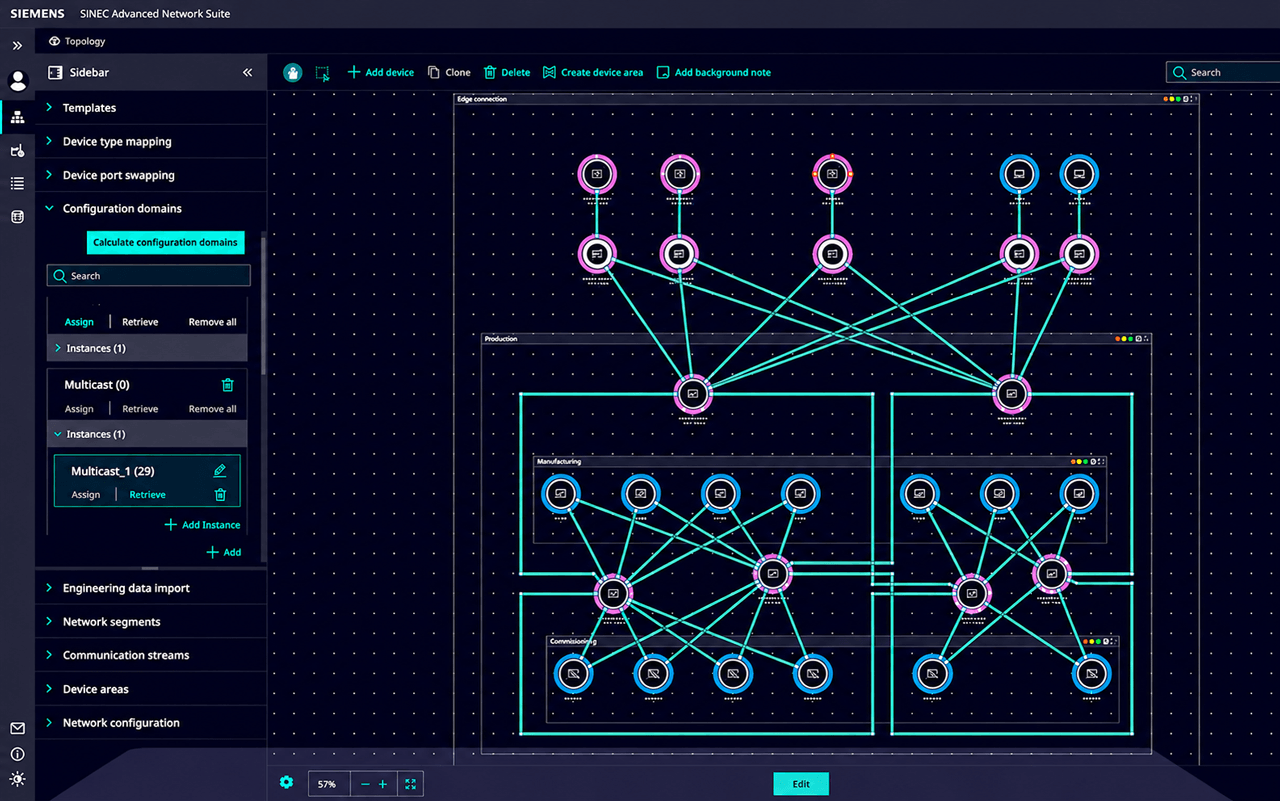
Figure 1: Siemens’ SINEC Advanced Network Suite (ANS) uses an intent-based approach to help engineers design, configure, and manage secure and scalable industrial Ethernet networks, while reducing manual engineering effort and configuration errors.
Focus on Network Modernization
Industrial Ethernet replacing legacy fieldbus systems.
According to Steve Pickhardt, OT Portfolio Specialist at Siemens Digital Industries, network modernization is one of the biggest trends shaping industrial networking, with industrial Ethernet largely replacing legacy fieldbus systems.
“Many factory networks were never designed as complete architectures, instead evolving over decades as machines, PLCs, HMIs, drives and switches were added to meet individual production needs,” Pickhardt told Industrial Ethernet recently. “Ethernet itself often entered the plant as a replacement for serial or proprietary fieldbus connections and continued expanding throughout the automation architecture.”
Pickhardt said that organic growth has left many manufacturers with flat networks, inconsistent architectures, limited asset visibility and legacy equipment without modern cybersecurity capabilities. As manufacturers connect these environments to MES, enterprise systems, remote services and cloud applications, cybersecurity and network modernization increasingly must occur together.
“The goal is not to rip and replace functioning automation systems all at once, but to move legacy media toward Ethernet in phases,” Pickhardt said. “These efforts improve network architecture, segmentation, visibility, and cybersecurity over time, while creating the connectivity foundation for industrial wireless, edge computing, analytics, and AI.”
Layered, Multi-Protocol Architectures
He added that modern factory networks are moving away from flat architectures toward structured, layered industrial Ethernet designs. A practical model separates the network into production-cell, aggregation, and backbone layers, with each layer addressing different requirements. Production cells emphasize deterministic communication and availability; aggregation provides segmentation, redundancy, and traffic management; and the backbone provides high-capacity connectivity between production areas and the IT/OT boundary.
Equally important, these networks increasingly span multiple protocols and vendors. A factory may contain Siemens controllers connected via PROFINET alongside Rockwell Automation systems using EtherNet/IP, in addition to others relying on Modbus TCP, OPC UA, and others. But because all these systems use common Ethernet digital media, they can share common, structured Ethernet infrastructure.
Additionally, proper segmentation, VLANs, QoS, and redundancy allow different applications to coexist while maintaining the deterministic performance required by automation. This provides manufacturers with greater flexibility to integrate new and legacy equipment, expand production, improve cybersecurity, and connect OT to higher-level systems without continually creating separate network infrastructures.
Advances in AI in Automation
“AI and advanced analytics are increasing the prominence of the industrial network backbone because these applications depend on reliable, contextualized OT data,” Pickhardt said. “The industrial network provides the foundation for applications such as predictive maintenance, production optimization, and cross-site analytics.”
The second impact is on how networks themselves are engineered and operated. As access to network and device data improves, AI can help engineers recognize abnormal behavior, identify developing problems, and reduce troubleshooting time.
For example, Siemens’ SINEC Advanced Network Suite (ANS) applies an intent-based architecture approach, using the engineer’s operational and business intent to help design network configurations that are error-free, cybersecure, and easier to scale (Figure 1). This moves AI beyond simply analyzing production data toward assisting engineers in building and maintaining the infrastructure carrying that data.
“AI will not replace network or automation engineers; its real value is in helping engineers make better decisions and manage increasingly complex OT environments,” Pickhardt said. “Looking forward, AI will work alongside industrial Ethernet, edge computing, and cloud applications, but AI does not eliminate the need for good OT architecture. In fact, it makes that foundation even more critical.”
Challenges for Automation Engineers
“Automation engineers are being asked to manage networks that are larger, more interconnected, and increasingly complex while still maintaining the availability and deterministic behavior required by production,” Pickhardt added. “At the same time, many engineers inherit legacy equipment, flat networks, and architectures that have grown organically for years.”
Engineers require high visibility to effectively troubleshoot and secure their environments. Modern factory networking therefore needs better topology discovery, device diagnostics, configuration management, and asset visibility.
He said that another challenge is maintaining interoperability across multi-vendor and multi-protocol environments while protecting deterministic production traffic. And segmentation, controlled IT/OT connectivity, secure remote access, and monitoring must be inherent in the network architecture.
“The objectives are not simply more bandwidth, but making increasingly sophisticated OT environments more visible, interoperable, standardized, resilient, secure, and easier to operate throughout their lifecycle,” Pickhardt concluded. “This also helps address workforce limitations by reducing manual engineering, simplifying troubleshooting, and making specialized networking knowledge easier to apply consistently across sites.”
Software-defined Architectures
Containerized, microservice‑based standardized software modules gaining traction.
John Wang, FieldComm Group China Tech Director, said that factory automation is based on PLCs or controllers, with large numbers of AI, AO, DI and DO signals from the workshop field. Besides the fieldbus-based networks between the PLC/Controller with the field devices/nodes (sensors, switches, valves…), ethernet-based networks between PLCs, and PLCs with various monitoring, management and optimization applications such as IDM, SCADA, MES/EPR, are increasing sharply.
Time‑Sensitive Networking (TSN), 5G/Wi-Fi and single-pair ethernet (SPE) are becoming mainstream complements to traditional copper ethernet, and ethernet-based networks are going down to the field to replace the analog and field-bus connections between the PLCs with the field devices.
“On the software side, containerized, microservice‑based standardized software modules are gaining traction. Especially, software-defined architecture is influencing the next PLCs/controllers generations,” Wang said. “New PLCs/controllers can be cost-effective, high performance and solid industrial computers, or even cloud based virtual machines, with many kinds of standard software modules and various ethernet physical ports that can be used to connect with both the field devices and upper M&O applications. Such a new PLC/controller includes not only the traditional control logics but also edge gateway, data server and AI functions.”
He added that standardized data & information models are also a trend for FA connections. Now OPC-UA builds not only the bridge between OT (PLC and edge gateway) with IT (MES/ERP and others), but the trend is also for OPC-UA to be implemented in the field devices directly. As a reference, FDI and PA-DIM defined for PA field device integration should be adopted in FA applications to unify the data from various FA communication protocols.
Factory Networking Solutions
“ISA-95 industrial hierarchy remains universally applicable. The features and requirements for information vary at different levels: the lower the level, the more data nodes (or access points), the faster update rate, but less payload in one communication transaction; vice versa. The hierarchy architecture also meets the industrial security and authority management requirements,:” Wang said. “And considering the applications of FA are diverse and ever-changing, multi protocols, PROFINET, EtherNet/IP, EtherCat, Modbus-TCP, etc., would exist forever, even though they are sharing the same ethernet physical layer, or even the same IP + TSN network layers.”
He said that the result is that layered, multi‑Protocol architectures will be kept as the key feature of industrial ethernet. SPE/APL and 5G/Wi-Fi with industrial protocols would be the end of the industrial ethernet network connecting with the field nodes, for low-power, cyclic data but widespread connections; switches and gateways in the middle level act as network bridges, connecting the field devices with the software defined virtual PLCs/controllers; and above the level 2, Gigabit ethernet or even internet connecting the PLCs with the upper OT & IT applications.
“This layered design is not only for green-field, but also brings flexibility for brown‑field modernization,” Wang said. “Existing legacy automation devices can connect to the new ethernet network via protocol translation layers and gateways, avoiding large‑scale equipment scrapping. The control plane manages scheduling and traffic prioritization, isolating motion‑critical low‑latency traffic from non‑real‑time IT data flows.”
Advances in AI
“AI reshapes factory connectivity mainly through intelligent network operation, predictive network maintenance and adaptive traffic scheduling,” said Wang. “Traditional industrial networks rely on static manual configuration; AI‑driven network analytics continuously monitor latency, packet loss and jitter across thousands of shop‑floor nodes. Machine learning models identify subtle network degradation long before it triggers production downtime alarms.”
AI‑enabled TSN scheduling dynamically adjusts bandwidth allocation. When mobile AGVs, vision inspection systems and motion controllers generate fluctuating data loads, AI algorithms re‑prioritize real‑time traffic automatically, removing the need for engineers to manually tune network parameters for every production‑line change.
“Looking ahead, AI will not replace deterministic industrial connectivity foundations, but act as an optimization overlay,” he added. “Edge‑local AI processing keeps latency‑critical decisions on‑premises instead of sending raw data to cloud. The main outlook is closed‑loop self‑optimizing factory networks: connectivity infrastructure senses conditions, AI computes adjustments, and networks reconfigure themselves to match shifting manufacturing requirements.”
Looking Ahead
The continuous emergence of new knowledge, new products, new tools and new methods, bring huge challenges to the automation engineers facing the on-going plant digital transformation, not even considering the increasingly urgent demand for rapid market responsiveness.
Wang said that, looking into the future, automation engineers face four core difficulties: heterogeneous legacy device integration, growing network security exposure amid OT‑IT convergence, frequent production‑line reconfiguration demands, and shortage of skilled OT networking talent.
FA connectivity solutions should address these challenges:
As previously mentioned, the layered, multi-protocols architecture works for brown-field as well, this can relieve the pains of integrating the legacy devices and learning new ethernet knowledge; and hierarchy architecture is benefit for network security;
Cyber security should be standardized, and standardized network management and operation methods should be normalized. The Industrial Security Harmonization Group (ISHG) has been set up by the four leading Standards Development Organizations (SDOs) to strengthen cyber resilience in industrial automation and control systems (IACS) with various industrial protocols;
A unified device information model like FDI & PA-DIM is a powerful support for digital data integration. Automation engineers can pay less attention to the multi protocols understandings and new devices & tools learning but on the real data applications, to re-config the production-line more efficiently to meet the rapid market responsiveness.
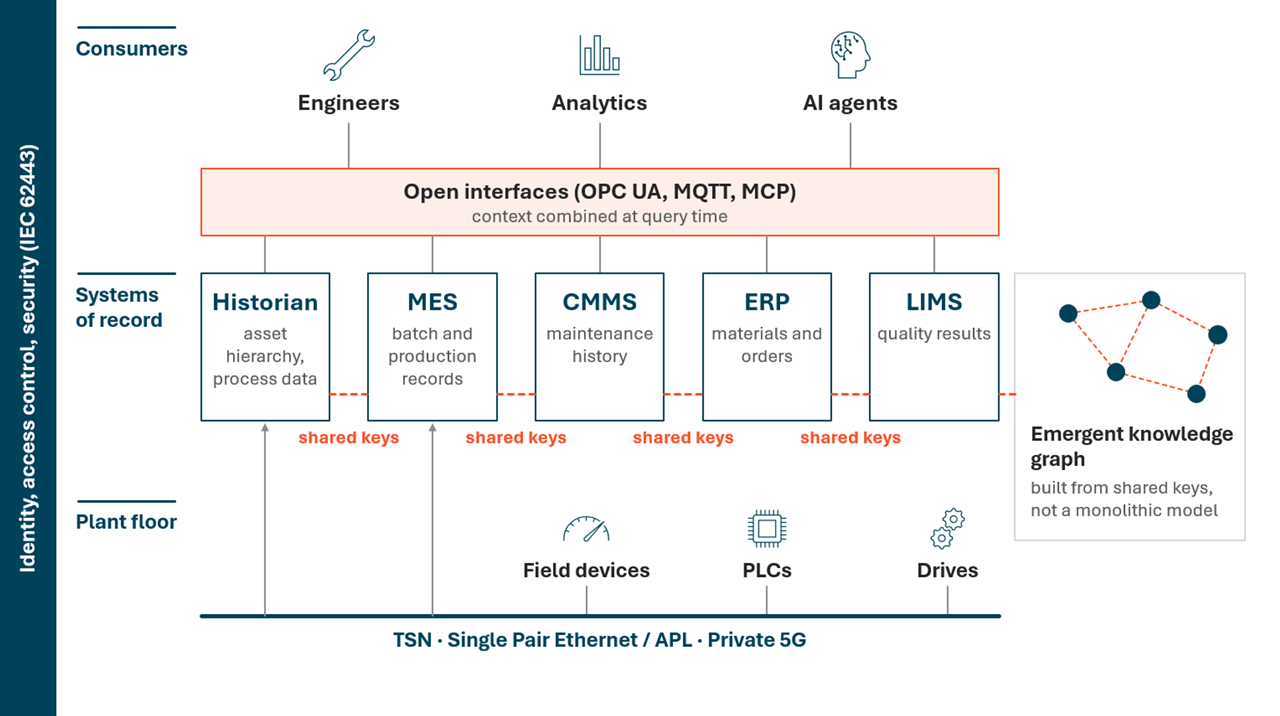
Open industrial connectivity empowers process engineers, analytics platforms, and AI agents to securely access data and gain context across plant and enterprise systems.
Technology Shaping Future Networks
Time-Sensitive Networking, Single Pair Ethernet, Ethernet-APL and Software Solutions.
Key technology megatrends including expanded hardware, software and connectivity options are playing a key role in the future of Industrial Automation networking.
“Several trends are shaping the future of industrial networking, starting with hardware, where Ethernet is reaching further into the plant,” said Chris Herrera, head of API and interoperability at Seeq. “Time-sensitive networking provides deterministic behavior for standard Ethernet, single pair Ethernet and Ethernet-APL extend it to field devices that used to sit on 4-20 mA loops, and private 5G is filling in for mobile applications and locations that are difficult to wire. Over time, this is breaking down protocol silos and consolidating assets on a single IP-based network from sensor to cloud.”
Herrera said that automation is also becoming software-defined, with virtual PLCs, containerized edge applications, and publish/subscribe architectures built on OPC UA and MQTT to separate control and data logic from the hardware they run on. This empowers plant personnel to update functionality much the way IT staff updates software, rather than waiting for a hardware refresh.
“At the same time, the convergence of OT and IT data is changing what networks are expected to do. Industrial information now flows to cloud-based data lakehouses and enterprise systems, and it is increasingly used by AI agents,” Herrera said. “As a result, identity, access control, and cybersecurity are now part of system design from the start. Taken together, these trends make more data from more places available to more consumers than ever, but the new challenge is making that data useful to whoever needs it.”
Development of Connectivity Solutions
Industrial data has always needed context, and Herrera said that ISA-95 defined that need more than two decades ago. In practice, though, much of that context lived in people, such as the engineer who knew which tag represented feed flow to Reactor 3. Because AI cannot draw on that experiential knowledge, increased context is ultimately required. AI can, however, reason across the context that systems already hold, as long as the data is connected in some way.
Because the context that systems hold has traditionally been siloed, the predominant thinking today is centralizing first by building a single knowledge graph or unified model before turning on AI. That work can provide value, but it is often slow and tends to fall behind the plant it describes. The alternative is to let each system contribute what it already knows, such as asset hierarchy in the process historian, batch record in the MES, and maintenance history in the CMMS. Open protocols such as the model context protocol (MCP) then give AI agents a governed way to query each system and combine that context on demand.
A knowledge graph can still emerge, built from the shared keys that link systems, rather than from an enterprise ontology modeled up front.
Moving Ahead
“Most automation engineers work with and in mature plant environments, where a single site may include equipment spanning several decades, many different fieldbuses, an old DCS, and multiple historians,” Herrera said. “However, open standards like OPC UA, MQTT Sparkplug, and common information models help engineers connect diverse assets from different vendors and eras without requiring a bespoke integration for every minor system.”
In addition, as experienced engineers retire, the informal knowledge that kept plants running often leaves with them. Connectivity that carries context into systems—along with the AI tools supporting them—helps new engineers continue carrying the baton.
“Security is a growing concern as well, since every new connection to the cloud, a partner, or an AI agent widens the attack surface. IEC 62443 and zero-trust architectures are becoming baseline expectations, so identity and access control must now be built into connectivity solutions,” he added.
“Engineers are increasingly asked to serve IT and business stakeholders who expect data on demand. Solutions that facilitate secure OT data flow to enterprise systems, with its context intact, make this sustainable.”
Three Connected Priorities
Open Industrial Ethernet, distributed intelligence, and practical access to field data.
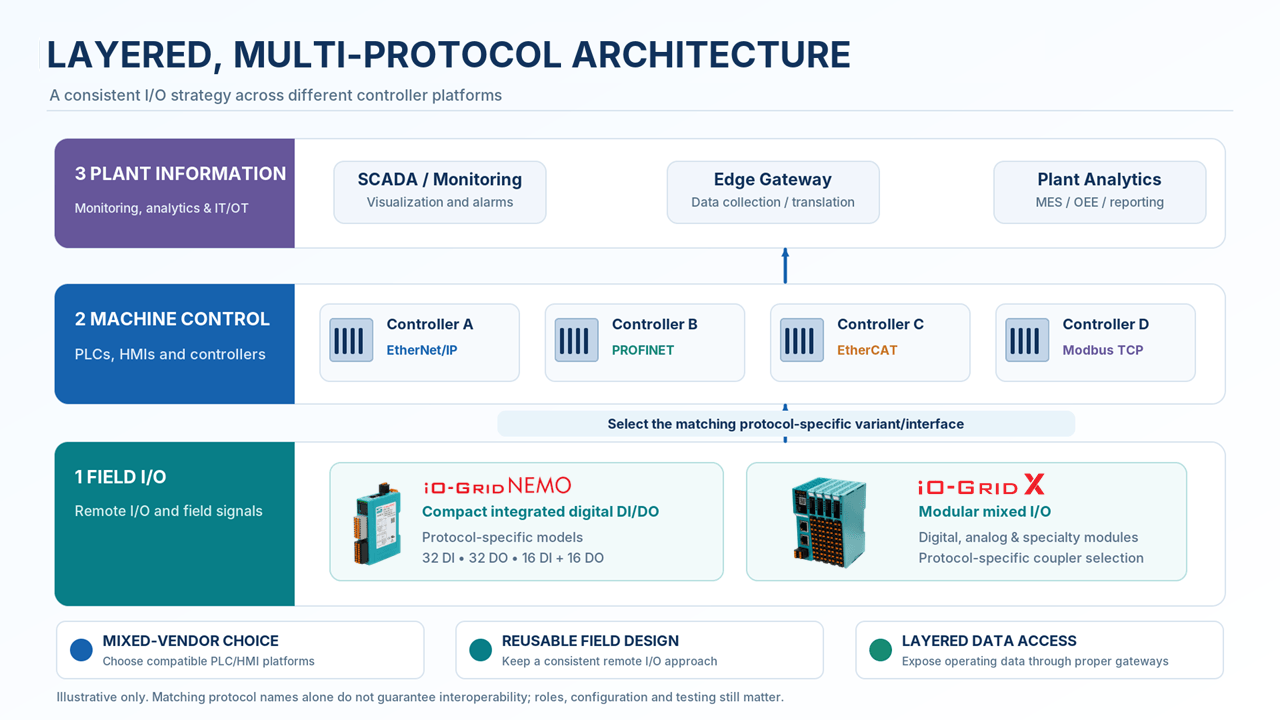
“Factory networking is moving toward three connected priorities: open Industrial Ethernet, distributed intelligence, and practical access to field data. Machine builders increasingly need to connect PLCs, HMIs, remote I/O, and higher-level systems without being locked into a single vendor,” said Matt Hou, a sales engineer for Dinkle International. “As a result, support for established protocols – such as EtherNet/IP, PROFINET, EtherCAT, and Modbus TCP – remains essential, even as edge software and secure data integration evolve.”
Hou said that, at the machine level, distributed remote I/O is becoming an efficient entry point for field signal digitization.
Instead of routing every sensor and actuator wire back to a central cabinet, engineers can place I/O devices closer to equipment and communicate over industrial networks. This helps simplify wiring, supports modular machine layouts, and speeds expansion.
Dinkle/Daudin’s iO-GRID portfolio reflects this direction in two complementary forms: iO-GRID NEMO integrates digital inputs and outputs in a compact unit, while iO-GRID X provides modular I/O expansion for mixed signal needs. The important trend is not simply more connectivity; it is making field data easier to access and reuse across control architectures.
Architectures based on Industrial Ethernet
“Layered, multi-protocol architectures are changing factory networks by separating the functions of field signal acquisition, machine control, and information exchange,” Hou said. “At the field layer, sensors and actuators connect to distributed remote I/O. At the control layer, PLCs and HMIs exchange operating data over the industrial Ethernet protocol selected for that machine. Edge gateways or supervisory systems can then make relevant information available to plant applications, without requiring every field device to communicate directly with enterprise software.”
This structure helps system integrators work with different controller ecosystems and preserve established machine designs. For example, Dinkle/Daudin iO-GRID NEMO offers compact digital I/O variants for protocols including EtherNet/IP, PROFINET, EtherCAT, and Modbus TCP, while the modular iO-GRID X series supports configurations that require additional I/O types. Selecting the appropriate protocol-specific interface allows a consistent field I/O approach across different projects.
“The key benefit of mixed-vendor integration is architectural flexibility. Engineers can choose controllers, visualization tools, and remote I/O on the basis of application requirements rather than adopting a single supplier’s entire portfolio. Interoperability still depends on compatible roles, configuration, and validation—not merely matching protocol names,” Hou said.
Challenges Automation Engineers Face
Hou noted that automation engineers are being asked to connect more equipment while shortening commissioning time and keeping existing systems running. Typical obstacles include limited cabinet space, long field wiring runs, multiple PLC brands, troubleshooting across network segments, and the need to obtain usable data from machines that were not originally designed for plant-wide monitoring.
“Distributed remote I/O can address several of these issues at the source. Placing I/O near sensors and actuators reduces the amount of point-to-point wiring back to the main cabinet and makes machine sections easier to standardize,” Hou said.
“Compact, integrated digital I/O such as Dinkle/Daudin iO-GRID NEMO fits installations with concentrated DI/DO requirements; modular platforms such as iO-GRID X help when signal types or channel counts change. Multi-protocol product options also make it easier to reuse an I/O concept across different controller platforms.”
For projects such as conveyor systems, packaging lines, semiconductor equipment, and data center coolant distribution units, the goal is the same: turn field signals into reliable, accessible information without making the control system unnecessarily complex. Clear diagnostics, sensible network design, and verified interoperability remain as important as the hardware itself.
Two Connected Megatrends
End-to-end Ethernet connectivity and semantic interoperability based on standard models.
Pingsheng Xu, Director of Device Integration BU at M&M Software (Suzhou) GmbH told Industrial Ethernet that he sees two closely connected megatrends: end-to-end Ethernet connectivity that supports multiple services, and semantic interoperability based on standardized information models. The first brings control, device management, diagnostics, and video onto a more unified network foundation. The second makes the resulting data easier to integrate and reuse.
“The commercial feedback loop matters as much as the technology itself. As adoption grows, suppliers can reuse more hardware designs, software components, and engineering tools across products and projects,” Xu said. “Greater scale spreads development costs, improves product availability, and lowers adoption costs. Lower costs then attract more users and suppliers, reinforcing the cycle.:
Xu said that semantic interoperability addresses the labor side of integration. Standardized information models can reduce repeated data mapping, custom adaptation, and commissioning effort when connecting devices from different vendors. I expect these two trends to reinforce each other: network convergence lowers the cost of connectivity, while shared semantics lower the cost of making that connectivity useful. Together, they can shorten project schedules and make future expansion more economical.
Layered, Multi‑Protocol Architectures
The most immediate value of layered, multi-protocol architectures is making brownfield modernization more affordable. Existing devices and control networks can remain in service while new connectivity and applications are introduced incrementally. This avoids turning each digitalization project into a replacement project and allows investment to follow actual operational needs.
“The architectural benefit is that applications can become less dependent on specific field protocols,” Xu said. “Once device information is exposed through consistent interfaces, changes at the device or network level need not trigger equivalent changes in every application. This creates more scope to reuse integration work across projects.”
For greenfield projects, Xu expects a stronger preference for end-to-end Ethernet connectivity and converged infrastructure from the outset. Evidence of reliability, cybersecurity, and economic value from real deployments will strengthen that preference, but greenfield adoption does not have to wait for brownfield modernization.
The two paths can reinforce each other: brownfield projects expand compatibility and practical experience, while greenfield projects increase scale and encourage simpler architectures.
AI Advancements
“AI will increase demand for richer, machine-readable device data with clear meaning and context. Data-intensive applications will also require more bandwidth,” Xu said. “My expectation is that, as communication bottlenecks ease, the central question will shift from how much device data can be transmitted to which additional data can create value.”
He said this could influence the design of intelligent devices themselves. Manufacturers would have greater incentive to expose more diagnostic information, operating conditions, and detailed measurements rather than limiting external access to a small set of control variables. Better connectivity would make this richer information more practical to use, while standardized semantics would make it easier for AI applications to interpret.
“The opportunity is not to fill unused bandwidth. It is to make useful information available that was previously too costly or difficult to access. Combined with advances in device sensing and processing, this can support new applications in fault diagnosis, condition monitoring, and production optimization, Xu said. “I therefore expect better connectivity, richer device data, and valuable AI applications to reinforce each other and drive further investment.”
Challenges Moving Ahead
The growing number, variety, and complexity of intelligent devices create a compounding challenge for automation engineers.
The burden is therefore not simply managing more devices, but managing more differences and interactions throughout construction, commissioning, and maintenance.
“I expect converged Ethernet infrastructure to reduce the connectivity side of this burden by reducing fragmented networks, unnecessary protocol conversions, and duplicated integration work,” Xu said. “More consistent device interfaces would also allow engineering knowledge and workflows to be reused instead of recreated for each product.”
He noted that AI tools could significantly reduce training and knowledge acquisition costs. By combining device documentation, operational data, and engineering experience, they can provide guidance for the task at hand, assist configuration, and help interpret faults. Engineers would spend less time learning where information is hidden or remembering the details of unfamiliar tools.
The combined opportunity is to simplify what can be standardized and make the remaining complexity easier to handle. This would let engineering teams support more diverse equipment without a proportional increase in training and maintenance effort.