

TechnologyMay 23, 2026
Connecting Operations with IT using Industrial Edge Switches
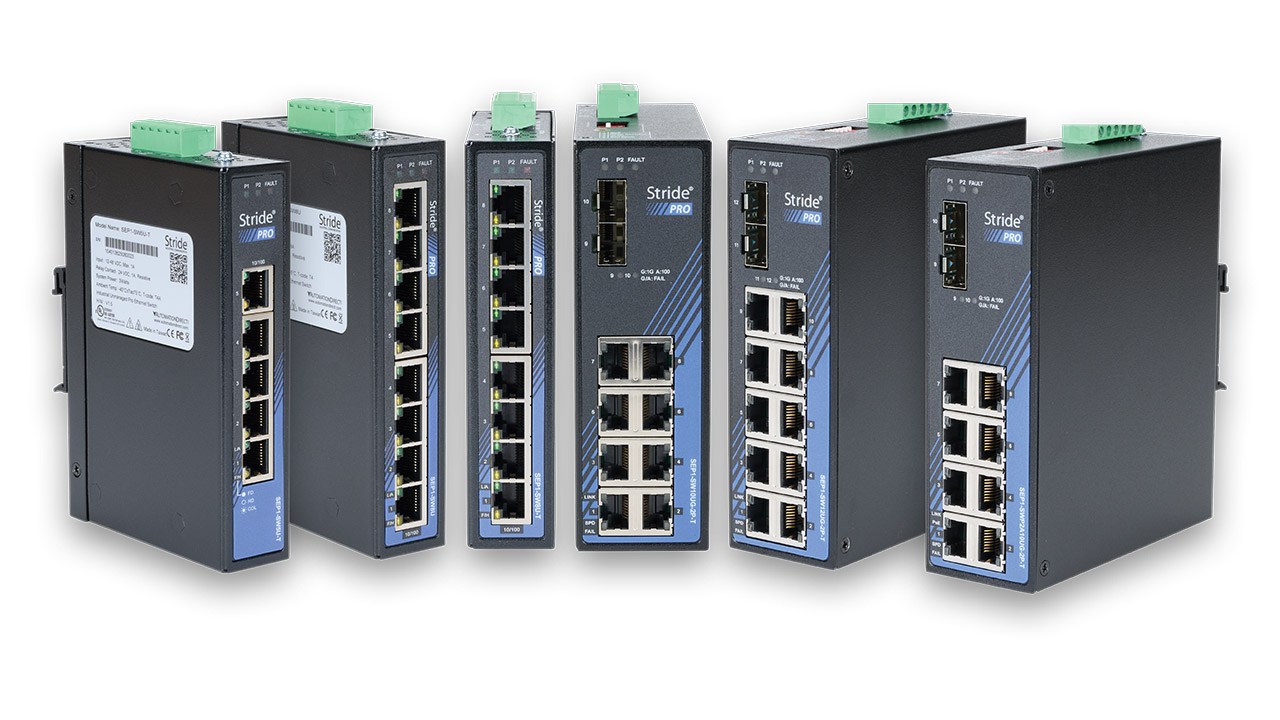
Edge-optimized Ethernet switches incorporate best practices from IT (information technology) without compromising operation technology (OT) performance or introducing complexity, enabling organizations to turn data into better processes, systems and outcomes.
Figure 1 (above): Unmanaged+ industrial Ethernet switches like the Stride PRO series from AutomationDirect simplify data sharing. Advanced network monitoring and troubleshooting features are activated via DIP switches, delivering high performance without the complexity of traditional configuration.
In modern manufacturing and automation systems, the distinctions between operational technology (OT) and information technology (IT) digital networking are increasingly blurring. OT implementations originally used networks to control physical processes and machinery, while IT has long focused on managing electronic data in business environments. Advances in analytics, driven by artificial intelligence (AI), are accelerating the convergence as OT data is desperately needed by IT-centric resources, creating new opportunities for operations of all sizes. Now there is more common ground than difference for these approaches, as both seek to leverage data and maximize its potential.
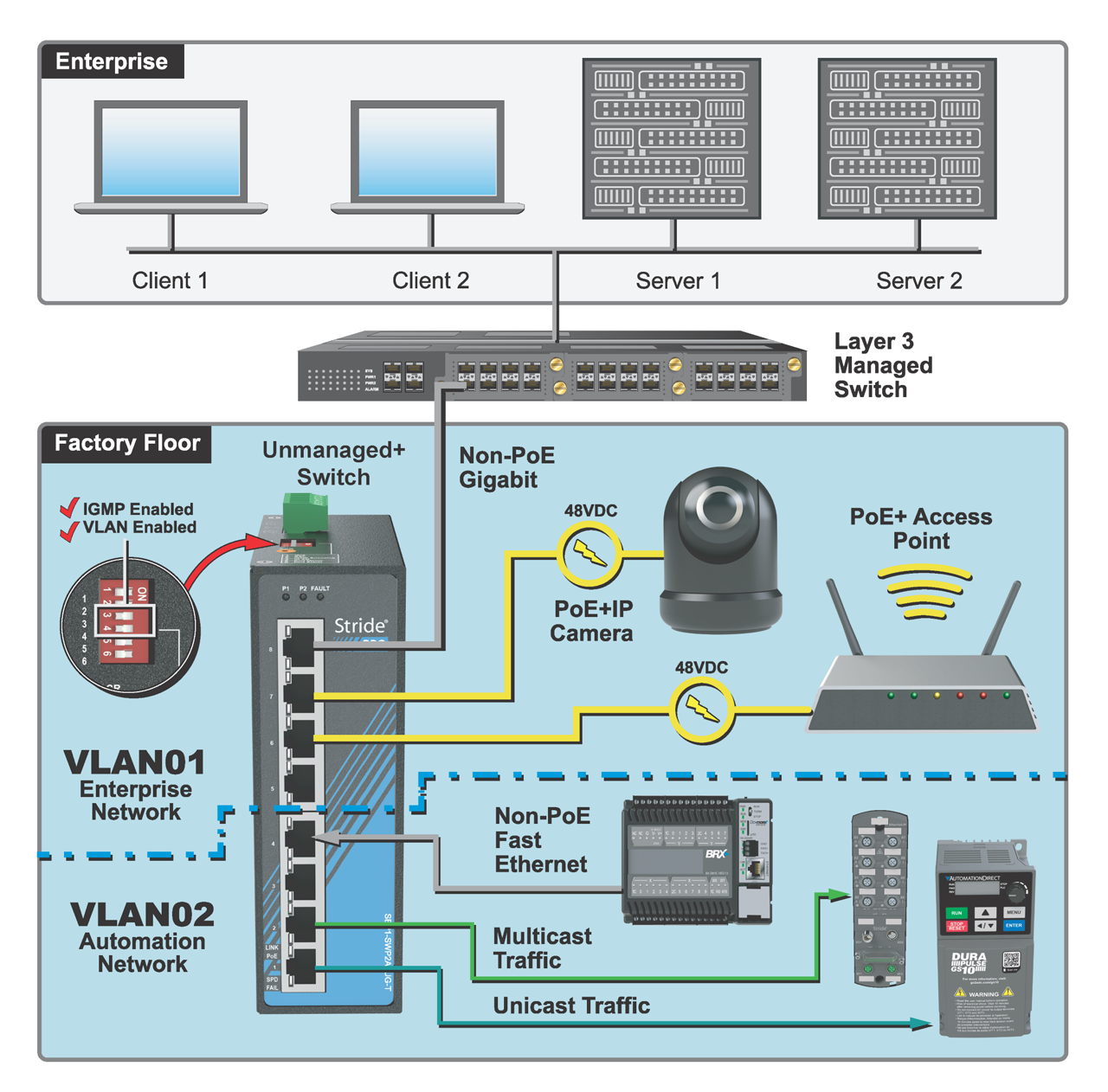
Figure 2: Unmanaged+ industrial edge switches facilitate secure, seamless data sharing between IT and OT networks, supporting AI and analytics in an accessible, user-friendly manner.
Thoughtfully designed and selected hardware can help build the bridge between these two domains in a manner that satisfies the goals and requirements of the entire organization. This means prioritizing solutions that:
- Enable secure data sharing between the plant floor and enterprise
- Support industrial protocols alongside IT standards
- Provide visibility without compromising determinism
- Reduce complexity without sacrificing resilience
Of course, this is sometimes easier said than done. OT personnel may believe that IT doesn’t understand what is needed to implement a robust and deterministic network, while IT staff may deem OT as lacking deep enough knowledge about properly configuring managed switches to interface with corporate networks. Furthermore, for many industrial organizations, both OT and IT resources and expertise are limited, making a fully-managed network infrastructure cost-prohibitive and difficult to support.
With this in mind, a new class of industrial edge switches have emerged—devices that skillfully bridge the gap between unmanaged OT hardware and a fully-managed, configurable IT-administrated Ethernet-based network infrastructure, with features such as simple plug and play options.
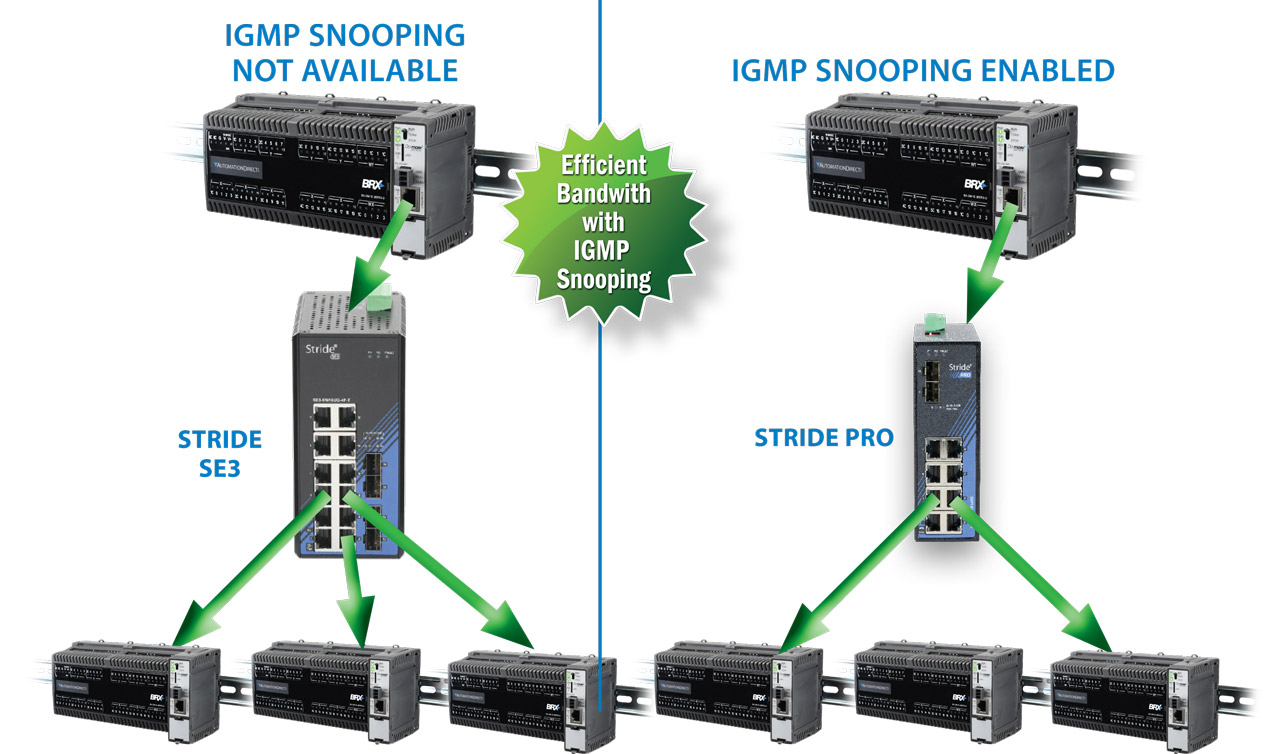
Figure 3a
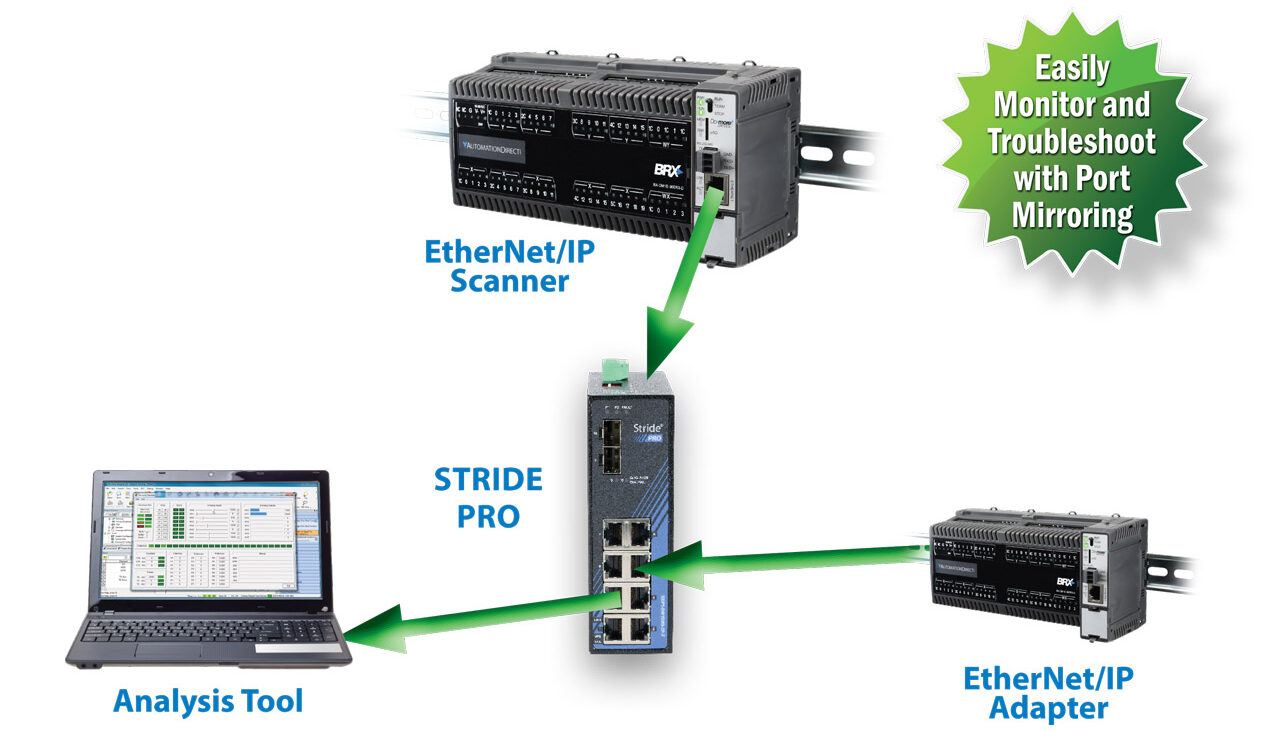
Figure 3b
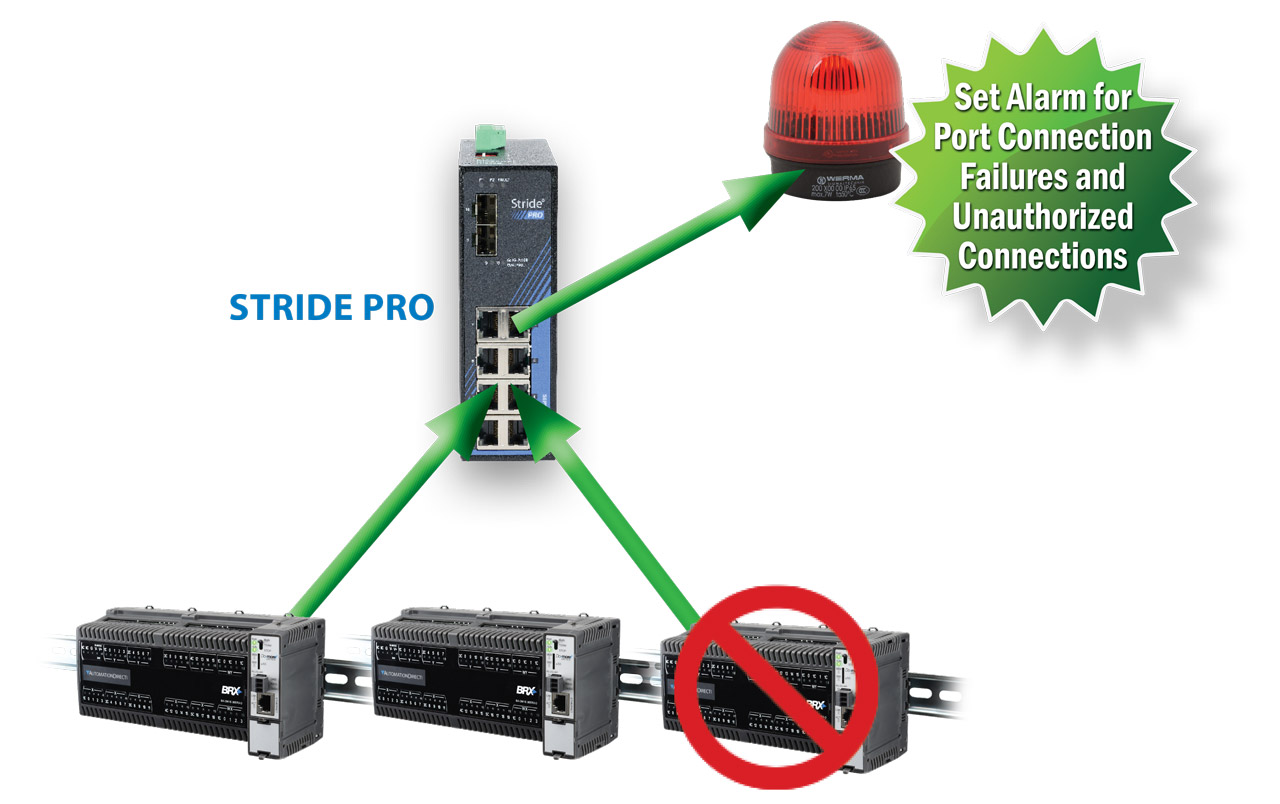
Figure 3a, 3b, 3c: Unmanaged+ switches like the Stride PRO from AutomationDirect allow OT teams to troubleshoot the control network using traditional IT tools like IGMP snooping (3a) and port mirroring (3b) along with more OT-focused options such as port disconnect alarms (3c), without IT support.
Striking a balance
IT typically segments networks for security reasons and to minimize unnecessary traffic to destinations that don’t require it. Typically, IT accomplishes this using a port-based virtual local area network (VLAN) philosophy across highly-managed switches. OT networks are segmented for similar reasons using unmanaged switches and dedicated physical connections to implement a robust and deterministic network, especially for devices like remote input/output (I/O) that can generate tremendous multi-cast traffic with programmable logic controllers (PLCs), and for human-machine interfaces (HMIs) connected to multiple PLCs.
At the edge where IT and OT networks converge (Figure 2), a hybrid approach using industrial edge switches is increasingly the preferred option. Industrial edge switches are built with withstand the industrial environment and with specific features to help ensure seamless data transmission of OT data throughout the organization, without the complexity that requires an entire IT department to support. Some industrial edge switches may be referred to as lean or lightly managed, and will still require a degree of software configuration. However, another category called an unmanaged+ switch can provide the essential OT capabilities, with simple DIP-switch configuration.
For convenient and reliable industrial use, edge switches should be DIN-rail and panel mountable with IP30 metal housings, able to withstand extreme temperature ranges, and readily powered by 24 VDC. Perhaps most importantly, they require significantly better immunity to electrical noise and surges than commercial-grade switches with superior models offering redundant power inputs with industrial surge, spike, and reverse power protection.
An example of an industrial edge switch providing advanced features yet only requiring DIP-switch configuration is the Stride PRO Unmanaged+ Ethernet Switch from AutomationDirect (Figure 1). This series consists of smart, industrial switches specifically developed to interface with equipment such as PLCs, HMIs, and variable frequency drives (VFDs), while maintaining consistent cycle times for control data even under heavy I/O traffic. Unmanaged+ switches make it simple to upgrade legacy serial communications to Ethernet protocols so data can be easily shared and analyzed.
Unmanaged+ switches deliver the right amount of intelligence to secure and optimize common industrial protocol traffic—without requiring IT-level expertise to configure. For easiest implementation, designers should consider unmanaged+ switches with rapid provisioning technology to simplify set-up, eliminating the need for software, configuration files, and IP addressing. Instead, key features on the unmanaged+ switch are enabled by toggling a DIP switch setting. Troubleshooting is equally streamlined, since OT teams have direct access to diagnose issues without relying on support from or coordinating with IT. In this way, uptime is maximized, unlike traditional managed switches where access is often restricted for security reasons.
On the edge—in a good way
As the boundaries between IT and OT dissolve, industrial edge switches increasingly utilize IT strategies to help secure and optimize network traffic. The leading unmanaged+ switches incorporate features including:
Fast/Gigabit Ethernet and SFP
Communication speed is a growing consideration for industrial networks. Designers should look for unmanaged+ edge switches support varying connector types, including copper RJ, fiber optic, and small form-factor pluggable (SFP). Fast Ethernet (100Mbps) is quite common for industrial devices, although an increasing number are capable of Gigabit (1000Mbps) or faster speeds. Fiber optic cabling enhances reliability in harsh and noisy industrial environments since the cables are immune to electrical and magnetic interferences as well as induced voltage transients, and it greatly increases networking distances, allowing more devices than ever to communicate on the same network.
Power over Ethernet (PoE)
More industrial switches now support PoE technologies (PoE, PoE+, PoE++), delivering both power and Ethernet communication over a single cable. This reduces material and labor costs during commissioning and simplifies moves, adds, and changes as the network matures. Depending on the model, unmanaged+ switches can supply up to 240W at 48 VDC. Many models, like the Stride PRO, also auto-detect PoE-enabled devices, further simplifying provisioning.
Traffic prioritization
Quality of service (QoS) is used to prioritize time-sensitive control data, while broadcast storm protection (BSP) limits network traffic to help maintain network reliability and prevent network issues from interrupting critical automation processes. Unmanaged+ switches are tuned to prioritize industrial protocols such as EtherNet/IP, PROFINET, Modbus TCP, and others.
IGMP snooping
Network bandwidth is automatically optimized by enabling IGMP snooping to ensure multicast traffic is sent only to specific ports. When IGMP snooping is activated, the switch listens to traffic, directing data to specific physical ports that require and subscribe to the information. This prevents a device from sending unnecessary data to all connected devices, regardless of whether the information is relevant (Figure 3a). IGMP snooping protects sensitive industrial equipment from too much data and prevents unnecessary network congestion, ultimately improving efficiency.
VLAN support
Utilizing unmanaged+ switches with port-based VLANs allows for the creation of isolated broadcast domains by assigning each physical port to a specific VLAN. This approach provides a flexible, cost-effective architecture that is easier to manage than physically segmenting the network with multiple managed switches.
Port mirroring
An excellent tool for troubleshooting and analysis, port mirroring provides real-time visibility to network traffic without the need to interrupt operations. Port mirroring sends a duplicate stream of data between selected devices to a designated monitoring port on a laptop or diagnostic tool (Figure 3b). This helps quickly identify suspicious activity, unauthorized devices, and echo requests that can interrupt automation controls.
Port disconnect alarms
Quickly identify hardware issues—including broken cables, unplugged connectors, or failed devices—by utilizing port disconnect alarms. This proactive monitoring feature speeds up troubleshooting by pinpointing physical network problems, especially when paired with visual signaling via a hardwired tower light or PLC/HMI alarm (Figure 3c).
Network utopia starts with simplicity
Today, there are more reasons than ever to prioritize the integration of IT and OT to enable data sharing between plant and enterprise, by supporting industrial protocols alongside IT standards. In the current business environment, better processes, systems, and outcomes create a significant competitive advantage, and leveraging insights across IT and OT networks can help tip the scales. Everything from remote diagnostics to machine learning, AI agents, and even off-line analytics requires a practical and reliable network infrastructure. IT and OT networks that share a common infrastructure and policies are most successful at consistently and efficiently providing visibility without compromising determinism while exchanging data.
Unmanaged+ edge switches were designed to accelerate scalable integration in an affordable manner, providing a practical way to simplify what has historically been complicated, while increasing resilience. Network utopia is neither a single product nor standard. Rather, it is an ecosystem where:
- IT gains visibility into operations without disrupting them
- OT gains access to enterprise intelligence without sacrificing uptime
- Security is built in, not bolted on
- Performance is engineered, not assumed
This utopia is no longer unachievable. In environments where IT and OT networks are successfully integrated, data flows seamlessly where it needs to, machines communicate efficiently, and systems are protected from security threats. Most importantly, organizations make smarter decisions because information moves securely from the plant floor to the boardroom.