

TechnologySeptember 21, 2026
The Real Cost of Temperature Monitoring: Wiring, Lifecycle and Room for Growth
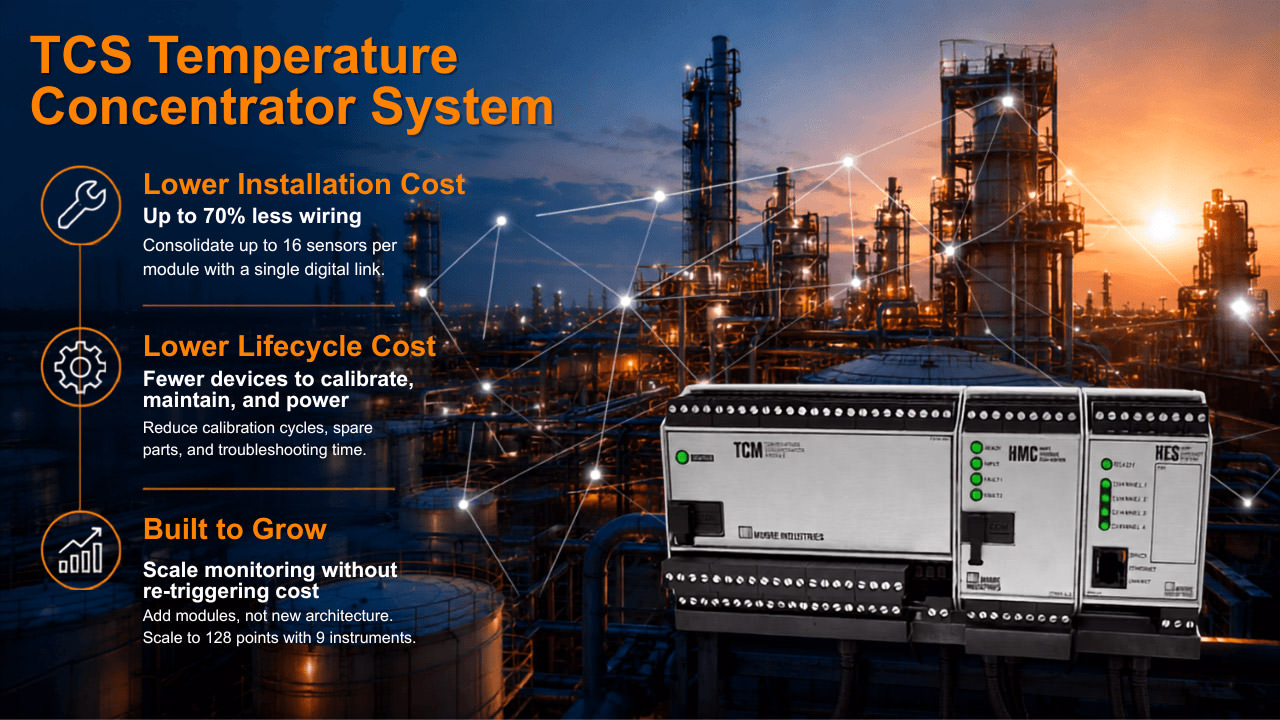
The true cost of a temperature monitoring system isn't fully visible on day one. It's the sum of what a facility pays to install it, what it costs to operate and maintain over years of service, and what it costs to expand as monitoring needs change.
Background
Process facilities live and die by tight control over temperature. A few degrees of drift in the wrong direction can spoil a batch, trip a safety interlock, or put a facility out of compliance with limits it’s required to hold. That stakes-driven reality is why so many points across a facility end up monitored in the first place, and why the high-density temperature monitoring system built around those points deserves scrutiny that goes beyond the price tag on the purchase order.
For decades, the default architecture has been point-to-point: an RTD or thermocouple wired to its own dedicated transmitter, with a separate cable run from every measurement point all the way back to the control system. In hazardous areas, that architecture layers on further cost: explosion-proof housings, intrinsically safe barriers, and marshaling infrastructure, required for every single point. What that architecture costs beyond the initial installation rarely enters the conversation.
Three cost stages make up the full financial picture of a temperature monitoring system: what it costs to install, what it costs to operate over its working life, and what it costs to expand as monitoring needs grow. A local, multi-channel temperature concentration approach changes the economics at each of these stages compared to traditional point-to-point architecture built around individual transmitters.
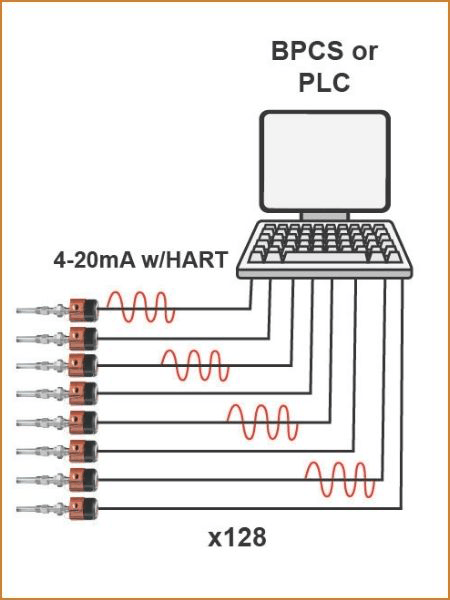
Figure 1: Figure 1: In a traditional architecture, each temperature sensor is wired individually to its own transmitter, with a dedicated cable run all the way back to the control system.
The Upfront Problem: The Cost of Wiring Every Point
In a traditional temperature monitoring architecture, every sensor is wired individually to its own transmitter, and every transmitter is wired individually back to the control system. Older temperature monitoring designs required RTDs and thermocouples to be wired directly back to the control room, adding long-term costs due to expensive thermocouple extension wire that degrades over time and eventually requires replacement. For a facility monitoring dozens or hundreds of points, this means running dedicated extension wire, often over long distances, through cable trays, conduit, and marshaling cabinets, for every single measurement point. The cost drivers stack up quickly: copper wire, conduit, termination hardware, and the skilled labor required to install, terminate, and document each connection correctly.
Beyond materials and labor, this wiring density creates its own risk during commissioning. When a wiring fault or crossed connection is discovered during startup, tracing it through a dense bundle of point-to-point cabling can consume days of a technician’s time and delay a project’s go-live. A facility bringing 80 to 100 new temperature points online in a single project can find that troubleshooting wiring issues, not the instrumentation itself, becomes the largest source of schedule risk.
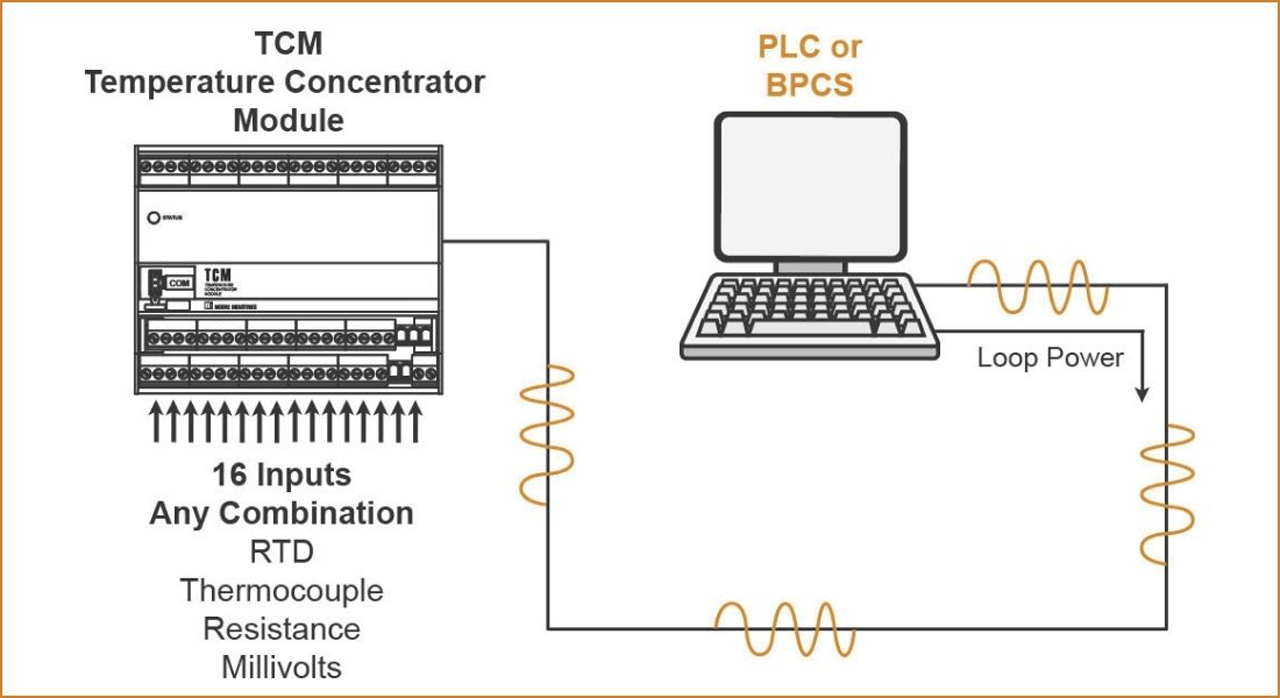
Figure 2: The TCM Temperature Concentrator Module consolidates up to 16 sensor inputs into a single connection back to the control system, replacing dozens of individual wire runs with one digital link.
A temperature concentration system changes this equation by moving the aggregation point out into the field, close to the sensors themselves. With the Moore Industries TCS Temperature Concentrator System, up to 16 sensors connect locally to a single TCM Temperature Concentrator Module, which then transmits all 16 signals back to the control system over a single twisted pair or Ethernet connection. Instead of dozens of individual wire runs converging on a control room, a single digital link carries aggregated data. This shift from many discrete home runs to one consolidated connection can reduce installation costs by as much as 70%, while maintaining the signal integrity of every monitored point.
The Hidden Problem: What Happens After Installation
Installation is only the first cost a monitoring system commits a facility to. Every transmitter placed in the field becomes an ongoing obligation: a device that must be calibrated on a routine schedule, a component that draws power, a potential point of failure, and a line item in the spare parts inventory. As the number of transmitters grows, this maintenance burden doesn’t scale in a straight line. Each additional device adds its own calibration cycle, its own failure probability, and its own documentation trail, so the operating cost of a large traditional system compounds well beyond what the point count alone would suggest.
That compounding has a reliability dimension as well as a cost one. More field instruments statistically mean more opportunities for a single failure to interrupt monitoring on a process line and diagnosing which of dozens of transmitters is at fault takes time that a leaner instrument count doesn’t demand. There’s also a configuration cost that’s easy to overlook: every traditional transmitter needs to be individually tagged, ranged, and configured within the control system, and that work repeats every time a device is replaced.
Reducing the physical instrument count changes this cost profile directly. Because a single TCM manages up to 16 sensor inputs, a facility monitoring 128 points needs only eight TCMs, rather than 128 individual transmitters, to calibrate, power, and maintain. Fewer devices in the field means fewer calibration cycles, less spare parts inventory to carry, and a simpler troubleshooting path when an issue does arise, since technicians are working with a consolidated, well-documented signal path rather than tracing faults across a large population of independent instruments. Over a 5-to-10-year equipment lifecycle, that reduction in recurring calibration labor, spare parts spend, and power infrastructure adds up to savings that installation cost alone doesn’t capture.
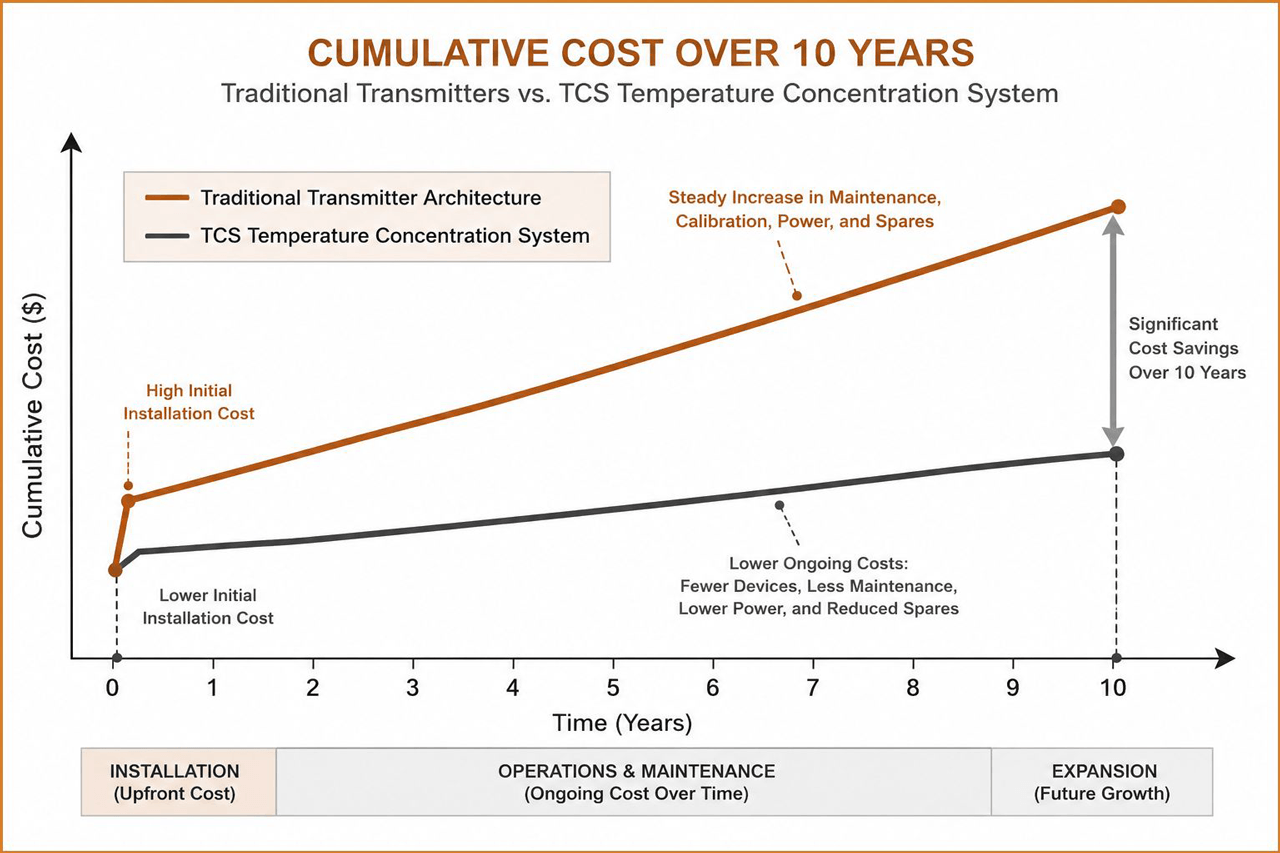
Figure 3: Cumulative cost over a 10-year period. Traditional point-to-point architecture carries a higher installation cost and a steadily rising maintenance burden, while the TCS Temperature Concentrator System starts lower and grows at a flatter rate.
The Future Problem: Planning for Growth
Facilities rarely stay static. New process units come online, monitoring requirements expand, and points get added long after the original system was commissioned. In a traditional transmitter-based architecture, every new temperature point re-triggers the same cost problem the facility faced at initial installation: a new sensor requires a new transmitter, a new home-run wire pull, and new engineering and documentation work, regardless of how much spare capacity the rest of the system has.
A modular temperature concentration architecture avoids re-triggering that cost. Because each TCM handles up to 16 channels, and multiple TCMs can connect to a single HMC HART-to-MODBUS Converter or HES HART-to-Ethernet Gateway System, adding monitoring capacity becomes a matter of adding a module rather than re-engineering the I/O architecture from scratch. A single-channel HES supports one or two TCMs, while a four-channel HES scales to eight TCMs, supporting up to 128 temperature points through just nine total instruments.
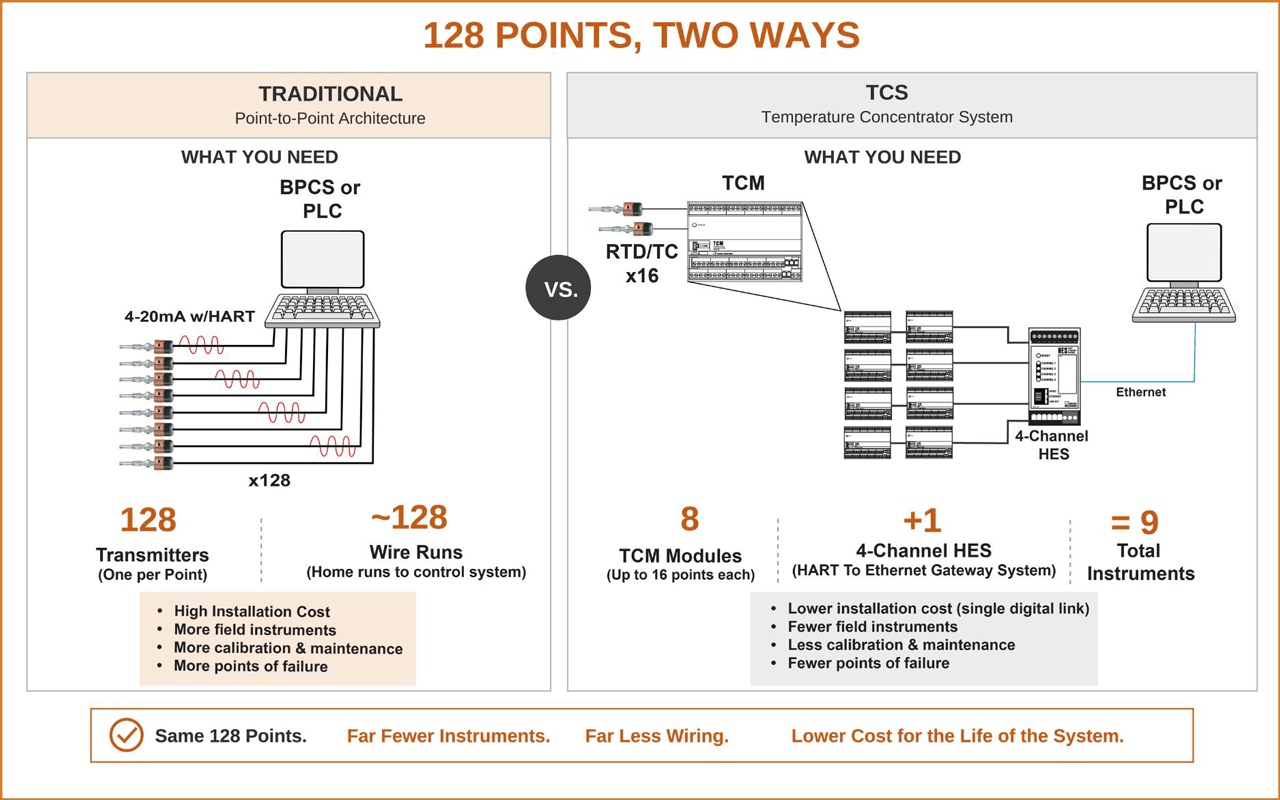
Figure 4: Monitoring 128 temperature points requires 128 individual transmitters and roughly 128 home-run wire runs in a traditional architecture, compared to 8 TCM modules and one 4-channel HES, for a total of 9 instruments with the TCS Temperature Concentrator System.
The scale of what that replaces is worth stating plainly. A facility monitoring 128 points with traditional transmitters would need 128 individual transmitters and 128 individual home-run wire pulls, potentially totaling thousands of feet of cable once distances across a typical plant are accounted for. The TCS accomplishes the same monitoring scope with nine instruments and a fraction of the wiring, and the engineering hours required to add a module to an existing TCS network are a fraction of what re-engineering a traditional I/O architecture demands for the same expansion. That difference compounds with every future project, since it means expansion cost scales with the number of points added rather than with the complexity of the existing system.
There’s a longer-term benefit here as well. A modular architecture protects the facility’s original investment. Monitoring needs change over the life of a plant, and a system built to expand incrementally means a facility isn’t stranded with infrastructure that must be replaced wholesale to accommodate new requirements. The system grows with the plant instead of becoming an obstacle to it.
Conclusion
The true cost of a temperature monitoring system isn’t fully visible on day one. It’s the sum of what a facility pays to install it, what it costs to operate and maintain over years of service, and what it costs to expand as monitoring needs change. A traditional transmitter-based architecture front-loads none of that cost transparently: it commits a facility to expensive dedicated wiring at installation, an escalating maintenance and calibration burden over time, and a repeat of the original wiring cost with every future expansion.
A local, multi-channel temperature concentration approach, as demonstrated by the Moore Industries TCS Temperature Concentrator System, addresses all three cost stages together. It reduces installation cost by consolidating wiring, lowers lifecycle cost by reducing the number of field instruments requiring calibration and maintenance, and keeps expansion cost predictable through a modular architecture that scales with the facility rather than against it. For facilities weighing not just what a monitoring system costs today, but what it will cost to operate and grow over its full working life, high-density temperature monitoring through concentration offers a cost structure that stays favorable at every stage, and a more dependable one along the way.